




 Weather
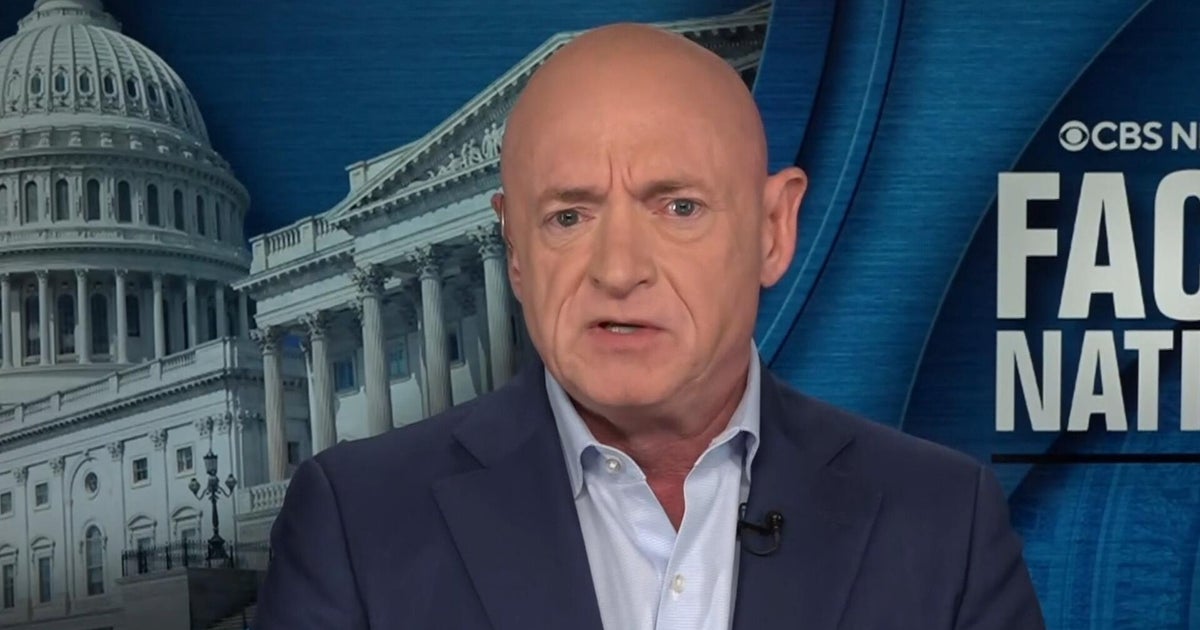
The following is the transcript of an interview with Democratic Sen. Mark Kelly of Arizona that aired on “Face the Nation with Margaret Brennan” on Aug. 2, 2026.
MARGARET BRENNAN: We turn now to Arizona Democratic Senator Mark Kelly, who joins us from Columbus, Ohio, this morning. Good morning to you, Senator.
SENATOR MARK KELLY: Good morning, Margaret.
MARGARET BRENNAN: We’re now in the sixth month of this war we had been told would last four to five weeks. In the past week, the targets have widened. Iran hit Egypt. We saw Saudi Arabia join the U.S. in bombing Iranian-backed militias there, and then late last night, President Trump used the term that he had been considering military action on levels unseen since World War II. You sit on Intelligence, you sit on Armed Services. Has the administration shared anything in regard to its plans on Iran?
SEN. KELLY: I mean, not these latest plans, and I think what we’re seeing here is a president who has an approach to this that’s just rather erratic. He says one thing, he does another thing. It’s escalatory. At this point, he’s trying to get us back to February, and I think if he could, he would. If he had a big reset button he could hit, he would certainly take that option. Hey, we’ve got 18 dead Americans. Prices have skyrocketed across the country for the American people. I was here in Ohio- I’m here in Ohio now, but I met with some veterans the other day, and they’re struggling. I mean, these are a lot of retired service members that can’t afford to put gas in their car, can’t afford groceries. Rent is going up, and this president is not dealing with the issues that the American people need him to deal with.
MARGARET BRENNAN: Well, you know, in our polling, we see that this is a very unpopular war, and it’s weighing on the president’s own approval ratings. But Democrats are faring slightly worse. According to CBS polling, when asked who has the better approach to Iran, 32% say Trump and the GOP. Only 30% say the Democrats. So we are in this thing. Do Democrats need to offer an affirmative vision for ending it?
SEN. KELLY: Well, I don’t think it’s the president’s vision. Here’s a guy who got us into this without a strategic goal, without a plan, without a timeline. He’s got a Secretary of Defense that doesn’t know how to manage this war, who decided a good metric at the beginning was just to drop as many munitions as he could on as many targets, and now we’ve got a munitions shortage. Big surprise. So they’re flailing. They’re stuck. They’re responsible for this, and the president is the one that has to try to figure out a way out of this. I would suggest to him, though, that the solution is not to do the same thing that he’s been doing, not to have his real estate buddy and his son-in-law in charge of a negotiation, to put some people in here that know how to do this, how to talk to the Iranians, and put a coalition together, bring our allies back together. He’s alienated not only our GCC allies but our European allies as well, and it’s just making this much harder for him to figure out a way out.
MARGARET BRENNAN: But the Washington Post is reporting that the top U.S. general in Europe, General Grynkewich, warned the Pentagon that he lacks resources to protect Israel from incoming ballistic missiles, and if he’s without another Navy destroyer, he will be forced to choose between defense of the homeland versus that of Israel. It sounds like for the moment Israel’s not rejoining combat operations. But what does that say to you? Have you heard these concerns from this top commander yourself?
SEN. KELLY: I haven’t heard this specifically from Grynkewich on- on this issue, but we- it’s- it’s not- Margaret, it’s not- this isn’t rocket science. It’s not hard to figure out. I mean, we- we struck over 14,000 targets with multiple munitions. That- that is- puts a lot of stress on the magazine depth. So of course, our commanders, probably not only in Europe but in other places are starting to feel some stress on can they meet the need if they need to defend the homeland or our allies. You can see why this is an issue for him, and that’s because at the beginning of this thing there was no strategic goal, and without the goal, it’s hard to figure out what to do next.
MARGARET BRENNAN: Yeah.
SEN. KELLY: And I think that’s why, that you know, that’s why Hegseth went just to try to set records on the number of targets hit.
MARGARET BRENNAN: Yeah, I should say for the record that the Pentagon says it’s media speculation, and they don’t comment on operational capabilities. We did ask them to clarify that. But on the point about restocking, Secretary Hegseth says he needs money from Congress to do that to replenish munitions. He needs money from Congress to pay salaries. He needs $67 billion. You recently were asked, and you said you were undecided on how you would vote on additional funding. How do you deny that needed funding?
SEN. KELLY: Well, Margaret, last year we passed a defense budget that was over a trillion dollars. That was the first time ever. It was sold to us as a one-time generational investment in the department, and in my view, they squandered that. Now they’re coming and they’re asking for $1.5 trillion, plus a supplemental. We’re gonna- we’re approaching the amount of money that every other country on the planet spends on defense in a year. This is irresponsible, and now they want a blank check. Hey, I’m going to make sure the troops have what they need to defend themselves and defend the United States–
MARGARET BRENNAN: — So you would vote for the 67?–
SEN. KELLY: –but they need to come to us– no, not- no, not necessarily. They need to come to us with a reasonable approach here. The $1.5 trillion, you know that has systems that I am very confident aren’t going to work. They’re still working on space-based interceptors for ICBMs. The physics on this is really very, very challenging. It’s not going to make us safer. The other systems that we don’t need. They- they need to understand that we do not have unlimited resources in this country. We’ve got 39 and a half trillion dollars in debt, and the defense budget that they’re requesting is twice what it was when I got to the United States Senate in 2021. It’s twice that budget.
MARGARET BRENNAN: Well, you mentioned that you’re in Ohio right now, and you were campaigning for fellow Democrats there. We’re about 90 days out from the midterms. We looked at some recent Quinnipiac polling. It showed Democrats have a 23%- two, three percent- approval rating, worse than President Trump’s approval. You’ve got a lot of headwinds. Republicans have an advantage in terms of fund- over Democrats in terms of funding. There’s redistricting that I know Democrats say disadvantages them, though they’ve also gerrymandered. We see interparty fighting in Minnesota and in Michigan with no real promise to unify Democrats over a- a common candidate here. How concerned are you that- that Democrats are going to lose this thing or- or end up with this very, very tight race?
SEN. KELLY: Well, I think we have an opportunity here, despite the Republican gerrymandering that started in- in the state of Texas, to try to you know rig the- the deck, so to say here, and make it more challenging. That- that provides an advantage to them. But this president is historically unpopular for a midterm president, and he’s not meeting the needs of the American people. You know, gas is up over $4 a gallon. Half of Americans are having a hard time affording food, rent, home ownership is down. Rent is up. The American people are really struggling. So we have an opportunity to win back the House, and I am confident we will. On the Senate side, it’s challenging. I’m not gonna- I’m not gonna paint this as a rosy picture, but we’ve got 90 days to go. We have opportunities in a lot of different places, more than we thought we had six months ago. And a year and a half ago, I would say we had no opportunity to win back the Senate. But because of the horrible job that Donald Trump has done for the American people, I think we have a chance we could win back control of the Senate, and that’s why I’m here supporting Sherrod Brown. You know, he- he- he wasn’t successful in 2024. He could definitely win here in 2026, but it’s going to take some effort.
MARGARET BRENNAN: Let me ask you about what may happen tomorrow. Bill Pulte, who is the acting director of National Intelligence, has said that he is going to hand over the top job to the man who was just confirmed by the Senate, Jay Clayton. Democratic objection had been one of the holdups as well in getting that FISA authority passed. I’m wondering, once you see this change of command, are those Democratic objections going to melt away?
SEN. KELLY: I can’t speak for everybody, but for me they will. Bill Pulte was not qualified in any way for this job; should have never had it. He fired, according to him, about half of the director’s office. And hey, I, you know, thought there were too many people over there anyway. But this guy was not qualified. Didn’t even really understand what the Office of National Intelligence did. So I can’t imagine he did a very good job at figuring out who to let go and who to keep. And because we’re also in the middle of a war right now. So I suspect in fact, when we- when we sort this out, we’re gonna probably realize that he fired a bunch of the wrong people. So, hopefully on Monday he is out of the office and we can talk about FISA renewal.
MARGARET BRENNAN: All right, Senator Mark Kelly, thank you for your time this morning.