





 Weather
Published on •Updated
More than 320,000 people have now been evacuated across parts of France and Spain as wildfires continue to ravage southern Europe.
ADVERTISEMENT

ADVERTISEMENT
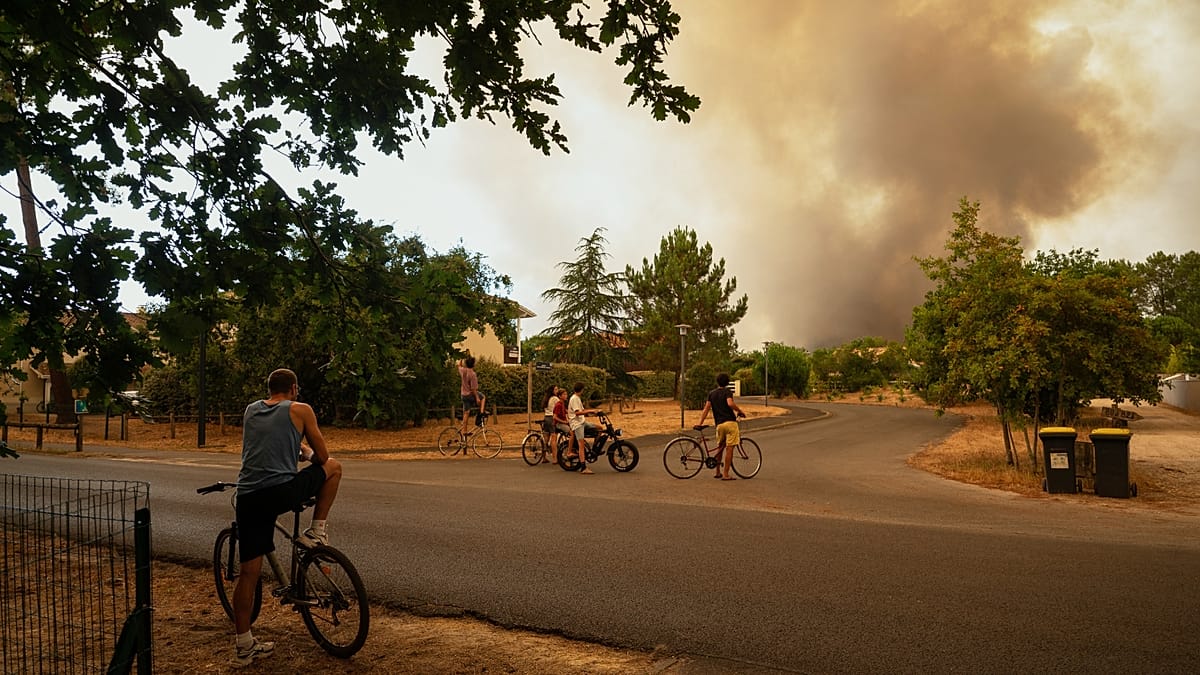
In southwestern France, more than 220,000 people have been forced to flee their homes after evacuation orders were issued in a further five villages around Bordeaux on Saturday night, as the parched landscape and strong winds helped the area’s main blaze spread rapidly, local authorities said.
As of Saturday evening, the fire had burnt through around 32,700 hectares across the region, per the Gironde prefecture.
The blaze began in the town of Saumos on Tuesday before spreading southwest to the areas of Le Porge and Lège Cap-Ferret later in the week and then eastwards towards the Bordeaux metropolitan area over the weekend.
Around 1,400 firefighters, 1,500 military personnel, and 1,700 security forces have been deployed to tackle the wildfires in southwestern France, with aerial firefighting resources also providing support.
European Commission President Ursula von der Leyen said on Saturday that five aircraft and two helicopters from the EU’s rescEU fleet had been deployed to France.
French government officials say almost 100,000 hectares have burnt across the country since the beginning of the year. French Interior Minister Laurent Nuñez has called the figure a “historic record.”
Wildfires are also affecting the departments of Landes, Var, and Hautes-Alpes.
Spain
In Spain, wildfires are continuing to burn throughout the Madrid area and the province of Ávila.
The Spanish government has declared a national emergency over the situation in the two regions, where around 100,000 people have been evacuated.
According to the Interior Ministry, the EU’s civil protection mechanism is making a number of resources available to help support with firefighting efforts.
Italy has sent 14 emergency personnel and two Canadair planes while Portugal has delivered 129 personnel and 41 support vehicles. Greece is also providing a further 33 personnel, two Canadair planes and one support aircraft.
Copernicus is also providing emergency mapping to support the response in both countries.
Francisco Martín Aguirre, the delegate of the Spanish government in the Community of Madrid, said the next few hours were “crucial.”
“We are going to make a major effort to protect the various facilities, homes and housing estates in this area, where we have been working for all these hours,” Aguirre said in comments to local media.
Speaking to reporters on Saturday, Spanish Prime Minister Pedro Sánchez added that the priority now was to “safeguard lives, protect communities and fight the fires.”
All levels of government are working together to coordinate resources to provide an effective response and help evacuees, he said, adding that affected areas would also receive governmental support during the recovery process.
Read the full article here