



 Weather
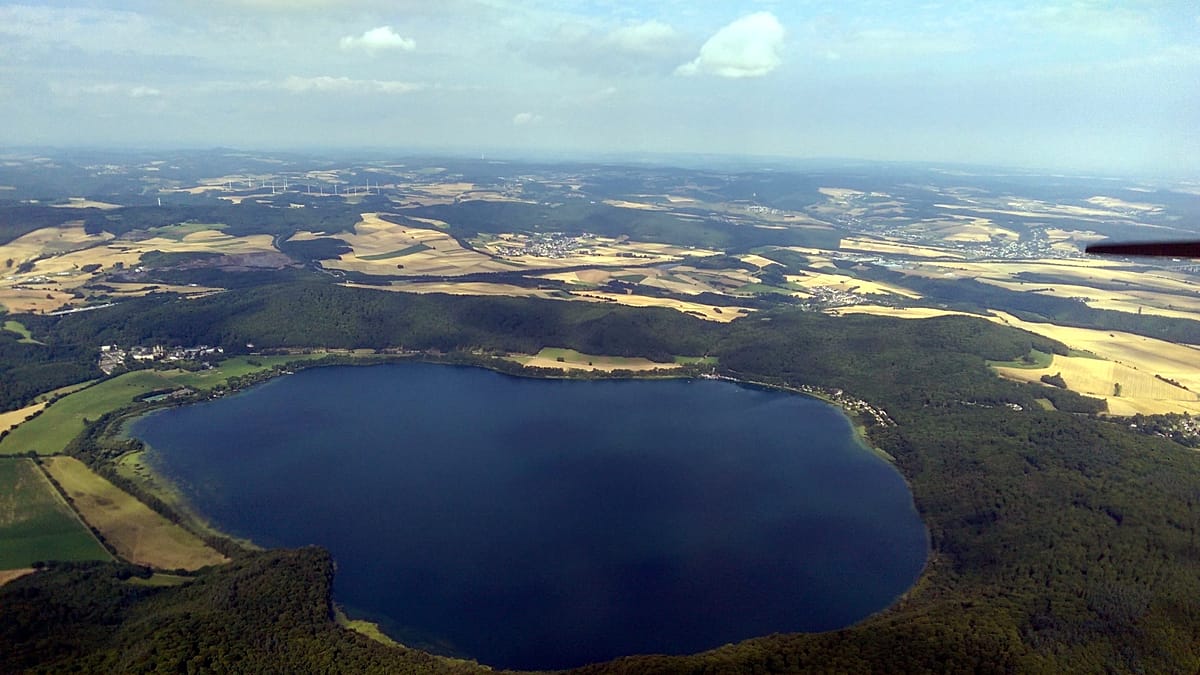
Earthquakes occur in Germany again and again, but many never notice them.
ADVERTISEMENT

ADVERTISEMENT
That’s because these tremors occur deep below the ground and often have low frequencies.
But far beneath the surface, something could be stirring. That is the suspicion of researchers who have been monitoring Lake Laach in the Eifel region in western Germany over the last few years.
Between September 2022 and August 2023, they used several monitoring stations to record more than 500 micro-earthquakes beneath the lake – which formed in the crater of a volcano that last erupted around 13,000 years ago.
Germany’s most powerful volcano
That last explosion was so powerful that ashfall was carried as far as Sweden and Italy, and experts still call for continuous monitoring of the site today.
Several studies show that there is still activity underground. In October 2025, a renewed increase in seismic activity was reported in the Eastern Eifel, most recently confirmed by a study published in 2019.
Researchers refer to these movements as deep low-frequency earthquakes, or DLF for short. These DLF quakes are seen as a sign that the Laacher See volcano could one day erupt again.
The focus of investigations is Lake Laach in Rhineland-Palatinate, the largest lake in the federal state.
The region is known as the Volcanic Eifel for good reason – the Eastern Eifel alone is home to a volcanic field with around 100 volcanoes.
“DLF earthquakes are regarded worldwide as an indication of the movement of magmatic fluids at great depth,” explains Torsten Dahm, head of the Earthquake and Volcano Physics section at the GFZ, referring to a study from 2019. “Under active volcanoes, for example in Iceland, Japan or Kamchatka, such earthquakes can be observed regularly.”
According to the study, magmatic fluids appear to accumulate at depths of about 12 to 14 kilometres. Magmatic fluids can be water, oxygen, sulphur compounds or halogens. They are released from molten rock and play a key role in determining how explosively a volcano erupts. Their movement can also trigger earthquakes in the subsurface.
These magmatic fluids could rise from the upper mantle into the Earth’s crust. According to the Helmholtz Centre Potsdam GFZ German Research Centre for Geosciences, they would ascend along the Ochtendung fault zone – evidence that the volcanic system at Lake Laach is still active.
They also indicate that magma chambers exist in the Earth’s crust beneath Lake Laach and may be slowly filling.
On the night of 10 October 2025, there was an unusual earthquake swarm with around 92 small microquakes within twelve hours. The strongest quake had a magnitude of just 0.9.
“In total, four spatially confined clusters of such DLF earthquakes have been detected in the Eastern Eifel over the past five years,” said lead author Martin Hensch from the Association of State Seismological Services in 2019.
However, researchers do not expect any volcanic activity in the near future. Dating of the magma produced when the volcano last erupted suggests that it may have taken around 30,000 years for the upper magma chamber beneath Lake Laach to fill before the eruption eventually occurred, according to a GFZ statement.
“The ascent of magma into the shallow crust is almost always accompanied by high-frequency earthquake swarms. Such activity has not yet been observed in the Eastern Eifel,” said Joachim Ritter from the Geophysical Institute (GPI) at KIT.
“Moreover, there is no evidence of uplift of the Earth’s surface, which would have to be clearly detectable in the event of massive magma ascent,” adds Dahm.
In addition to the small quakes and, most recently, a so-called earthquake swarm, there are further signs of ongoing CO2 degassing from the mantle.
In 2024, the GFZ carried out RMT measurements at two locations around Lake Laach. At both sites the emission of CO2 gases of magmatic origin was detected. Taken together, all these activities ultimately indicate that underground processes are active.
From September 2022 to August 2023, geologists recorded more than 500 local micro-earthquakes in a study published in 2026. In the process, the rock is hydraulically fractured; the researchers describe this as an example of natural hydraulic fracking.
They also found that there is likely a reservoir structure, such as a possible magma chamber, at a depth of around 12 to 14 kilometres. It extends horizontally over 15 kilometres beneath the active earthquake zone.
Ice Age eruption
During the Ice Age, the volcano in the Eifel erupted. Recent studies have redated the eruption: it is now thought to have occurred 13,084 years ago, around 184 years earlier than previously thought.
The eruption was enormous. Volcanic ash is thought to have risen into the stratosphere and probably reached an altitude of 30 kilometres. Winds are believed to have transported the ash over thousands of kilometres – north as far as Sweden and south as far as northern Italy. Today, its explosive power is estimated to be equivalent to around 500 Hiroshima bombs, according to the website of nearby Maria Laach abbey.
Volcanic ash and pumice formed a seven-metre-thick layer in the Rhine valley. Near the volcano, this layer is thought to be around 60 metres thick. In what is now the Cologne-Bonn region, volcanic ash accumulated to a depth of up to one metre.
It was only after this that Lake Laach formed. The eruption lasted for 10 days, interrupted by several periods of relative calm. Hot gases, which shattered the basement rock and ancient lava flows when they came into contact with groundwater, cleared a path for magma rising from below.
To date the eruption precisely, a research team from the universities of Mainz, Frankfurt and Heidelberg searched for sulphur deposits in various natural climate archives. They found evidence both in an ice core from Greenland and in a stalagmite from a cave in the Westerwald, with the sulphate concentration proving key.
The volcanic rocks produced during the eruption were later used, among other things, as building material in the 19 Century.
Read the full article here