




 Weather
Two fishing companies — Norebo JSC and Murman Sea Food — were placed on Brussels’ blacklist in May 2025. Not because of their fishing activities, but for being part of a Russia-state sponsored surveillance campaign that have conducted espionage missions and sabotage on critical infrastructure, including undersea cables.
ADVERTISEMENT

ADVERTISEMENT
Following Brussels’ lead, Norway sanctioned the two businesses months later, with the country’s foreign minister Espen Barth Eide stating their operations could facilitate future sabotage incidents.
Norebo JSC has refuted both allegations.
A year later, European Commissioner for Fisheries and Oceans Costas Kadis acknowledged that the Kremlin was conducting intelligence-gathering operations using trawlers.
“We are aware that Russia is involved in illegal, unreported and unregulated fishing activities, as well as espionage, mapping of critical infrastructure and sabotage activities,” Kadis told the Financial Times newspaper in May. “This raises security concerns.”
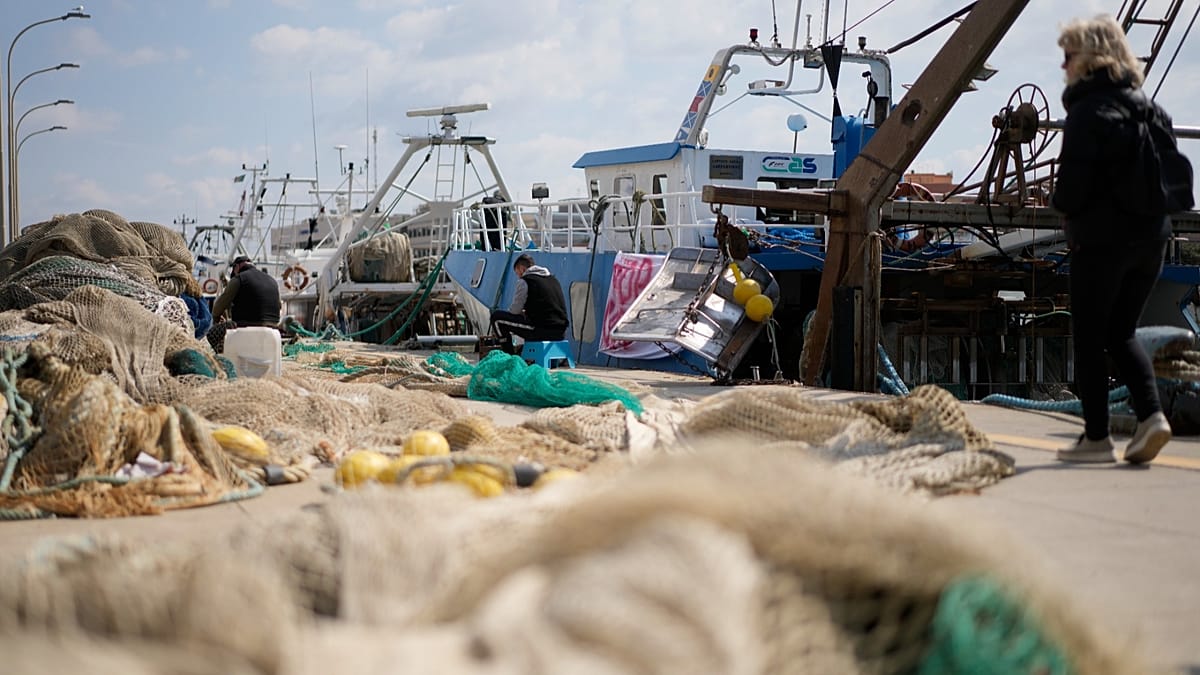
The Commissioner is not alone in voicing his concern, with experts telling Euronews there are many vessels connected to the Kremlin pretending to catch cod or crab and travelling near Europe’s coastlines. But in reality, some are collecting intelligence and damaging crucial subsea infrastructure hindering the bloc’s security.
A drop in the ocean
Erlend Heier, an expert in hybrid warfare at the Fridtjof Nansen Institute, said that almost all major powers — from Moscow to Washington to Beijing — have used spies posing as fishermen to conduct espionage operations for decades.
Since before the Cold War, listening devices have been discovered on-board fishing vessels, with more than just nets and rods on-deck, as fishing provides ample cover.
“In 1940, you had German soldiers dressing as civilians on fishing vessels entering Oslo the day before the full-scale invasion. Norway did it, the United States did it, the United Kingdom did it. Most states with a naval maritime area have done something like this,” he said.
What’s new, Heier said, is that Russian intelligence-gathering activities on these fishing vessels have steadily increased since the country’s 2022 full-scale invasion of Ukraine, and have become more pernicious. The activities have gradually gone beyond undersea mapping to allegedly damaging important maritime infrastructure in the North and Baltic seas, such as cable cuts.
“This is all part of the wider hybrid grey zone campaigns to essentially destabilise Norway and European societies,” Heier said. “The targets are now civilian critical undersea infrastructure instead of solely surveying military exercises and ports.”
The North Atlantic Treaty Organisation’s (NATO) senior expert on cyber and hybrid threats, James Appathurai, said these hybrid warfare activities constitute “the most active threat” to Western infrastructure.
“The Russians are carrying out a program they have had for decades,” Appathurai told Euronews in 2024. “It’s called the Russian Undersea Research Program, which is a euphemism for a paramilitary structure, very well-funded, that is mapping out all of our cables and our energy pipelines.”
Following a major cable-cutting incident at the end of 2025, NATO Secretary-General Mark Rutte acknowledged a “concerted campaign” of hybrid warfare was afoot in the Baltic Sea and pledged more support.
Safeguarding infrastructure “is of utmost importance”, Rutte said, citing energy from pipelines and the 95% of internet traffic that is secured through undersea cables.
‘There is no fish’
Mariia Vladymyrova, a Copenhagen-based academic specialising in the intersection of Russia’s maritime activities and foreign policy, told Euronews that it is difficult to provide a “credible number” of Russian fishing vessels involved in espionage operating in European waters, but said she believes their presence is increasing.
Anecdotal accounts and open-source monitoring prove that some of these vessels are doing more than catching fish. They show “navigational” and “loitering” patterns, Vladymyrova said, the latter referring to how long a ship remains in an area without leaving.
News organisations such as Follow The Money have published detailed investigations tracking these loitering events, showing that fishing boats in European waters were the most likely to circle in place, drift aimlessly, or take routes that deviated from the norm. Much of this can be explained, while some of it cannot.
Vladymyrova gave an example. “A Belgian officer told me once about a Chinese vessel, in which he said, ‘There is no fish. We know this 100%. No one fishes in this water, but this one vessel is standing there for two weeks’,” she said.
When the Belgian officer contacted the sailors by radio, an individual replied saying they were fixing their nets, “which is also not an activity you are doing on the high seas,” Vladymyrova added.
Troubled waters
A larger problem is how to tackle these suspected operations from an EU and national level. As hybrid warfare expert Julian Pawlak points out in a paper published by the German Institute for International and Security Affairs, many shadow fleet vessels operate with falsified or concealed ownership structures and insurance arrangements, or are re-flagged.
This makes shadow fleet vessels — ageing oil tankers used to circumvent EU sanctions — difficult to track and trace back to their origins. The same opacity can make it harder to identify vessels suspected of intelligence-gathering activities.
“These companies change names and they change their juridical persona from one day to another… but they are not on a sanctions list,” Vladymyrova said. “Closing all these loopholes, I think, is an important task for the EU.”
A European Commission official said that any vessels attempting to “threaten critical infrastructure” or “engage in hostile activity” is taken seriously, and that individual incidents should be followed up with national authorities.
Six weeks after Russia started its full-scale invasion of Ukraine in 2022, the EU passed its fifth sanctions package against the Kremlin. As part of the package of measures, the EU banned Russian-flagged vessels from accessing its ports, subject to certain derogations.
According to Vladymyrova, this initiative — as well as sanctioning the two fishing companies Norebo JSC and Murman Sea Food in 2025 — showed that the EU is attempting to address the problem. “What would be welcomed from the EU is to continue on this path (of sanctioning fishing vessels) and update the list,” she said.
However, she argued that national governments, including those overseeing port authorities and domestic legislation, can be just as effective. “More meaningful interventions can be made at the national level because it is usually a matter for the coast guard or police, depending on national laws,” she said.
Read the full article here