


 Weather
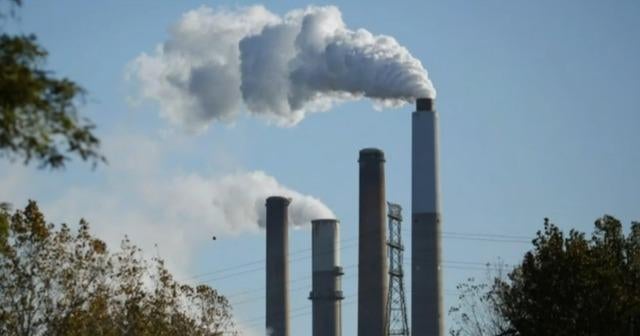
The greenhouse gases emitted from sources like cars, trucks and power plants, major contributors to climate change, will no longer be regulated by the federal government, following an announcement Thursday by President Trump and Lee Zeldin, the head of the Environmental Protection Agency.
The administration’s action formally repeals what is known as the “endangerment finding,” which provides the legal and scientific underpinning for the federal government to regulate the emission of greenhouse gases like carbon dioxide and methane into the atmosphere.
Speaking at the White House, the president called the elimination of the finding the “single largest deregulatory action in American history.”
“Under the process just completed by the EPA, we are officially terminating the so-called endangerment finding, a disastrous Obama-era policy that severely damaged the American auto industry and massively drove up prices for American consumers,” Mr. Trump said.
The White House claims the move will save Americans roughly $2,400 on vehicles produced in the future.
“The red tape has been cut,” Zeldin said. “Manufacturers will no longer be burdened by measuring, compiling and reporting greenhouse gas emissions for vehicles and engines. And the forced transition to electric vehicles is eliminated.”
Environmentalists have condemned the move as a dangerous setback for the planet and human health. Dr. Gretchen Goldman, CEO of the Union of Concerned Scientists, called it “an obvious example of what happens when a corrupt administration and fossil fuel interests are allowed to run amok.”
What is the endangerment finding?
Up to 20% of the heat-trapping gases emitted in the United States come from the tailpipes of cars and light trucks. Other significant sources include airplanes, power plants and oil and gas facilities.
For the past 17 years, the federal government has regulated those emissions to attack the problem of climate change and help reduce associated risks from things like worsening heat waves, wildfires, droughts and floods.
The government’s regulatory actions were based on a 2009 determination from the EPA under the Obama administration. It was called the endangerment finding because it found that greenhouse gases pose a threat to public health and welfare and thus could be regulated under the Clean Air Act.
With Thursday’s announcement, the EPA is eliminating that core justification for regulating those emissions. The reversal was set in motion last year, when Zeldin announced plans to repeal the rule.
Zeldin claimed eliminating the rule will realign EPA rules “to reflect the Clean Air Act exactly as it is written and as Congress intended, not as others might wish it to be.”
Why is the Trump administration doing this?
Mr. Trump’s team argues that the endangerment finding is unnecessarily expensive and impedes American energy dominance.
White House press secretary Karoline Levitt framed the repeal as a way to lower costs for Americans, saying it would save the public roughly $1.3 trillion in part by making new vehicles cheaper. She estimated average savings of more than $2,400 on a light‑duty car, truck or SUV.
Mr. Trump reiterated that point on Thursday, saying: “Prices went up incredibly for a worse product. This action will eliminate over $1.3 trillion of regulatory cost and help bring car prices tumbling down dramatically.”
However, the National Consumers League disputed that claim, saying that according to its analysis, “Federal safety and fuel economy standards save households thousands of dollars over the life of their vehicle while having a marginal effect on vehicle prices.”
Critics argue any short-term gains ignore the far larger, longer-term economic costs of unchecked climate pollution.
“This action will only lead to more of this pollution, and that will lead to higher costs and real harms for American families,” said Fred Krupp, president of the Environmental Defense Fund.
CBS News previously reported that according to the EPA’s own data, maintaining Biden-era fuel efficiency and electric vehicle policies would result in lower gas prices than if they were revoked.
Mr. Trump has long dismissed concerns about climate change, calling it a “hoax” despite broad scientific consensus about the role of emissions and the risks of a warming planet.
What is likely to happen next?
Legal experts note the 2009 endangerment finding is supported by long-standing science and years of federal court rulings. The Supreme Court has affirmed that greenhouse gases are air pollutants subject to Clean Air Act regulation.
That backdrop makes the Trump administration vulnerable to protracted litigation over whether it can legally erase the government’s own scientific and statutory conclusions.
John Tobin-de la Puente, a business professor at Cornell University’s SC Johnson College, says he does not expect companies to make long-term plans based on the Trump administration’s latest action.
“Business operates on a far longer time scale than the four-year cycle of presidential elections, and to rely on the current administration’s announced action would be imprudent, especially given the substantial likelihood that the next administration will once again regulate carbon emissions,” he said.