





 Weather

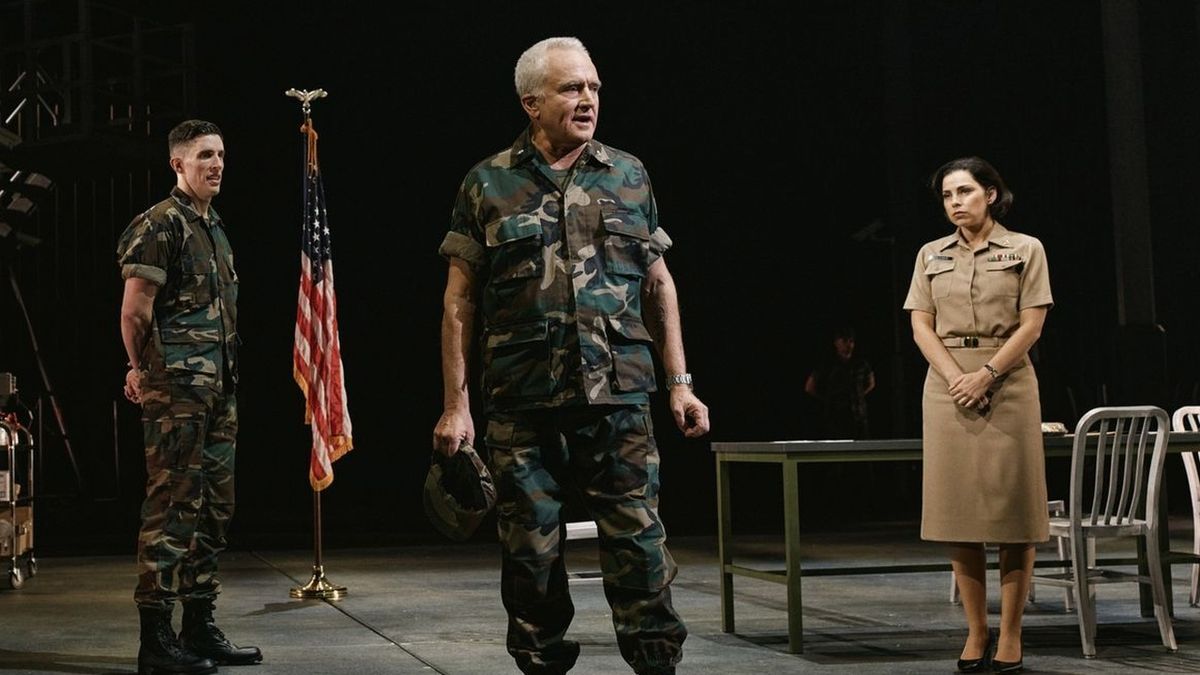
Lincoln Center Theater’s first-ever Broadway revival of Aaron Sorkin’s A Few Good Men is playing at the Vivian Beaumont Theater, directed by Tony Award winner Michael Arden. The limited engagement stars Tom Blyth in his Broadway debut alongside Krysta Rodriguez and Bradley Whitford.
The production marks the return of Sorkin’s courtroom drama, which follows military lawyer Daniel Kaffee as he defends two Marines accused of murder. Working alongside determined attorney Joanne Galloway, Kaffee uncovers evidence of a possible cover-up that places him in direct conflict with the military chain of command.
Blyth stars as Lt. Daniel Kaffee, with Rodriguez as Lt. Commander Joanne Galloway and Whitford as Lt. Col. Nathan R. Jessep. The cast also includes Stephanie Berry, Nick Blaemire, Michael Braugher, Christopher Gurr, Billy Eugene Jones, Collin Kelly-Sordelet, Michael Oberholtzer, Lavel Schley, Thom Sesma, Daniel Velez and John Zdrojeski.
The production plays a strictly limited 13-week engagement through January 10, 2027.
What are critics saying about the Broadway revival of A Few Good Men? Read the reviews below.
Alexis Soloski, The New York Times: In its second half, the show settles into the familiar framework of a legal thriller. The trial includes too many asides and recesses to generate suspense, but the payoff, when it comes, is satisfying. Yet, Jessep’s big speech, which follows it, fizzles. Although salient in the movie, his ends-justify-the-means argument claiming that unethical behavior is the necessary cost of security, is less persuasive or provocative here.
 Charles Isherwood, The Wall Street Journal: Yet even with an ideal cast and in a more congenial theater, the play would feel diffuse and somewhat convoluted. While the film follows the play’s text closely, Mr. Sorkin’s screenplay is tauter, more trenchant. The camera can cut instantly between short scenes, while actors, sets and props take time to shuffle on and off the stage. Mr. Sorkin’s writing can certainly be baldly manipulative, but in the movie at least the manipulation is effective. Onstage we aren’t so much manipulated as kept at a cool distance. Perhaps a miniseries reboot would have been a better way to go?
Sara Holdren, Vulture : That might be a truly powerful statement — if I actually believed that the production was making it. I don’t. While there’s plenty of high competency on display in A Few Good Men, the stalwart traditionalism at its core makes it a strange and unsettling choice for revivification. I’ve written before about how movies, as unchanging objects, can sustain both their own innate qualities and the patina of our nostalgia in a way that theater, a living event, cannot. But A Few Good Men isn’t primarily a nostalgia project in the way of, say, a musicalization of Pretty Woman or The Notebook, which are meant mostly to appeal to the tastes of our younger selves. It was a play before Jack Nicholson shouted “You can’t handle the truth” for posterity, and everything about its current shape, down to the theater presenting it, asks us to take it seriously as a story engaging with our ghoulish political reality. Can it really do so, though, when in its DNA it carries such faith in the institutions we now see exhibited daily in all their intentional brokenness? The purpose of a system is what it does, but Sorkin still believes that, in the face of a few bad men, a few good ones will save us.
 Richard Lawson, The Guardian:
Given the current state of the US military brass, it makes some sense that audiences would want to drift back to an older, nobler idea of the armed services, in which bad actors exist but are rooted out by the good guys in uniform. That perhaps explains the Broadway revival of A Few Good Men, Aaron Sorkin’s 1989 courtroom drama about a cocky military attorney defending two young marines who followed an illegal order with fatal results. The play is at once sharp and misty-eyed, critiquing a hallowed institution while reverently imbuing it with a certain dignity – in some ways, it does for the military what Sorkin’s The West Wing did for the Oval Office.
 Thom Geier, Culture Sauce: The courtroom drama, once a staple on the stage, has migrated mostly to television. But there’s a craft to this play’s construction still shines through. Plus, the play returns at a moment when the idea of the military refusing unlawful orders has gained some currency. (Calling Senator Mark Kelly.) That said, Sorkin doesn’t delve deeply into the philosophical or moral questions that he raises. There’s no mistaking who the bad guys are, or whether they will get their comeuppance in the end. But his breakout play remains a crackerjack entertainment, which unfolds with brisk efficiency under Arden’s coolly professional direction.
Adam Feldman, Time Out New York: The production may not generate much excitement, but it earns a respectful salute—the proper response to a show whose duties have been discharged honorably, if not with special distinction.
Matthew Wexler, 1 Minute Critic: Director Michael Arden (The Lost Boys) handles Sorkin’s dense script with a deft hand, navigating a sprawling stage conceived by scenic designer Dane Laffrey as a military airstrip and 20 other locations, brought into focus by Japhy Weideman’s precise lighting.
Robert Hofler, The Wrap: Michael Arden directs Sorkin’s play, which unspools on the vast Vivian Beaumont stage as if it were really a screenplay. Arden knows how to keep the snippets of scenes flowing without pause, but the mammoth set, by Dane Laffrey, only highlights the play’s weaknesses.
Patrick Ryan, USA Today: “A Few Good Men” is hardly the most provocative or audacious play running in New York, nor does this clear-cut revival blow the dust off to reveal an urgently timely artifact. But if you’re hankering for a smart piece of entertainment that also goes down easy, you’d be foolish not to grab a ticket ‒ and that’s an order.
Shelby Stivale, Entertainment Weekly: Even for the casual theatergoer, it was hard to avoid the social media chatter that came after A Few Good Men started previews earlier this month. Buried among the photos of Blyth in his dress blues (shout-out to costume designer Alejo Vietti for making the man look good in a uniform) was a debate brewing between users as to whether Col. Jessep was a villain or a hero for imposing his brand of rugged military justice. While the truth to be handled in this case may be in the eye of the beholder, it shows the difficult questions A Few Good Men still poses almost four full decades after its original staging. Grade: B
Caitlin Hornik, The Independent: In some ways, A Few Good Men is a classic tale of an overqualified woman fighting for her place at the male-dominated table. This particular story gets off to a slow start with legal jargon and military ranks foreign to the plebeian ear requiring a careful listen. But Sorkin’s script evens out, and includes well-placed zingers landing in crucial moments (aided by Arden’s direction) to break up the intensity of the story. Here, though, the few good men are led by a great woman.
David Gordon, TheaterMania: Like The West Wing, A Few Good Men airs its morality proudly, and there’s an innocence to its structure that could only come from a writer who was still figuring out how to tell stories. A thrilling production, the kind that leaves you hanging on every word, could mask the plot machinations you can guess five minutes before they occur. Arden’s customarily luxurious staging isn’t commanding enough to make that happen.
Joey Sims, Theatrely: A solidly built piece of entertainment, Few Good Men is hardly a tough sit, and looks good on the Vivian Beaumont stage. The suffocating set, by Dane Laffrey, overwhelms its characters in intriguing ways. But the play did not demand to be staged today, and it shows.
Amelia Merrill, New York Theatre Guide: Who were the few good men of Guantanamo Bay in 1989, and who are they 37 years later, when the torture and human rights abuses at the base’s military prison is common knowledge? Galloway and Kaffee part ways to go defend drunken soldiers making mistakes on the dime and time of the taxpayer. The individual bad actors are gone, but the system stands. Sorkin believes in a protagonist who can bring down a broken system from within it. A Few Good Men asks us not to let a few bad apples spoil the barrel. But is the barrel worth salvaging?
Greg Evans, Deadline: But if that relevancy – this is, after all, a tale in which a lawless, egotistical, bullying commander shifts the blame for a stupid, negligent action from himself to the two patriotic dupes blindly following his orders – seems more than a tad obvious, its power to shock feels drained. Not even as skilled a wordsmith as Sorkin and an actor as in control of his own talents as Whitford can offer a new take of villainy interesting enough to spur some newfound, good-faith reconsideration after all these years. As Sorkin proved with his remarkable adaptation of To Kill A Mockingbird, revivals work best when they demand an audience re-think its long held assumptions. A Few Good Men would be more compelling now if Sorkin could make us believe, even for a scene or two, that there just are some very fine people on both sides arguments.
Melissa Rose Bernardo, New York Stage Review: Regarding Blyth, his Kaffee is fresh-faced, more naive than he’ll admit, and cocky but not off-putting—precisely what the role requires. As for the courtroom confrontation between him and Jessep—the one that produces the famous line—it’s fine. Best known for his turn as Josh Lyman (“I drink from the keg of glory!”) on Sorkin’s seminal political series The West Wing, Whitford—who understudied, then took over, the role of Kaffee in the original Broadway production—simply seems out of place as the insufferable colonel. Jessep is supposed to be “the stuff of which nightmares are made,” but Whitford doesn’t inspire that bone-deep fear. He does, however, pull off “You can’t handle the truth,” and that’s what you’ll find emblazoned on T-shirts, mugs, hats, hoodies, totes, and dog-tag keychains on sale in the lobby.
Frank Scheck, New York Stage Review: Sorkin has apparently tinkered with the script, but such new lines as Jessup commenting about Code Red, “I believe it’s an energy drink” aren’t exactly an improvement. Arden provides plenty of theatrical flourishes via various military rituals performed by members of the large ensemble, while Dane Laffrey’s utilitarian set design is dominated by the giant U.S. and Marine Corps flags on the theater’s walls. Their oversized nature only emphasizes the way the small-scale play strains to live up to its expansive surroundings.
Chris Jones, Chicago Tribune: No one else in this otherwise stellar cast has this problem. Whitford is a live wire, as one would expect from him, and brings to the role a new kind of charm, which functions to explain how Jessep has survived until now. Bulked up yet nuanced and verbose, Whitford does as much to humanize his guy as the script allows and the result is a potent but nonetheless dignified central performance. Rodriguez is very much present and likable, too, even if her character, the woman who figured all this out first, basically has to stand aside and let the guy she had to convince take all the credit. It is one of several things about this play that now would get more scrutiny than was the case in the 1980s.
Johnny Oleksinki, The New York Post: At times the scale is exciting, particularly during movement choreographer Ricky Ubeda’s entrancing military rituals. But when it’s just three underdog lawyers in a small room trying to nail their defense strategy or during a meat-and-potatoes courtroom scene, the intensity floats up to the rafters.
Jonathan Mandell, New York Theater: Sorkin’s brand prominence is surely the truest explanation for why this play, although often portentous and glib, and long overshadowed by the later blockbuster movie version, is getting a monumentally staged, occasionally riveting, but ultimately unmemorable Broadway revival. It opened tonight at Lincoln Center’s Vivian Beaumont Theater, starring Tom Blyth as the reluctant crusading lawyer, Krysta Rodriguez as his relentless goad, and Bradley Whitford as his nemesis.
Average Rating: 59.0%