




 Weather
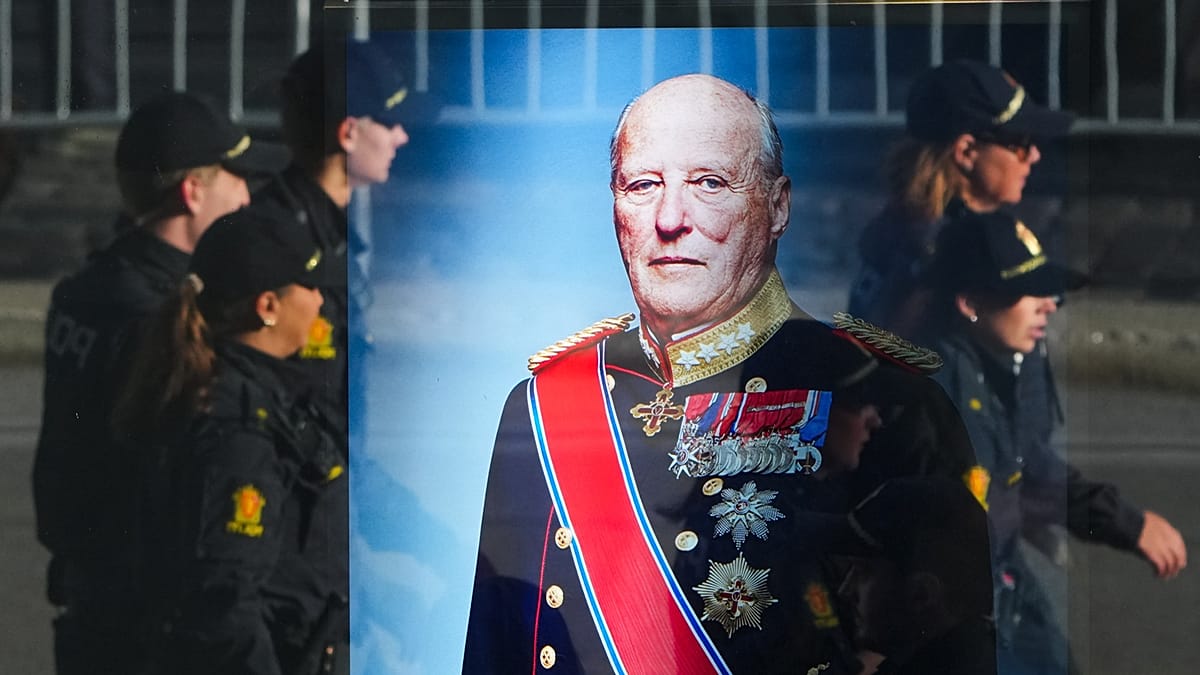
Norway observed a nationwide minute of silence on Wednesday at the funeral of King Harald V, a modern and unifying figure in a funeral that is being attended by European royals and foreign dignitaries.
ADVERTISEMENT

ADVERTISEMENT
The funeral is the culmination of 13 days of national mourning since the 89-year-old monarch’s death on 28 August.
Ukrainian President Volodymyr Zelenskyy, Britain’s Prince William, Spain’s royal couple, the presidents of Finland, Germany and the Czech Republic as well as the French and Thai prime ministers are among those in Oslo who paid their respects.
The casket was carried on an artillery carriage along the city’s main avenue from the royal palace to Oslo Cathedral.
Norway’s royal family, led by new King Haakon VIII, foreign royals, heads of state and dignitaries took part in the procession on foot.
Only Harald’s widow, 89-year-old Queen Sonja, and the new Queen Mette-Marit, who underwent a lung transplant in June, followed in a car.
Marius Borg Høiby, Mette-Marit’s son from a previous relationship who is under house arrest pending the appeal of a rape and assault conviction, was granted permission to attend the funeral.
Among other guests announced were Japan’s Crown Prince Akishino and Princess Kiko, the Scandinavian royal families, the Belgian and Dutch royal couples, Prince Albert of Monaco and Jordan’s King Abdullah II.
High security
At the end of the religious service, four F-35 fighter jets will fly over the cathedral in a “missing man” formation, as the casket is taken to the Akershus Castle chapel.
There it will be lowered into the crypt of the royal mausoleum, next to Harald’s parents and grandparents.
He will be laid to rest in a $2 million (€1.7 million) sarcophagus whose design remains secret.
Once the burial is completed, flags across the country, which were lowered to half-mast after Harald’s death, will once again be raised and church bells will ring for an hour.
Norway’s police force has mobilised nearly 3,000 officers in what it has described as “one of the biggest operations” in its history.
Some 3,500 soldiers have also been deployed, while exceptional airspace restrictions have been imposed over much of the eastern part of the country.
Until his death, Harald, who ascended the throne in 1991, was the oldest reigning monarch in Europe.
Despite mounting health issues in his later years, he had always ruled out abdicating and was extremely popular among Norwegians.
Embodying an open and tolerant Norway, he made a deep impression by celebrating diversity in a 2016 speech marking the 25th anniversary of his reign.
“Norwegians are girls who love girls, boys who love boys, and girls and boys who love each other,” he said, adding: “Norwegians believe in God, Allah, the Universe and nothing.”
Reinvigorated monarchy
Thousands of Norwegians filed past the king’s casket in the past week, some waiting in line for hours.
The square in front of the palace has been covered with flowers, drawings and candles.
“He was the grandfather of the nation,” said Gunn Johnsen, 81, speaking to the AFP news agency on Tuesday, explaining that she took an hour-long train ride to pay her last respects.
“Generous, inclusive, kind,” added her friend Vigdis Simonsen, 64.
Near the University of Oslo, a large billboard displayed a photo of a smiling Harald with the inscription “Thank you for everything.”
Almost 72% of Norwegians said they support the monarchy, up by eight percentage points from a previous survey in May, in an opinion poll conducted after the king’s death and published last week.
Support had dropped to its lowest level in February, when 60% said they were in favour of maintaining the monarchy while 27% were not.
At the time, the royal family was embroiled in a series of scandals that damaged its image.
Mette-Marit in particular was under heavy criticism for her past ties to the late convicted American sex offender Jeffrey Epstein and her son’s legal troubles.
While Haakon VIII, 53, is very popular, opinions on the new queen remain deeply divided.
Read the full article here