




 Weather

Nearly three decades after Wendy Wasserstein’s AN AMERICAN DAUGHTER premiered in a Lincoln Center Theater production at Broadway’s Cort Theater (now the James Earl Jones Theatre), the Pulitzer Prize-winning playwright’s sharp examination of politics, media, and the impossible standards placed on ambitious women feels less like a period piece and more like today’s headlines.
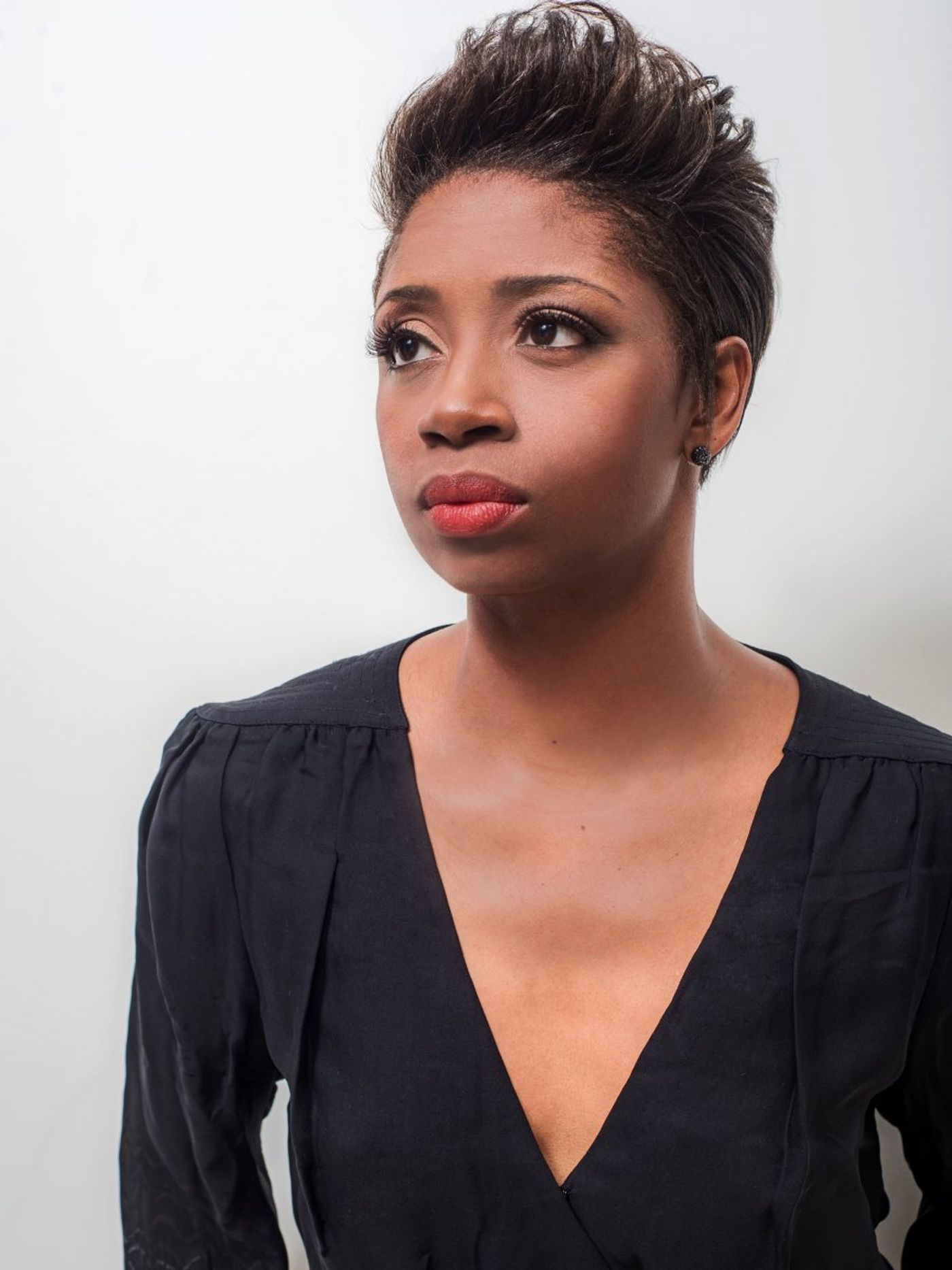
That realization struck Tony Award nominee Montego Glover almost immediately when she began preparing for La Femme Theatre Productions’ first New York revival of the play. “What struck me first and foremost is how prescient Wendy was,” Glover reveals. “I couldn’t believe I was reading things that were relevant when the play was written and relevant in this very moment in our history, in politics, in women’s rights, women’s perception, etc. Wendy was extraordinarily prescient, almost spookily so.”
Directed by Sarna Lapine, AN AMERICAN DAUGHTER follows Dr. Lyssa Dent Hughes, a respected physician whose nomination for Surgeon General unravels after a seemingly minor personal oversight explodes into a national media scandal. While Glover doesn’t portray the title character, she plays someone whose story mirrors and amplifies the play’s central questions.
Glover portrays Dr. Judith B. Kaufman, Hughes’ fellow physician and lifelong friend. “I play her colleague in science, a fellow doctor, her very best friend, going back to their days of girlhood in their boarding school abroad, and I’m having my own personal eve of major life change,” she explains. “The beauty of this is that I feel like the characters of Lyssa Hughes and Judith Kaufman are set side by side so that you can see how two women of equal intelligence, standing, and importance in their fields can be viewed and spun in ways that they could not have ever conceived.”
That word, “spun,” became a recurring theme throughout the conversation with Glover. Long before social media algorithms and twenty-four-hour news cycles dominated public discourse, Wasserstein was asking audiences who controls a narrative and what happens when perception overtakes truth.
“I think both answers are true, but ultimately they remain very much the same,” Glover imparts when asked whether the play’s questions have evolved or remained the same since 1997. “Who tells your story? Who tells what version of it? And what really is the story?”
“Sometimes the truth is the thing, sometimes the way it’s spun is the thing, and sometimes it’s neither of those things,” Glover adds. “Who tells it? Who spins it? And what is really the truth?”
Those ideas have only grown more relevant in the decades since Wasserstein first put them on paper. “It’s hard to believe that Wendy wrote this play to be a treatment of the idea of how this works,” Glover reflects. “It was just starting to be introduced in our culture in the United States in the way that we know it now. It’s unbelievable that now it’s just such an everyday part of our lives.”
“However, the way it affects people, the way it affects our culture, the way it affects the way we connect, the way it affects the way we communicate, is seemingly new all the time,” emphasizes Glover. “We’re discovering new and unsettling ways that it can affect people, affect communities, affect culture.”
While the play tackles weighty issues, Glover says the rehearsal process has embraced the humor and humanity that have always defined Wasserstein’s writing. “It’s a lot of play,” she says of what’s happening in the rehearsal room. “It’s a lot of really trusting Wendy’s writing and leaning in. You can’t be apprehensive. You don’t need to second-guess. Wendy’s writing is so strong and so clear. The real test is being able to give over to it, enjoy it, and be really willing to explore it.”
That exploration extends beyond the rehearsal room. This production also marks the first time audiences will experience Wasserstein’s previously unpublished second act, offering fresh insight into relationships and themes that have remained unseen for nearly thirty years. “I think with this unpublished second act, we’re going to see character development a little more clearly,” Glover says. “We’re going to see a sharper picture of relationships, and we’re going to get a clearer view of how the larger picture works.”
The expanded material also broadens the scope of the play itself. “In this play, we talk about feminism, we talk about politics, we talk about science, we talk about media, and how the media works,” Glover points out. “This new second act actually pulls back and gives you a much larger, sharper, clearer view of what that means in the lives of people, but also how it fits in the bigger picture of the world, of our society, of our culture, particularly as Americans.”
For Glover, who has built an acclaimed career portraying complex women on Broadway and beyond, Judith Kaufman is another richly layered addition to an already remarkable body of work. “Judith B. Kaufman picks up where the last lady left off, and she is another delicious lift,” she says with a smile. “I often refer to them, the ladies I’ve played, as full plates of food, hearty meals, a lot to digest, a lot to take in, a lot to enjoy and savor, and Judith is no exception.”
Rather than looking for similarities between her characters, Glover delights in discovering both their common ground and their differences. “I think she’s [Judith] taught me that there is always more to discover,” she states. “Many of these women have similar experiences and dramatically different ones, and the joy of doing my job is exploring where they overlap and where they absolutely do not. That’s about characterization, but it’s also about where they land in history.”
She pointed to the vastly different worlds inhabited by characters like Fantine, Felicia Farrell in MEMPHIS, and Judith Kaufman, noting, “I love finding the places and spaces where these women overlap, but then how they are very different and what they call on. It teaches me to keep exploring.”
That spirit of exploration has extended to the rehearsal room as well, where Glover has been joined by Robert Sean Leonard, Jean Lichty, Dakin Matthews, Mary Beth Peil, and an accomplished ensemble she says has made every day a discovery. “Being in the room with these incredible actors and artists has been, to begin, fun,” she beams. “They’re all so excellent at what they do. It’s been the most fun. We have loved getting to know one another.”
The production has also transported the company back to the mid-1990s, reminding them just how much has changed since Wasserstein first wrote the play. “We’re all living and functioning in 2026, and we’ve just traveled back to this time 30 years ago where the world was the same but also very different.” Glover says. “That’s been a major discovery every day. Every day, things we very much take for granted or assign an everyday value to have a much newer effect at the time this play was written and at the time it takes place.”
Despite the passage of time, Glover believes the play’s emotional and political questions remain startlingly current because of the playwright behind them. “In my opinion, Wendy was fearless,” she declares. “She saw it, she felt it, she wrote it. Fearless.”
“I am so grateful to her for that fearlessness,” adds Glover, “and that willingness to share what she saw, what she felt, what she experienced. That’s the key: not being afraid to put it forward.”
Asked what audiences unfamiliar with Wasserstein’s work will discover through this revival, Glover’s admiration only grows stronger. “Oh, Wendy is a pivotal artist,” she remarks. “It’s the writing, it’s the artistry, it’s the view, it’s her lens, it’s the wit and the truth.”
“There are playwrights that you study because they consistently demonstrate this in their work, and Wendy is one of them. She’s an icon,” Glover concludes.
For Glover, the hope is that audiences leave the theater talking, not only about the characters they have met, but about the country they inhabit. “I hope audiences will have conversations around communities; around our politics in the United States; around women and the treatment of women in politics in America; around media and the position of media, how it affects people, how it affects careers, and how all of these things are made better,” she says.
More importantly, she hopes the production inspires action rather than resignation. “I hope it will start to plant seeds that ultimately drive people to a better society, a better community, a better understanding of society and community and how we are connected and affected by what goes on close to us and far away.”
Occurring on July 3, 2026, the conversation naturally turned toward the 250th anniversary of the United States. Glover reflected on the possibility that theater can help audiences imagine something better. “I think this play can sit itself in the exact right space and give you a look into the future that will empower you to do better,” she says. “To work toward that more perfect union. It will empower you to do that.”
Nearly thirty years after AN AMERICAN DAUGHTER first premiered, Wasserstein’s words continue to challenge audiences to question who tells our stories, who shapes our narratives, and how a democracy chooses to value its women. If Glover is right, the play’s first New York revival is not simply revisiting an American classic. It is reminding us that some of our most urgent conversations have been waiting for us all along.
AN AMERICAN DAUGHTER begins previews on July 23, 2026, officially opens on August 11, 2026, and runs through September 6, 2026 on the Irene Diamond Stage at The Pershing Square Signature Center (480 West 42nd Street, New York). Tickets and additional information are available at www.LaFemmeTheatreProductions.org/An-American-Daughter

Buy Tickets to An American Daughter