



 Weather
By the end of next year, around 5,000 German troops will be permanently stationed between the Lithuanian capital, Vilnius, and the border with Belarus as part of the new Lithuania Panzerbrigade 45.
ADVERTISEMENT

ADVERTISEMENT
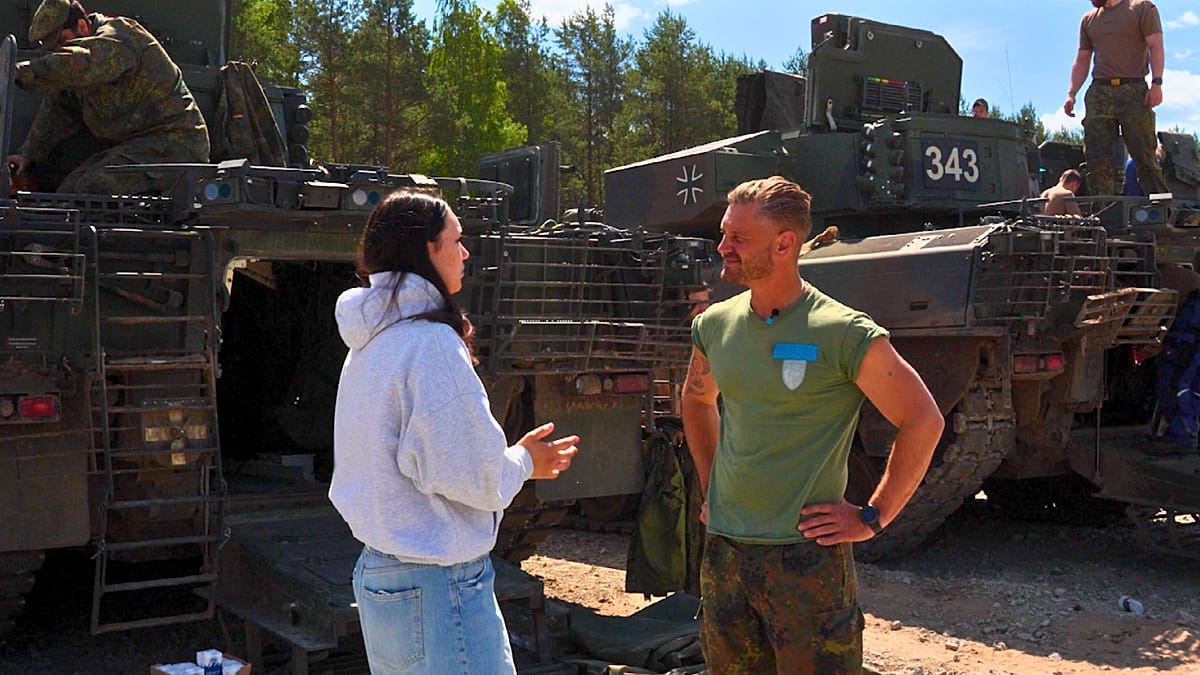
During a major military exercise in May and June, Lithuanian schoolgirl Kamilė V. found herself at the heart of the action after winning a Bundeswehr tank ride in a NATO essay competition.
Euronews met her shortly before the experience at the Pabradė training area, where she joined soldiers from the mechanised infantry battalion assigned to Brigade 45. They had just completed the nearly six-week “Freedom Shield” exercise.
Just a short distance from the Belarusian border, troops from eight NATO countries are training for a range of combat scenarios.
The German contingent of around 2,300 soldiers is part of the build-up to the permanent Lithuania Brigade. The exercise focuses on strengthening interoperability between allied forces along NATO’s eastern flank.
Top prize
Kamilė won an essay competition organised by the Lithuanian Ministry of Defence, which was designed to highlight the importance of NATO and collective defence.
“I first wrote about what hybrid threats actually are and how they affect us. Then I wrote about how young people can help protect themselves against these dangers,” Kamilė told Euronews.
“Kamilė’s achievement is exceptional, not only because of her high score, but also because of the language she chose for her essay,” her school wrote on its website.
She submitted her entry in German, showcasing not only creativity but also an excellent command of the language.
At the award ceremony, Germany’s ambassador to Lithuania, Dr Cornelius Zimmermann, presented her with a special invitation: a visit to the Bundeswehr’s Brigade 45 at Pabradė.
The visit
For Kamilė, the topic felt ever-present.
“Young people spend a lot of time on social media and see problems and conflicts between countries there,” she said.
In her essay, she underlined the importance of critical thinking, saying it “could really help us” to expose disinformation and falsehoods.
During her visit, Kamilė described the experience as a major opportunity.
“It will be a very big memory for me,” she said, adding: “I’m definitely very excited. I think it will be very different from being in a car, or on a bus or a train.”
The planned permanent deployment of the German brigade has received broad public support in Lithuania.
According to a representative survey commissioned by the German Embassy in June 2025, 72% of Lithuanians back the stationing of German troops near Pabradė. Thirteen per cent are opposed, while 15% were undecided.
Those in favour say the brigade will strengthen Lithuania’s security and defence. Defence is now seen as the second most important area of cooperation between Lithuania and Germany, behind only the economy and trade.
‘It looks like a PlayStation console’
Kamilė walked past a line of military vehicles before being greeted by Philipp. He took her straight to the Puma infantry fighting vehicles of Mechanised Infantry Battalion 122, which is currently based in Oberviechtach and is due to relocate to Lithuania as part of Brigade 45.
Philipp encouraged Kamilė to ask as many questions as she liked before talking her through the vehicle.
“Let’s have a closer look. In the past, the crew sat inside the turret as the vehicle moved, but that’s no longer the case,” he said, pointing to the turret on top of the vehicle. Today, the turret is operated remotely, allowing the crew to remain better protected inside the hull. It’s one of the ways the vehicle’s design has evolved.
“On top, we’ve got a 30mm automatic cannon capable of firing around 200 rounds a minute. In practice, though, the rate of fire is mechanically limited to help conserve ammunition,” Philipp continued.
For him, the key strength of mechanised infantry is the ability to fight both in vehicles and on foot. That gives the unit far greater flexibility, whether operating in urban environments or clearing trench systems. The battalion is made up of around 600 soldiers across four companies.
“To be honest, I thought there’d be more space inside, but it’s actually very cramped,” Kamilė said after climbing into the vehicle. Philipp explained that the interior also has to accommodate weapons, equipment and soldiers wearing full combat kit. While the two explore the inside of the Puma, Euronews has to remain outside, as filming or photographing the interior is not permitted.
“There are so many little controls and buttons, it looks like a PlayStation console,” Kamilė said with a smile. “It’s really exciting.”
In the end, the inside of the Puma was quite different from what she had imagined, Kamilė told Euronews.
After exploring the Puma, Kamilė was also given the chance to ride in the more modern Leopard tank. “What impressed me most was its size, the modern technology and what it looked like inside,” she said. Kamilė told Euronews she was able to sit in each of the tank’s four crew positions and even operate the turret.
Every year, Lithuania’s Ministry of Defence invites school pupils to take part in an essay competition, with the winners honoured on the anniversary of the country’s accession to NATO.
This year attracted a record of more than 400 entries, up from a previous high of 270. Marketed under a title which translates to “We Are NATO,” the competition allows pupils to write in Lithuanian, Polish, English, German or French.
Kamilė chose the topic “NATO and Hybrid Threats”. The other essay options were “Representing Lithuania at the NATO Youth Summit” and “Letter to the Future”.
All three themes encouraged students to reflect on the role of the younger generation.
“The growing number of participants shows that young people are interested in issues linked to Lithuania’s NATO membership,” Deputy Defence Minister Karolis Aleksa said at the awards ceremony in the Lithuanian parliament on 27 March.
He added that young people are closely following current affairs and are putting forward constructive ideas for tackling the alliance’s challenges.
“I am almost certain that some of them will join Lithuania’s national defence system in the future and help make the country more secure,” Aleksa said.
Read the full article here