




 Weather
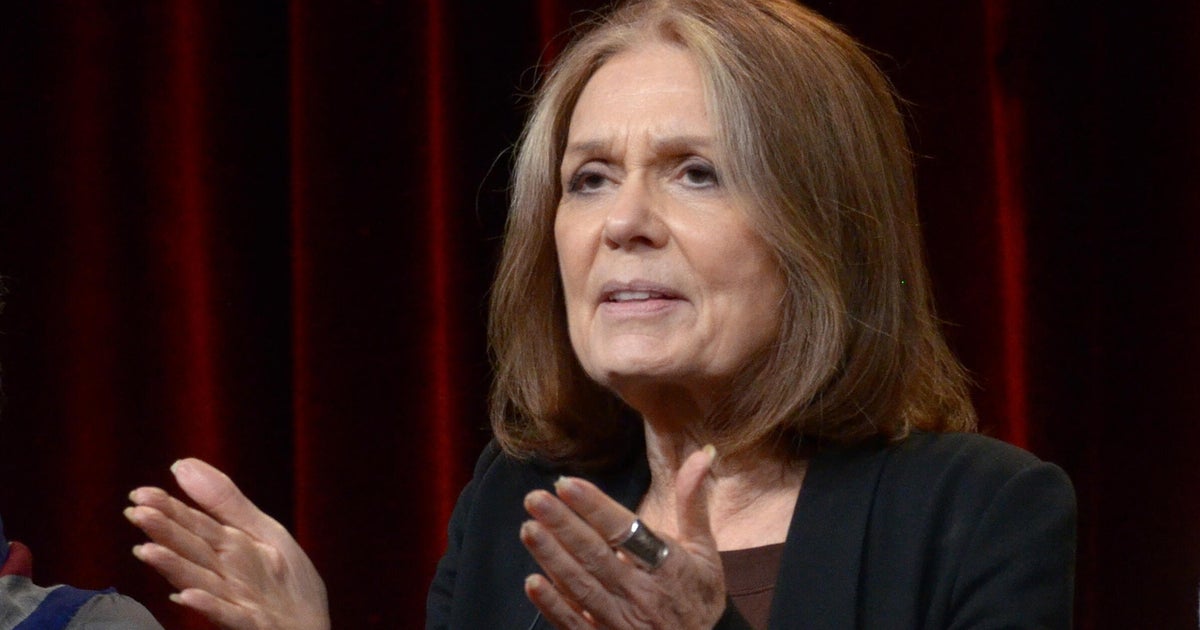
Gloria Steinem, a co-founder of Ms. Magazine and a trailblazing figure of the women’s liberation movement in the latter half of the 20th century, has died. She was 92.
The Gloria Steinem Foundation said in a social media post Thursday that she “passed away peacefully at her home in New York City, surrounded by some of the many who loved her.” The cause of death was not given.
Heralded by Newsweek magazine in 1971 as “The New Woman,” Steinem co-founded Ms. Magazine, the first major publication to be owned, run and written by women. Ms. was a spearhead for the promotion of equal rights, helping to raise awareness about issues of inclusion, media representation and social justice affecting women and girls, at a time when politics, mass media and consumerism were becoming conflated as never before.
As a journalist, Steinem exploded the notions that “women’s issues” were confined to women, or that female voices did not belong in discussions of politics or war. Steinem was a tireless advocate for women’s voices in politics — at the ballot box, and in the halls of power — by fighting for voting rights and promoting female candidates for office.
She advanced the cause of economic and social justice for women and girls, including reproductive freedom and safety from domestic violence, and worked to advance women in media. And a simple idea, Take Our Daughters to Work Day, begun by the Ms. Foundation for Women to advance opportunities in the workplace, would become a global endeavor encompassing millions of daughters (and sons) as it fought gender stereotypes.
The birth of Ms.
In her early years as a reporter for New York magazine in the late 1960s, Steinem attended a gathering of women speaking out about their experiences obtaining an illegal abortion. She told “Sunday Morning” in 2006, “I heard women standing up and saying in public and taking seriously something that only affected women. Up until then, I’d never heard that. If it didn’t also affect men, it couldn’t be ‘serious.’ Something that was illegal, shameful, theoretically. (Women who had abortions) had to enter a criminal underground. And suddenly I thought, ‘Wait a minute: You know, if one and three or four of us, and I too, had had that experience, why is it illegal?’ And that was the beginning of the unraveling.”
That “unraveling” of consciousness would lead to Ms. Magazine. Co-founded with activist Dorothy Pittman Hughes, the publication’s first full issue appeared on newsstands on July 1, 1972. In addition to having Wonder Woman on its cover, the issue featured a petition signed by women of various backgrounds announcing that they had had an abortion and were demanding that it become safe and legal. (It would be another year before the Supreme Court’s decision in Roe v. Wade.)
Katherine Spillar, an executive editor of Ms., who compiled a 2023 anthology titled “50 Years of Ms.: The Best of the Pathfinding Magazine That Ignited a Revolution,” told “Sunday Morning” that the magazine started and amplified trends, including “a lot of articles about men and marriage and relationships and childrearing and politics and violence against women – (issues) that keep coming back. And it shows the endurance of this movement, but also the endurance of our opponents.”
Richard Shotwell/Invision/AP 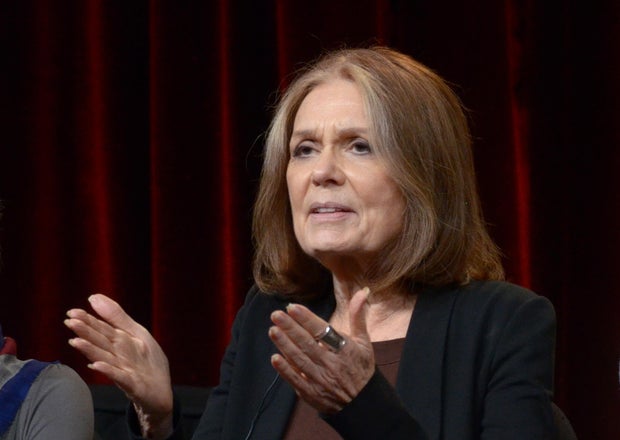
And of course there was controversy. A cover photo advertising a story about sexual harassment on the job, depicting a man fondling a doll, got the magazine pulled off newsstands. And selling ads was a challenge; the head of a major cosmetics company told Steinem that women who read Ms. don’t buy makeup, while car manufacturers didn’t want to advertise because they didn’t believe women bought cars.
Still, the magazine persisted, and won awards while publishing articles by such writers as Barbara Ehrenreich, Angela Davis, Alice Walker, Susan Faludi, Susan Brownmiller, Eleanor Holmes Norton, and Jane Wagner. It continued as feminism itself charted new courses. While coming under attack from commentators on the right (who claimed the magazine denigrated “family values”), Ms. was also attacked by some on the left (who claimed the magazine was too conservative and lacked a diversity of opinion).
Steinem said that, as the women’s liberation movement picked up steam, the very word “feminism” seemed to threaten people for two reasons: “One, because they didn’t understand it, and two, because they did understand it!”
Ms. underwent several owners beginning in the 1980s (including a female-driven consortium of investors led by Steinem herself), and a period of ad-free publication, before transitioning to a quarterly. And it continued as the status of women in America changed. In 1972, only 10% of doctors, 4% of lawyers, and 1% of engineers were women. Five decades later, those percentages were 38, 41, and 16, respectively.
But Steinem said the revolution about equality for women is still being fought. “There’s a barrier that has moved, but there’s still a barrier,” Steinem told “Sunday Morning” in 2006. “So, what used to be you couldn’t get a job, now you hit a ceiling after a few years. What used to be unequal marriage, is now unequal after children are born. The barrier has moved, thank goodness. So, there’s more room back here that’s liberated. But the barrier is still there to be pushed.”
And while some were denigrating the term “feminism” itself since the 1960s, Steinem told CBS News in 2015 that she believed the core tenets of feminism are by and arge approved of today: “If people just go to the dictionary and discover that [feminist] means a person — male or female —who believes in the full equality of women and men, then they do subscribe to it. And it is a majority now, which it didn’t used to be.”
Kevin Mazur/WireImage via Getty Images 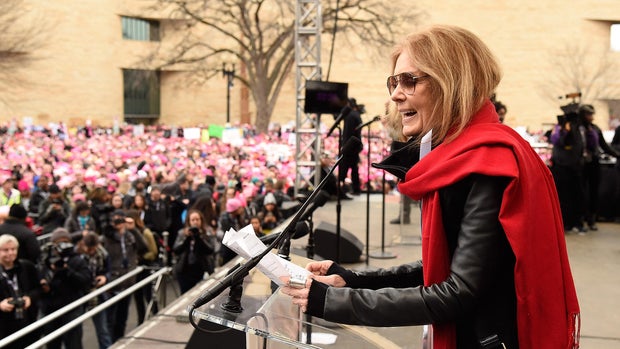
Pushing feminism into the mainstream
Born on March 25, 1934, in Toledo, Ohio, to a traveling salesman, Gloria Marie Steinem lived an itinerant life as her family moved about, residing in a house trailer, until her parents’ separation and divorce when she was a teenager. Steinem and her mother settled in Toledo, where Gloria ended up caring for her mom, who suffered from mental illness. She then moved to Washington, D.C., to live with her older sister, Susanne, and complete high school.
After graduating Phi Beta Kappa from Smith College in 1956, Steinem traveled to India on a scholarship. On her way, while in London, she received a doctor’s assistance in obtaining an abortion, something that was illegal in Britain (and America) at the time. She told NPR in 2015 that she’d tried other methods to terminate her pregnancy but failed: “I really was desperate. I just knew that if I went home and married, which I would’ve had to do, it would be to the wrong person; it would be to a life that wasn’t mine, that wasn’t mine at all.”
Steinem’s career as a journalist began in New York City, where she contributed as a writer to several publications. (One 1965 New York Times article was titled “Nylons in the Newsroom.”) Her first major assignment was a 1962 Esquire article on contraception and pre-marital sex.
She made a splash with her two-part 1963 exposé in Show magazine for which she went undercover as a Playboy Bunny at Hugh Hefner’s Playboy Club. She spent two weeks in three-inch heels, forced to wear a Bunny costume that was purposely two sizes too small (in order to accentuate the female servers’ curves). She wrote, “The boning in the waist would have made Scarlett O’Hara blanch. [The] entire construction tended to push all available flesh up to the bosom. I was sure it would be perilous to bend over.”
The article, which exposed sexual harassment on the club’s floor and the toll on female employees behind the scenes (including mandatory blood tests and gynecological exams), was a sensation. But Steinem had mixed feelings regarding the outcome. As she explained in a 2011 conversation with Interview magazine, “At first, it was such a gigantic mistake from a career point of view that I really regretted it. I’d just begun to be taken seriously as a freelance writer, but after the Playboy article, I mostly got requests to go underground in some other semi-sexual way. It was so bad that I returned an advance to turn the Playboy article into a paperback, even though I had to borrow the money. … But feminism did make me realize that I was glad I did it – because I identified with all the women who ended up an underpaid waitress in too-high heels and a costume that was too tight to breathe in. Most were just trying to make a living and had no other way of doing it. … In the sense that we’re all identified too much by our outsides instead of our insides and are mostly in underpaid service jobs, I realized we’re all Bunnies.”
In 1968 Esquire features editor Clay Felker invited Steinem to help found New York Magazine, a news, pop culture and style publication. With a writer’s rostrum that included such names as Tom Wolfe, Jimmy Breslin and Peter Maas, Gloria Steinem was advertised as “writing about the kind of things the ladies magazines don’t let her write about.” Those topics included local and national politics, the Vietnam War, the “New Marriage,” childcare, welfare, and women and power. As a sign of her celebrity, she was invited onto “The Tonight Show.”
Steinem befriended Dorothy Pittman Hughes, a childcare advocate on New York’s Upper West Side whom she profiled for New York, and the two made public appearances together to discuss the women’s movement. (Steinem was uncomfortable speaking in public, and preferred to have Hughes with her.) The two devised a magazine that aimed to push feminism into the mainstream, called Ms. — a newly emerging designation for women who did not want to be bound by the title Mrs. (for a married woman) or Miss (for a single woman).
Felker volunteered to publish a sample issue within the pages of New York magazine in 1971. Steinem and the Ms. team then hit the publicity circuit: “And when I got to California, somebody called the radio show I was on and said, ‘You know, we can’t find it,'” Steinem recalled to “Sunday Morning” in 2023. “And I called Clay Felker in a panic and I said, ‘It didn’t get here.’ And it turned out, it had sold out! That was a moment of recognition that, you know, it had an audience.”
Beyond Ms.
In 1973, Steinem – along with Marlo Thomas, Patricia Carbine and Letty Cottin Pogrebin – created the Ms. Foundation for Women to advance the cause of women and girls, supporting grassroots efforts and advocating for economic justice, safety and reproductive freedom. The foundation also created the Take Our Daughters to Work Day initiative, which was later expanded to sons and daughters.
Steinem was involved in helping nurture other groups and publications dedicated to advancing civil rights. She helped found the Women’s Action Alliance, which advocated for equality, supported battered women’s shelters, and fought stereotyping; and the National Women’s Political Caucus, which promoted women in public office.
She was president and co-founder of Voters for Choice (which later merged with the Planned Parenthood Action Fund), and was co-founder of the reproductive rights organization Choice USA (now URGE). In 2004, she co-founded (along with Jane Fonda and Robin Morgan) the Women’s Media Center, a nonprofit progressive women’s media organization.
In 1999 Steinem was asked by the “CBS Evening News” whether technological advances were responsible for the advancement of women. Steinem discounted that. “There’s nothing automatic about political change, about liberation,” she said. “There’s no substitute for self-respect, banding together with other people, standing up for ourselves. Liberation does not come from outside. Power can’t be given to you. The process of taking it is part of the empowerment.”
Marriage
In 2000, Steinem – who once thought marriage was demeaning – married David Bale, a human rights activist, and father of actor Christian Bale. “We shocked ourselves, both of us,” Steinem said. “Neither one of us thought that we wanted to get married.”
So, why did they? “It was something about me, I think. First of all, I was 66 years old. I was who I was. I no longer felt that I would have to give myself up in any way.”
But their life together ended three years later, when Bale died of lymphoma of the brain. “Maybe you never make peace with it,” she said. “But it taught me an enormous amount. Even if I knew what was going to happen, I would have chosen to go through it with him.”
She said that losing her husband made her understand the difference between sadness and depression. “Yes, because people would say to me, ‘Aren’t you depressed?’ And I realized that in depression, nothing matters. And in sadness, everything matters. It makes everything poignant.”
Steinem continued writing and lecturing into her 90s, as some of the topics introduced long ago by Ms. Magazine, such as sexual harassment in the workplace and domestic violence, took on new force with the rise of the #MeToo movement.
She co-produced a series of Emmy-nominated documentaries about violence against women around the world for Viceland, and co-produced and narrated an Emmy-winning HBO documentary, “Multiple Personalities: The Search for Deadly Memories.” She was also the subject of documentaries, including “Gloria: In Her Own Words,” and “The Glorias.”
In 2013, Steinem received a Presidential Medal of Freedom from President Obama, and in 2019, she received the Freedom Award from the National Civil Rights Museum.
Pablo Martinez Monsivais/AP 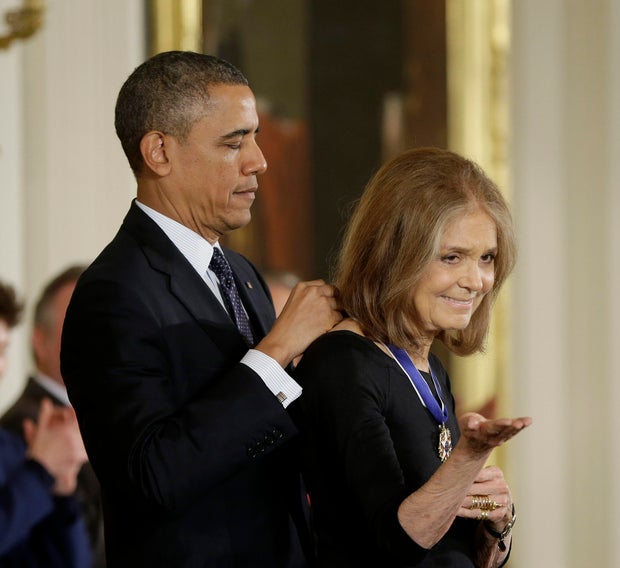
Steinem wrote numerous books, including “An Unexpected Life”; “My Life on the Road”; “Outrageous Acts and Everyday Rebellions”; “Revolution from Within: A Book of Self-Esteem”; “Moving Beyond Words”; “Marilyn: Norma Jean”; and “Doing Sixty and Seventy.” A 2014 collection of her essays was titled “As If Women Matter.” She was an editor of Houghton Mifflin’s “The Reader’s Companion to U.S. Women’s History.”
In her 2011 talk with Interview magazine, Steinem said that she felt regret for having wasted time: “I continued for too long to do things that I already knew how to do, or to write stories that I was assigned instead of fighting for stories that I couldn’t get, or doing ones that I thought were important on my own. The wasting of time is the thing I worry about the most. Because time is all there is.”