





 Weather
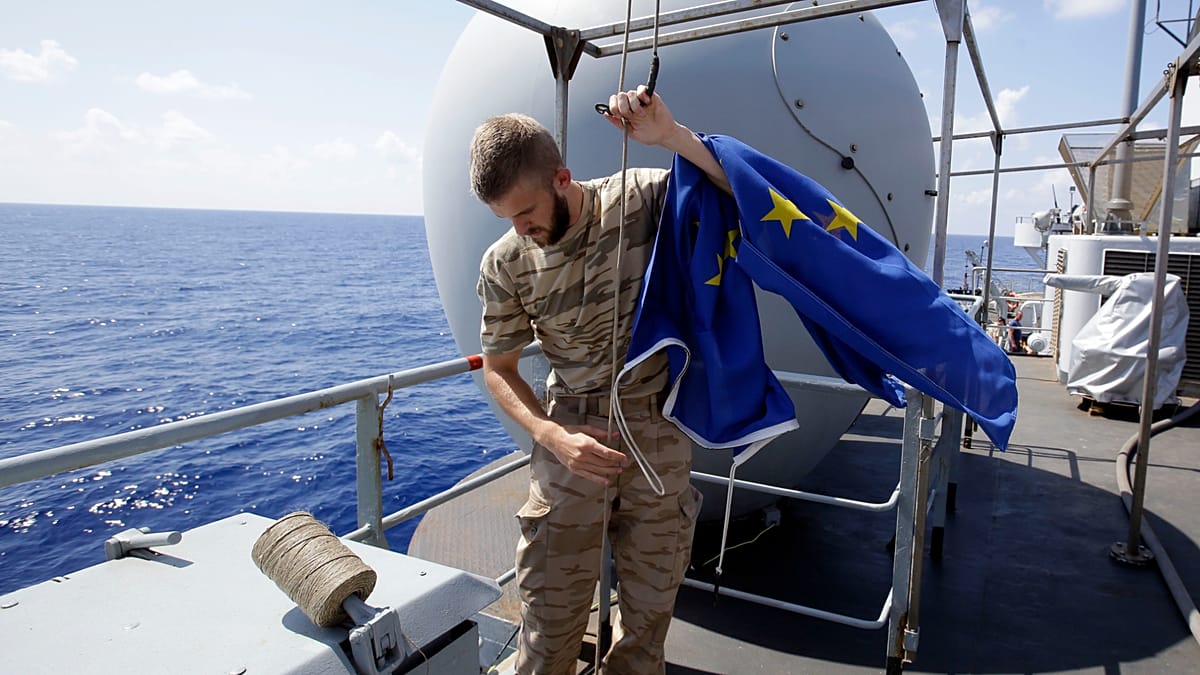
In just the last decade, the EU has spent almost €118 billion in maritime defence, with a sharp 23.6 percent increase in 2022 after Russia’s invasion of Ukraine.
ADVERTISEMENT

ADVERTISEMENT
Data from the EU Blue Economy Observatory show a sharp rise in domestic maritime defence spending, reaching a record high of €11.6 billion. Submarines alone account for 27 percent of the EU’s total production value; the rest includes surface ships, aircraft, and other types of warfare.
The bloc decided to transition from a purely commercial ‘blue’ economy approach to a securitised maritime strategy. In 2023, it updated its European Union Maritime Security Strategy (EUMSS) to protect critical seabed infrastructure.
Then it locked in its strategic defence priorities by launching dedicated European Defence Projects of Common Interest and implementing a Submarine Cable Security Toolbox to counter grey-zone threats and protect underwater networks.
Protecting international trade
The global economy relies almost completely on secure, open seas. More than 95 percent of international digital traffic moves through them. Financial transfers happen through over 1.4 million kilometres of submarine fibre-optic cables, which carry an estimated €9.2 trillion in financial transactions every single day. Approximately two-thirds of the world’s oil and gas is either extracted at sea or transported by water.
80 percent of global trade volume is transported by ocean shipping. For the EU, maritime transport accounts for 75.6 percent of all imports and 73 percent of all exports. It totals around €1.126 trillion in goods annually. A disruption at key maritime chokepoints risks triggering inflation and global manufacturing shortages.
An attack on these sea lanes and underwater assets would paralyse Europe, so it needs more than traditional naval patrols. “Underwater Domain Awareness is a critical activity to know what is happening below the surface, particularly around cables, pipelines and offshore energy infrastructure, prioritising those identified as critical for the security of the Union”, said Jürgen Scraback, Head of the Maritime Domain Unit at the European Defence Agency.
As threats increasingly come from low-cost drones, uncrewed underwater vehicles and mine warfare, governments are investing in autonomous technologies and surveillance systems. Between 2016 and 2025, the EU’s annual production value of crewless vehicles, including aerial and submarine drones, increased by 132 percent to €847 million. Fixed-wing unmanned systems accounted for one third of that output, worth €277 million, while production of traditional unmanned submarine platforms fell by 23 percent over the same period.
Fleet modernisation continues to focus on both conventional naval assets and autonomous platforms. Manned surface ships now account for 65 percent of EU maritime defence vehicle production value and serve as the primary platforms for command, logistics and force projection.
Submarines represent another 27 percent of production, supported by new procurement programmes and investment in next-generation underwater weapons. At the same time, autonomous surface vessels and unmanned underwater vehicles are becoming increasingly important for surveillance, reconnaissance and infrastructure monitoring missions.
Investments also extend to digital tech for maritime surveillance, with European operators deploying AI-enabled unmanned systems to monitor ports, offshore energy infrastructure, and submarine cables, detecting threats across large areas
For Scraback, “autonomous and unmanned systems combined with AI-enabled data fusion are among the technologies likely to have the greatest impact. They can provide persistent surveillance over large areas without requiring expensive crewed platforms to remain almost permanently deployed”.
How is the EU boosting maritime defence?
The 2014 Maritime Security Strategy guides Europe’s maritime strategy, protecting citizens, the economy, infrastructure, and borders, while redefining Europe’s approach to maritime defence.
“The new strategy calls for a greater emphasis on the hard power aspects of maritime defence and security, where the EU had previously faced challenges in establishing a role and identity”, said Chris Kremidas-Courtney, senior advisor at the European Policy Centre and associate fellow at the Geneva Centre for Security Policy. It identifies “the protection of critical infrastructure in the maritime domain as a key priority”, she added.
The Industrial Maritime Strategy, adopted in March 2026, backs this shift. It boosts Europe’s naval production through a new EU Industrial Maritime Value Chain Alliance and reinforces naval, underwater, and dual-use capabilities, including a dual-use ferry construction programme.
By July, Europe allocated €325 million to five European Defence Projects of Common Interest, including one maritime and seabed defence project to strengthen its industrial base. Since February, a new Counter-Drone Action Plan has shifted production towards unmanned naval drones and counter-drone systems for aerial, surface, and underwater threats.
The EU funds its naval ramp-up through defence tools, such as the European Defence Industrial Strategy and the €1.5 billion European Defence Industry Programme. The Readiness 2030 roadmap totals over €800 billion, including naval capabilities and sea lines of communication protection.
The bloc also invests in detection and surveillance technologies to fight threats and sabotage to seabed cables. As cables cover large areas, are privately owned and can be easily damaged, “the best approach is a layered resilience system designed to make interference detectable, limit the disruption caused by a successful attack and restore service quickly”, Kremidas-Courtney explained.
This thinking now drives EU policy. The Action Plan on Cable Security (2025) strengthens Europe’s ability to prevent, detect, respond to, and recover from cable incidents that disrupt critical functions like communication and energy supply. The €92 million OceanEye expands maritime awareness using AI, autonomous sensors, and digital twins.
Under Horizon Europe, the UnderSect and Smart Maritime and Underwater Guardian projects invest nearly €6 million each in underwater threat-detection systems for ports and maritime infrastructure. European Defence Fund (EDF) projects, such as SHIELD and SOUND2, develop AI systems to detect threats using underwater acoustic signals.
Ramping up maritime defence goes beyond detecting and repairing cable breaks. For Kremidas-Courtney, authorities should identify behavioural patterns such as unexplained slowing, shipping lane deviations, and manipulation of identification signals.
“The most effective solution to me is an integrated information-and-action network that fuses undersea sensors, AIS data, coastal radar, satellite imagery, intelligence and port records into a continuously staffed existing regional maritime operations centre”, she explained.
Who invests the most?
Between 2016 and 2025, cumulative EU production of maritime defence vehicles and equipment reached €117.8 billion. According to the EU Commission’s Blue Economy Observatory, production remained concentrated in four countries. France, Germany, Italy and Spain together account for 87 percent of the bloc’s maritime defence industrial output. The Netherlands, Sweden and Poland contribute a further 8 percent, largely through surveillance technologies and maritime security systems.
In 2025, France generated 37 percent of the EU’s total production of maritime defence vehicles. Germany and Italy each contributed 19 percent, and Spain followed with 8 percent. These four countries accounted for 82 percent of the EU’s total output value and 60 percent of the EU’s total defence expenditure. This shows that defence spending remains higher in member states with a long tradition of armaments.
“A few large navies can provide scarce high-end capabilities, but they can’t secure every coastline, patrol the sea lanes, and protect every piece of undersea infrastructure. Europe doesn’t need everyone to build a fleet to match Italy’s or France’s, but it does need credible, distributed forces connected by interoperable systems and a shared maritime picture. The only way to make that work is a whole-of-Europe approach which includes the UK and Norway”, Kremidas-Courtney warned.
At company level, the France-based Naval Group led with 24 percent of the EU’s total output, producing advanced surface combatants (frigates and corvettes), nuclear-powered submarines, and unmanned surface and underwater systems. Italy’s Fincantieri (15 percent) specialises in warships and underwater defence systems, including torpedoes and sonars.
The German Thyssenkrupp Marine Systems accounted for 8 percent of the EU’s overall market for maritime defence vehicles, focusing on surface vessels and submarine construction. Spain’s Navantia (7 percent) builds multi-mission frigates, AIP-equipped submarines, aircraft carriers and patrol vessels.
The EDF supports European companies in developing joint defence technologies and equipment. It invests €2.7 billion in collaborative defence research and €5.3 billion in collaborative capability development for the period 2021-2027. The 2025 EDF totals €1.07 billion and funds 57 projects, including E-DOMINION, which develops a digital architecture and combat cloud for European navies.
According to Scraback, “we need to continue shifting from fragmented national solutions towards interoperable, scalable and jointly developed capabilities”. He explained that the European Defence Project of Common Interest on Integrated Maritime and Seabed Defence “can be a key vehicle for this, bringing Member States, existing European programmes and investments together under one coherent framework”.
Read the full article here