




 Weather
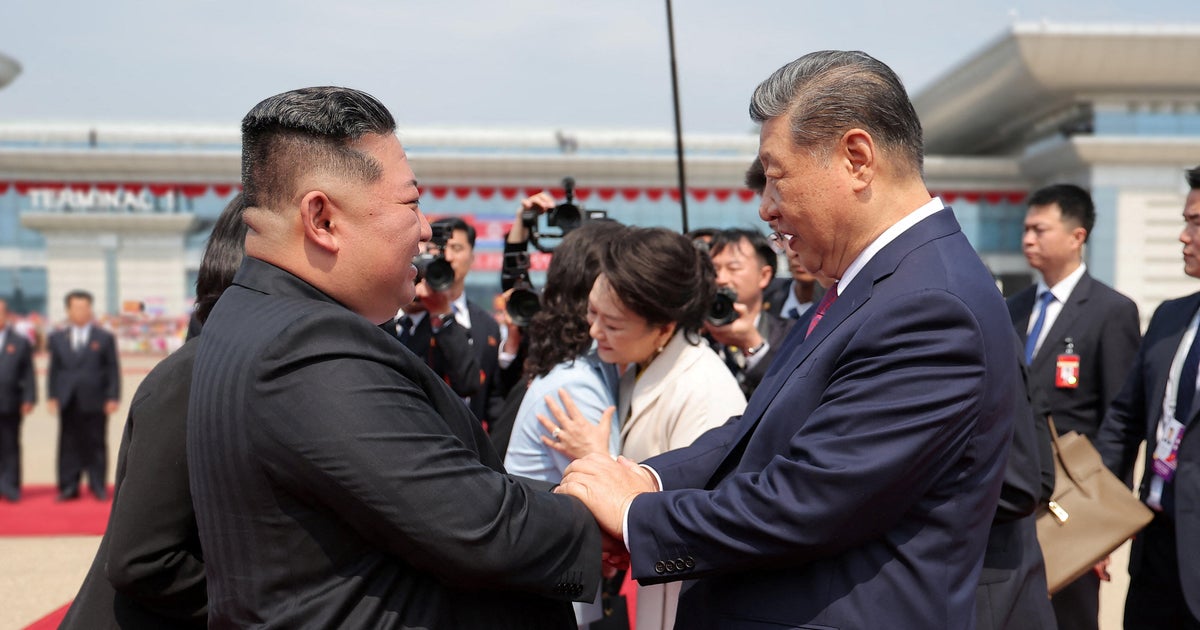
Hong Kong — Chinese President Xi Jinping wrapped up a two-day visit to North Korea on Tuesday by vowing to deepen ties and expand cooperation with Kim Jong Un. Xi called the summit a “new historical starting point.”
Beyond the optics and the carefully choreographed messaging from the Chinese and North Korean governments, experts say the real motivation for Xi’s visit was to keep tabs on an emboldened Kim — his nuclear armed neighbor.
“Never before have the Chinese had to deal with a North Korea that has any swagger in its step,” Bob Carlin, a former U.S. State Department official with more than 50 years of experience as a North Korea analyst, told CBS News on Wednesday.
KCNA via REUTERS
He said while North Korea has long felt “put upon by the big powers, that’s not Kim’s perspective these days.”
“Since 2023, Kim has completely changed the center of the strategic policy of North Korea,” Carlin said. “For so many years it was to engage the U.S., normalize with the U.S. That’s gone. They want to confront the U.S.”
Kim sees himself as “a leader in this movement, and sooner or later he’s really going to have a reckoning with the Americans,” Carlin predicted.
That presents Xi with a problem, he said, because China knows if Kim ends up in a conflict with the U.S, “it’s going to involve the Chinese in some way, shape or form. So they need to know what he’s up to, and they need to be counseling him [Kim] and holding him back when they can.”
Can China, or anyone, contain North Korea?
China-North Korea relations have been strained since Xi came to power in 2012. Kim took control of his country a year earlier, after the death of his father Kim Jong Il. But Carlin said the Chinese government had maintained closer ties with Kim’s uncle, Jan Song-thaek, who had been the second most powerful official in the country and “considered a mentor to Kim.”
He was executed in 2013 on Kim’s orders, and several years later the Chinese backed United Nations Security Council sanctions against North Korea over its nuclear weapons program.
Carlin said a “poisonous stream” still runs through Xi and Kim’s personal relationship, but both sides have accepted that, as neighbors, they’ll have to live with each other.
“Things can get very bad sometimes, really nasty, but they have to come back to a certain type of equilibrium. It’s the only way they can exist,” Carlin said. “It makes more sense for them to stand together and cooperate. They don’t have to love each other or trust each other, but they need to stand together to accomplish certain goals.”
Kim described the relationship as “rock solid” this week, while Xi called on both countries to firmly defend their respective sovereignty, security and development interests. The leaders discussed trade and economic partnerships, as well as ways to enhance tourism, Chinese investment and education exchanges, according to official readouts.
But Carlin said what “we should be worried about,” is military cooperation between China and North Korea.
“It stirs the pot, and both China and North Korea are happy to stir the pot,” he said, adding that the 65th anniversary of an existing defense treaty between Beijing and Pyongyang next month would likely offer a true indication of how cordial this week’s summit really was, depending on what’s announced.
If China announces, for instance, a sale of military hardware, such as air defense systems, to the North, or joint naval exercises in the Yellow Sea, it will be a clear indicator of genuinely deepening ties.
The Russia factor
Xi’s visit was also seen as a bid to balance Russian influence in North Korea, which has grown during Moscow’s ongoing full-scale invasion of Ukraine.
In exchange for weapons and thousands of North Korean troops, Russia has given Pyongyang desperately needed financial assistance. Moscow has also recognized North Korea as a fellow nuclear weapons state, giving Kim confidence as he doubles down on efforts to expand his country’s weapons program, which is considered far more advanced than Iran’s.
“China doesn’t want Russia and North Korea off in a corner planning anything between themselves,” said Carlin. Beijing wants “to be the control rod … they want to stabilize things and prevent them from getting out of hand.”
Just days before Xi’s visit, Kim unveiled a new nuclear production factory and visited a uranium enrichment facility. On the eve of the Chinese leader’s arrival, Kim’s powerful sister Kim Yo Jong declared that North Korea’s nuclear armed status “irreversible.”
“Kim is building new enrichment plants, churning out plutonium which is very, very dangerous,” said Carlin. “So he is building up a nuclear arsenal which is really, really hefty. And he’s got enough missiles to launch and carry all those nuclear weapons all over South Korea and Japan. So he feels he’s got a lot of power, and the question is how and when does he think it will be time to use it.”
Carlin believes Kim has three aims: To diminish the standing of the U.S. on the world stage, to reunify the Korean Peninsula and to be considered a peer by both China and Russia, so they can no longer treat him and his regime as a minor player.
Shen Hong/Xinhua News Agency/AP 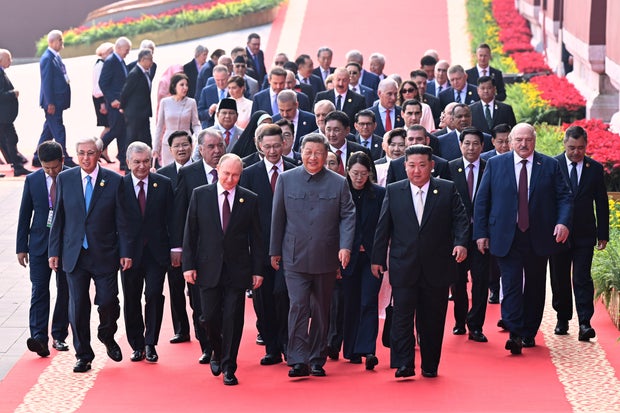
“The Chinese can’t do anything if they’re on the sidelines, so they’ve got to get back into the game,” said Carlin, adding that with this trip, “Xi was able to plant the flag again.”
The Chinese leader’s visit came after back-to-back summits in Beijing last month, with Xi hosting President Trump and then, just days later, Russia’s Vladimir Putin.
Neither government has said whether Xi delivered a message on behalf of the White House during his stop in North Korea, and Mr. Trump has spoken little of the topic in recent years, though he voiced a clear desire after his last talks with Kim to see negotiations resume.
Mr. Trump and Kim met three times during the U.S. leader’s first term, but since their last meeting in 2019, North Korea has tested more than a dozen intercontinental ballistic missiles, and Kim has made it abundantly clear that he’s unwilling to even discuss the notion of denuclearization.
Carlin believes there’s nothing the U.S. can offer at this stage to convince Pyongyang to give up its nuclear weapons.
“We completely lost that opportunity,” he said, when the talks between Mr. Trump and Kim broke down seven years ago.