

 Weather
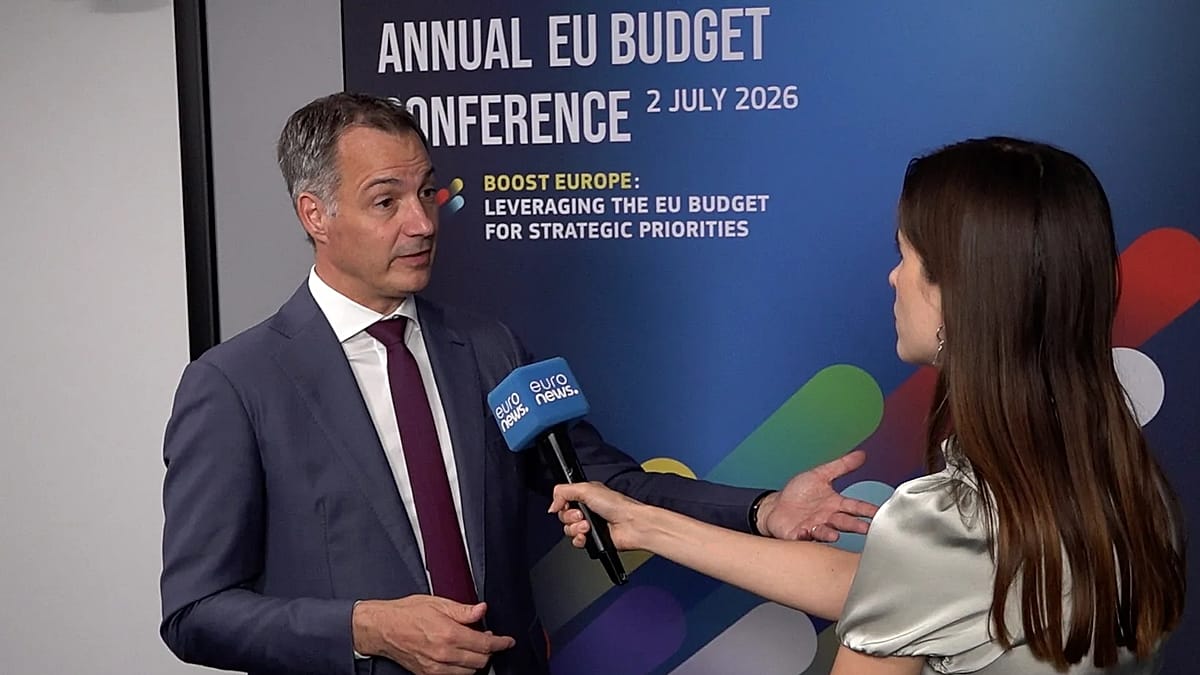
United Nations Development Programme (UNDP) administrator Alexander De Croo said on Thursday that the European Union’s long-term budget can balance defence and aid spending to ensure that Europe’s neighbourhoods are safe, as they are “two sides of the same coin.”
ADVERTISEMENT

ADVERTISEMENT
“We see more military spending, and we totally understand that in the current circumstances,” he said. “But if you want that military spending to be as effective as possible, you will also have to invest in preventing that conflict from arising.”
A stable neighbourhood means economic growth, democracy and peace, De Croo, also a former prime minister of Belgium, told Euronews’ flagship morning programme Europe Today.
In June last year the European Commission proposed €2 trillion in spending from 2028—2034 as part as the multi-annual financial framework, the EU’s seven-year budget.
The proposal is currently being debated by European heads of state before it will be ratified in the European Parliament, with a hopeful December deadline.
Competitiveness and defence have been prioritised by the EU executive, with the latter earmarked €131 billion to meet Europe’s security needs. There is no specific funding stream for aid, however various subheadings include money for outreach, such as the Global Europe Instrument, worth €200 billion.
De Croo does not believe there is a clear winner or loser in this budget, or that with defence being put at the top of the ballot, aid will miss out.
“Development is part of your security agenda, and development is also part of our economic agenda,” he said, using the eventual reconstruction of Ukraine once Russia’s invasion ceases as an example.
“The faster you reconstruct after a war, the better it is for everyone, because it avoids that it becomes a protected conflict and it creates also economic opportunity.”
Ukraine and Gaza
Along with various other European leaders, De Croo was in Gdańsk Poland this month for the Ukraine Recovery Conference — a major political event aimed at drumming-up support and financial backing for the war-torn nation amid Russia’s full-scale invasion.
In Ukraine, the UNDP provides support for veterans, de-mining operations, and civilians, through delivering more than 6.6 million civilians with electricity as Russia’s attacks on energy infrastructure intensifies.
“War is development in reverse,” he said.
“The human misery and the level of destruction in Ukraine is something which we deplore. The earlier it stops, the earlier we can bring human progress again.”
De Croo was also in Gaza in February. This month, the United Nations released a report stating that Israeli forces were deliberately targeting Palestinian children in what they described as a “genocide”.
“The circumstances on the ground are dramatic and I have not seen many worse places in the world than Gaza today,” he said, when asked whether this report chimed with what he saw on the ground.
“More than 80% of people lost their homes, live in constructions that one would not even call tents. The level of poverty is gigantic,” De Croo added.
He would also like the Israeli Defence Forces to provide more humanitarian access for organisations like the UNDP, so they can “bring more solutions” to areas significantly impacted, but he understands their concerns.
“The whole discussion is, can some of the material that you bring in, can it be abused (by Hamas)?” De Croo said.
“We think we have quite good systems of avoiding that, and we are in discussions with the Israeli authority on how to secure that. But our plea really is that it really is important to give more access and ensure that people can restart their lives.”
Read the full article here