


 Weather
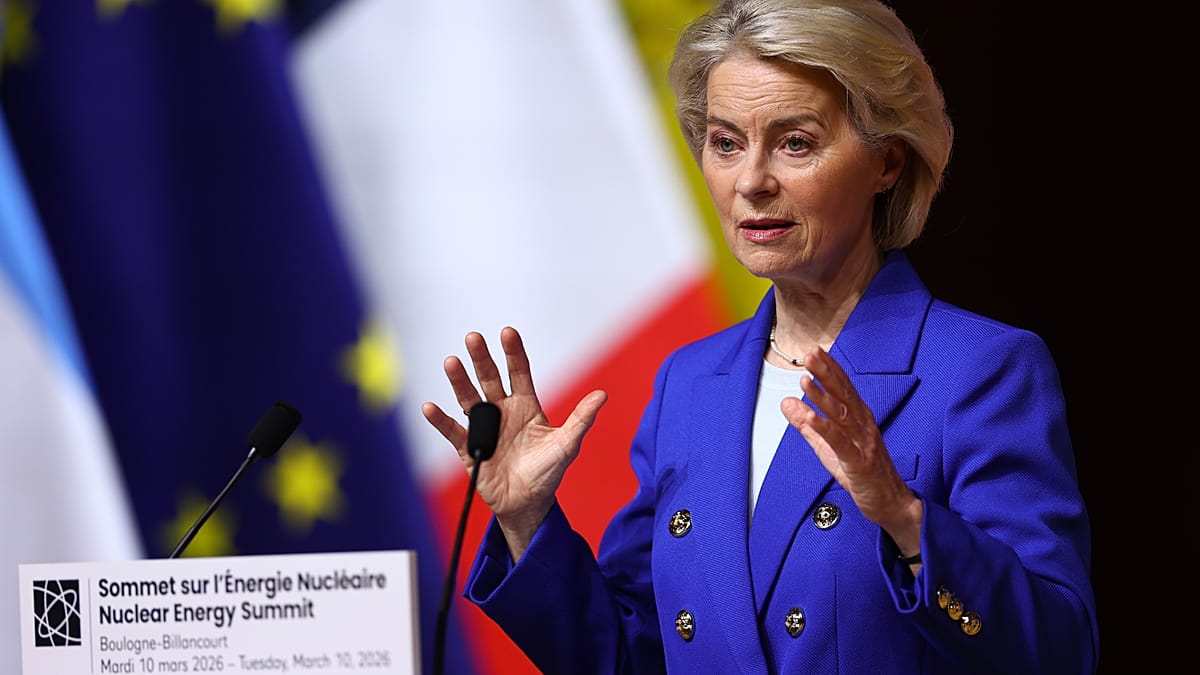
European Commission President Ursula von der Leyen is brushing off calls to overhaul the bloc’s carbon pricing system while urging member states to cut taxes on energy bills despite calls for Brussels to suspend rules, according to a letter seen by Euronews.
ADVERTISEMENT

ADVERTISEMENT
The document rejects calls for fundamental changes despite mounting pressure from energy-intensive sectors and countries like Italy, Hungary, Romania, and the Czech Republic, which have been lobbying the EU executive to scrap the ETS, arguing that carbon costs and high electricity prices are shutting down industries.
In the letter addressed to EU leaders on Monday, von der Leyen stressed that the EU’s Emissions Trading System (ETS), the bloc’s carbon market, won’t be dismantled to ease short-term pressure, as it remains a “proven” tool for driving decarbonisation and investment, in line with demands from Denmark, Finland, Luxembourg, Portugal, Slovenia, Spain, Sweden and the Netherlands.
“The ETS provides long-term certainty and rewards innovation,” reads the letter, underlining its role in reducing gas use and supporting the energy transition by using its revenues to finance clean technologies like storage and renewable energy.
The ETS is the bloc’s mechanism for making companies pay for their pollution, with the dual aim of reducing emissions and encouraging industry to invest in more sustainable alternatives. The system requires companies to buy allowances for their emissions, putting a price on carbon.
Despite backing the ETS, Brussels will revise its major climate policy by July, aligning it with the Paris Agreement and the EU’s 2040 climate target law.
Veteran lawmaker Peter Liese, a member of the European People’s Party (EPP), told a press conference on Monday that the ETS needs to be revised or the system will have no more allowances in 2039, leaving energy-intensive companies like steel, cement or aviation, unable to cover their emissions and threatening both energy prices and the EU’s climate targets.
‘Do your part of the work’, von der Leyen tells EU governments
The EU executive wants to preserve the integrity of the carbon market while shifting part of the burden of lowering electricity prices to EU countries, the letter suggests, asking them to act decisively to reduce electricity costs and protect competitiveness.
While the EU harmonises aspects of energy taxation, member states retain primary control over electricity tax rates and structures. EU leaders are also considering network charges as a quick fix for struggling industries, an idea discussed during Monday’s gathering of energy ministers and contested by Sweden, which threatened to cut off electricity to neighbouring countries.
The Commission signalled that national governments must do more in the short term to address the immediate impact of high electricity prices, which are still heavily influenced by fossil fuel costs and have been further exacerbated after the United States and Israel launched an attack on Iran and the subsequent closure of the critical Strait of Hormuz.
Von der Leyen suggested a range of measures already available to EU countries.
These include compensating industries for indirect carbon costs, providing targeted state aid to the most affected sectors and introducing temporary measures to limit the impact of high gas prices on electricity prices.
Such interventions, she noted, should remain carefully designed to avoid distorting the EU’s internal market or undermining clean energy investment.
Ireland’s energy and environment minister, Darragh O’Brien, wrote to energy and fuel suppliers in recent days, stressing the need to shield Irish consumers from global price shocks, an official spokesperson for the Irish Energy and Environment Ministry told Euronews.
O’Brien also contacted energy regulatory officials after requesting a review of retail energy competition last December, with the regulator already underway on the work alongside the Irish Competition and Consumer Protection Organisation.
Ireland introduced a range of measures in the 2026 budget to support homeowners with energy costs.
“This includes an extension of the 9% VAT rate currently applied to gas and electricity; an expansion of the eligibility criteria for the Fuel Allowance, as well as an overall increase by €5 to €38 per week; and a record €640 million budget allocation for the SEAI retrofit scheme to help households,” the official spokesperson told Euronews.
Market Stability Reserve comes to the rescue
The Commission also plans to revise the Market Stability Reserve, a EU financial tool in place since 2019 to help mitigate excessive price swings. The goal is to bring forward a broader revision to align the carbon market with the EU’s long-term decarbonisation pathway, according to the letter.
“The Market Stability Reserve has always been a separate proposal, never negotiated together with the big package on ETS, and that’s why we can do it rather quickly,” lawmaker Liese said, suggesting it could be done before the ETS review due in the summer.
Climate Action Commissioner Wopke Hoekstra suggested similar thoughts, without giving a specific timeline.
“Our current plan is to make sure that we will first deal in the next couple of months with the Market Stability Reserve (…) but we need more talks to calibrate what and when the tool will be most needed,” Hoekstra told reporters on Tuesday, on the sidelines of a gathering of environment ministers in Brussels.
The Dutch Commissioner said the latest outcomes from the industry gathering in Antwerp, where energy-intensive sectors called for scrapping the ETS, led to huge volatility in carbon pricing.
“That has talked down the price of ETS dramatically and has actually fuelled the volatility that we try to prevent,” said Hoekstra.
For Polish Secretary of State for Energy, Krzysztof Bolesta, von der Leyen’s letter lacked “concrete ideas,” but noted they were “interesting.”
“We are waiting for the meeting of the European Council and we will see what the leader is proposing specifically. For now, these are interesting ideas but still too little concrete to get to them,” Bolesta said on Tuesday.
Bernd Weber, founder and CEO of the climate action think tank EPICO, welcomed the bloc’s plan to reform the Market Stability Reserve to enhance price stability and maintain system flexibility, while providing reliable investment signals.
”To strengthen carbon leakage protection, free allocation needs to be used more strategically. As allowances become scarcer, they must be directed where competitiveness risks are greatest—such as in the chemicals industry,” Weber said.
The EU executive is also betting on faster deployment of renewable energy, expanded grid infrastructure and tax changes to make electricity cheaper relative to fossil fuels.
The debate is expected to intensify at the European Council on Thursday, where leaders will face growing pressure to balance climate ambition with economic realities.
Read the full article here