





 Weather
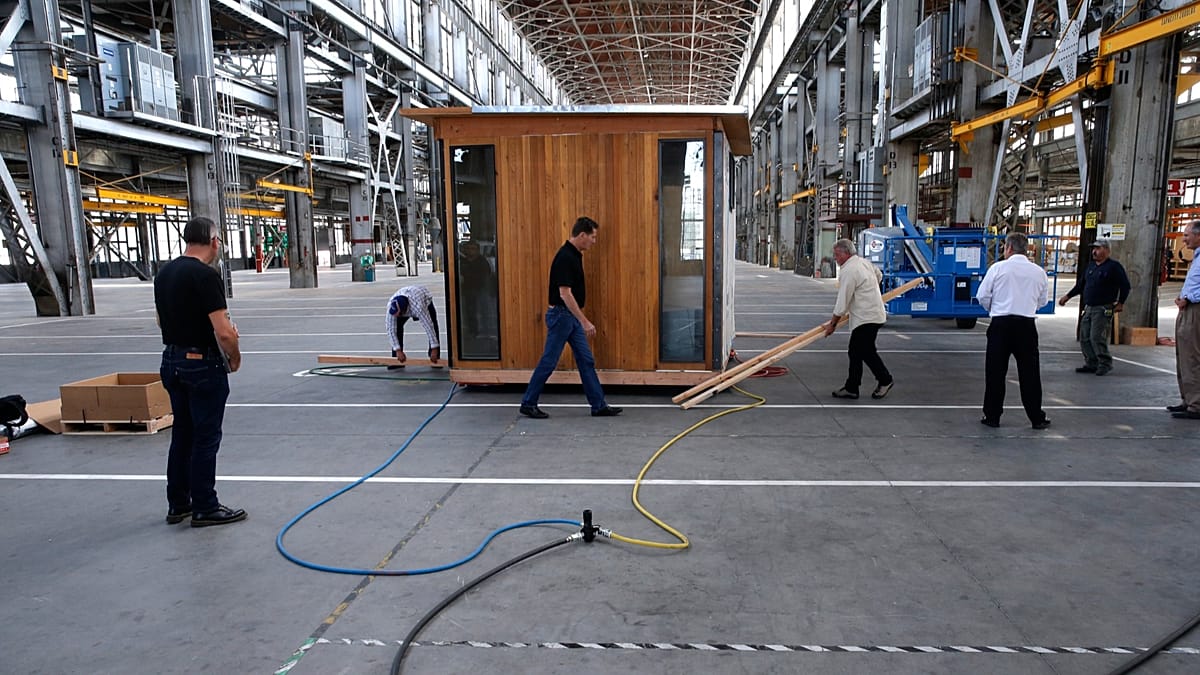
Governments have exhausted most quick solutions, and the construction industry is struggling to modernise. Modular construction, which prioritises factory-based building, could be part of the solution.
ADVERTISEMENT

ADVERTISEMENT
The EU faces a shortfall of up to 10 million housing units, roughly 3.5 percent of total stock. Germany needs 400,000 new homes a year but is nowhere near hitting that target. France has 2.8 million households on social housing waiting lists. The Netherlands must build around 1 million homes by 2031. And across the bloc, actual construction is meeting only about half the required pace.
Modular construction, where homes are built in factories and assembled on-site, is gaining serious political and industrial traction.
What is modular construction?
Modular construction involves prefabricating building sections, such as rooms, walls, or floor units, in a controlled factory environment before transporting and assembling them on-site. This approach treats housing as a product manufactured on a production line.
This type of construction offers important advantages over traditional methods. Projects can be completed 50 to 90 percent faster, as factory work and site preparation occur simultaneously. Waste is reduced to 10 to 15 kilograms per square metre, compared to 25 to 30 kilograms for conventional builds. Embodied carbon can be reduced by up to 45 percent, aligning modular construction with the EU’s sustainability goals.
Given chronic labour shortages in Europe’s construction sector, the ability to move skilled work indoors and scale production is crucial. The European modular market is valued at approximately €31 billion in 2025 and is projected to exceed €40 billion by 2030.
Who is leading in Europe?
Sweden leads the sector, with approximately 45 percent of new housing built using offsite or modular methods. This reflects long-standing policy support, efficient approval processes, and a cultural acceptance of industrialised construction. Stockholm Wood City, a major timber-modular development, serves as a model for other European cities.
Germany is the second largest market, with 26 percent of new single and two-family homes prefabricated in 2024, supported by federal subsidies for climate-efficient housing. The country’s emphasis on precision manufacturing supports the adoption of factory-built construction.
The Netherlands is rapidly expanding modular construction to meet its goal of building 1 million new homes by 2031. Developers are integrating Building Information Modelling (BIM) with modular systems to accelerate design and approval processes.
Spain and Portugal are emerging markets, offering simpler zoning regulations and increasing government incentives that attract modular developers seeking to expand in southern Europe. Poland, facing a shortage of 1.5 million housing units, is also attracting modular developers, especially for social housing projects.
Do modular homes meet EU standards?
In short: yes, but the regulatory landscape is fragmented, and that fragmentation is itself a barrier to scale.
At the EU level, the Construction Products Regulation (CPR) requires CE marking for building components, and the nearly zero-energy building (nZEB) standards under the Energy Performance of Buildings Directive apply equally to modular and traditional construction. Modular homes typically meet nZEB requirements comfortably, thanks to the precision of factory-controlled insulation and airtight envelopes.
But national building codes vary considerably. Germany applies strict DIN 1055 structural standards and has developed specific prefabrication guidelines. Sweden’s BBR rules include provisions for heavy snow loads. France’s RE 2020 regulation imposes detailed energy and carbon compliance checks, slowing the approval process compared to the Nordic model. Ireland requires full planning permission for permanent modular homes, though reforms in 2025 are moving to ease rules for smaller units.
A major structural issue is that modules certified in one EU country cannot be used automatically in another. Cross-border trade requires separate national certifications, creating obstacles for manufacturers seeking to expand within the EU.
The EU is beginning to address this. The updated CPR (EU 2024/3110) introduces Digital Product Passports for construction components, machine-readable records covering materials, carbon footprint, CE markings, and energy performance. These are designed to cut approval times and enable automated regulatory checks across borders. Authorities can scan a QR code or NFC tag and verify compliance instantly, rather than waiting weeks for a paper-based review.
The barriers that remain
Modular construction has limitations. Design flexibility is restricted, and changes after factory production significantly increase costs. Flat sites and crane access are required. High upfront factory setup costs may also deter developers without a secure project pipeline.
The main systemic barrier, however, is regulatory. Fragmented national certification requirements prevent the cross-border economies of scale that would make modular construction dramatically cheaper across Europe. Industry groups and the European Commission are pushing for harmonised Eurocodes and standardised European Technical Assessments specifically designed for modular systems.
Modular construction is not a complete solution to Europe’s housing crisis. However, it is one of the few approaches that can significantly accelerate housing supply without requiring additional workers, land, or extended timelines.
Sweden shows the potential when governments align policy, procurement, and planning regulations to support industrialised construction. Germany is following this path. The key question for the rest of Europe is whether political will can keep pace with technological progress, and whether Brussels can address the regulatory patchwork before another decade of housing shortages.
With millions of households across the EU priced out, waiting in queues, or living in overcrowded conditions, the pressure to find that answer is not going away.
Read the full article here