




 Weather
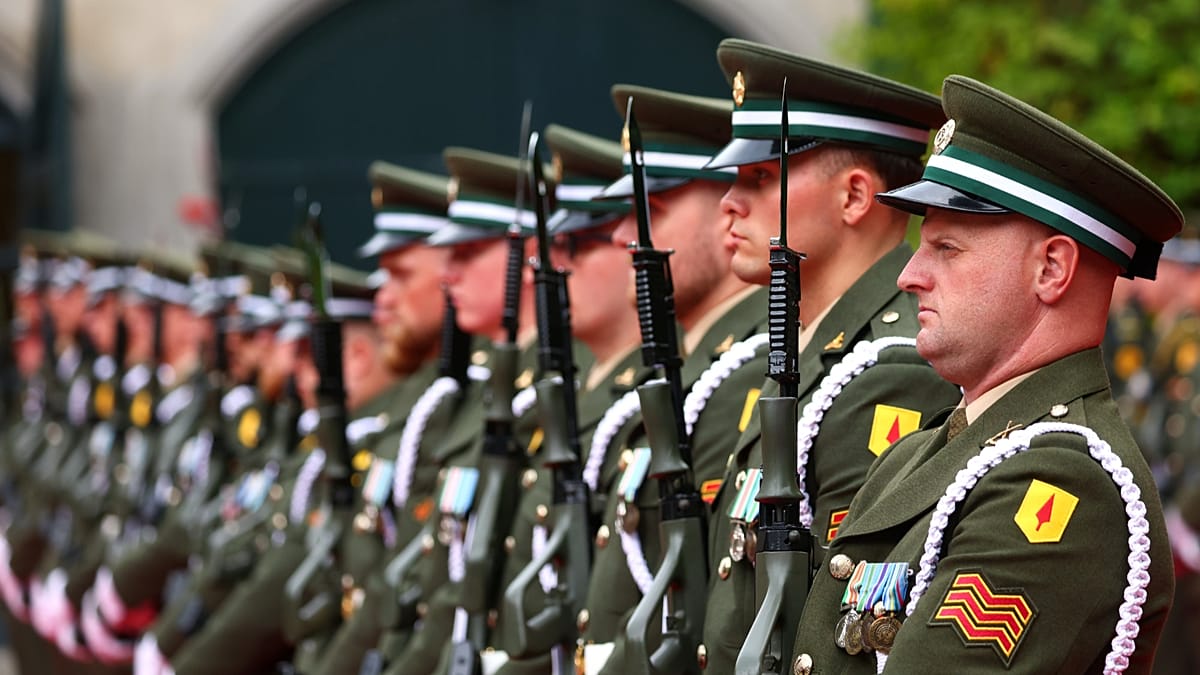
The European Union is rearming at an eye-watering pace not witnessed in decades. Yet as the continent invests billions into its military might, and confronts its most perilous environment since the Cold War, four EU countries cling to a defining principle: neutrality.
ADVERTISEMENT

ADVERTISEMENT
Austria, Ireland, Malta and Cyprus have each maintained policies of neutrality or military non-alignment — though they differ considerably in their legal status and interpretation. These concepts have adapted — or are adapting — to an increasingly volatile world, punctuated by Russia’s invasion of Ukraine and a turbulent US presidency.
For these countries, neutrality is a high-wire act — balancing a long-held principle against an EU rapidly reshaping its approach to the world around it.
Under international law, neutrality generally means that a state does not participate in an international armed conflict between other states. It also entails a range of obligations concerning relations with belligerents.
But the definition is nuanced, and the four countries do not share the same legal status.
Austria and Malta have neutrality enshrined in their constitutions. Ireland’s military neutrality is deeply entrenched, while Cyprus has historically pursued a policy of non-alignment — a position increasingly tested by its closer defence ties with the West.
Neutrality, in other words, is fluid and contested.
Austria
Austria’s Secretary-General of the Federal Ministry of Defence, Arnold Kammel, said the Central European country’s neutrality has shifted since joining the EU 31 years ago.
“Neutrality has somewhat changed its meaning,” he told Euronews, “however, the core substance of remaining neutral is heavily enshrined in the DNA of the Austrians, and thus it seems also to continue in the future.”
Austria enshrined neutrality in constitutional law in 1955 after the post-World War Two restoration of its sovereignty. Joining the EU decades later forced Austria to participate in the common foreign and security policy, among other things.
When Austria applied to join the EU in 1989, the European Commission stated that its “permanent neutrality” was incompatible with provisions of the existing treaties and could pose problems for the bloc’s emerging common foreign and security policy. Austria nevertheless joined the EU six years later.
Recent statements from the European Commission show a change in tune. The Commission now says security and defence choices remain a national competence, meaning EU treaties do not prevent Austria, Ireland, Cyprus or Malta from maintaining their neutrality.
In practice, neutrality does not prevent the four from supporting Ukraine, including through EU financial assistance, such as the €90 billion loan, and sanctions against Russia. Cyprus and Ireland have also joined the Coalition of the Willing, while Austria remains an observer.
Neutrality also does not remove their obligations under Article 42.7 of the EU Treaty, the bloc’s mutual assistance clause. It requires member states to provide aid and assistance “by all the means in their power”, while preserving the specific character of countries’ security and defence policies.
Crucially, it does not automatically require a neutral state to provide military assistance. For Austria, any response would require domestic political consultation “within the limits that are given to us by our constitution”, Kammel said.
France invoked Article 42.7 after the 2015 terrorist attacks. Austria did not provide direct military assistance, citing neutrality, but supported UN and EU missions elsewhere.
Neutrality does not limit defence spending: Vienna aims to raise it to 2% of GDP by 2032.
Kammel said Austria’s non-membership of NATO does not remove its obligation to defend its territory, which is why it is investing “across all the military domains” to meet the challenge.
Cyprus
Cyprus has historically pursued a policy of non-alignment, of not wanting to be closely attached to any foreign power, but recent statements and actions by President Nikos Christodoulides suggest a break.
In May, Christodoulides said the divided country was ready to join NATO “when political conditions allow”. Turkey’s opposition is the principal political obstaclegiven NATO’s consensus requirement.
A month later, Cyprus began receiving funds under the EU’s Security Action for Europe (SAFE) programme, with up to €1.2 billion available for defence investment. It is the only neutral or non-aligned EU state to receive SAFE funding, which is reportedly earmarked for drones, anti-tank missiles and ammunition.
“Europe that does not invest in its defence and security is a Europe that is dependent, and dependence cannot be a strategic choice, if we want — and yes, we do want — to be geopolitically strong,” Christodoulides said at the time.
Steven Everts, Director of the EU Institute for Security Studies (EUISS), said most of Europe’s neutrality is rooted in history but all EU member states must reckon with the realities facing them in 2026.
“The speed at which the world is changing requires everybody to assess whether the choices made decades ago — or 70 to 80 years ago — still apply to the world you live in today,” Everts told Euronews.
This is particularly pertinent for Cyprus, a divided island. Although recent efforts show a clear desire to solve the half-century-long division, another threat has mounted. The British sovereign base in Cyprus’ Akrotiri was struck by an Iranian-made Shahed drone in March.
Christodoulides said the incursion demonstrates the need for a “clear manual that ensures the union acts as a credible guarantor of security.”
Ireland
In July, Irish Prime Minister Micheál Martin clarified that Ireland is militarily but not politically neutral.
“Since World War Two, Irish people have remained steadfastly loyal to the principle of military neutrality, which is basically not being a member of any military bloc or military alliance, so in effect, we’re not members of NATO,” the Taoiseach said.
He added that Ireland cooperates with NATO through the Partnership for Peace on areas such as critical undersea infrastructure, cybersecurity, and hybrid threats.
Most notably, Ireland has instead built a reputation for its role in international peacekeeping, including in Kosovo and Afghanistan.
Martin said Russia’s war had prompted Finland and Sweden to join NATO, but had not altered Irish public opinion. “It is the overwhelming wish of the Irish people to remain militarily neutral,” he said.
Ireland’s policy of military neutrality was formally adopted in the run-up to the Second World War and has since been maintained by successive governments. It is not enshrined in the Constitution.
But despite this long-standing policy, Dublin has increased defence spending.
In December, the government announced a record €1.7 billion in capital investment for defence package for 2026–2030, aimed at strengthening capabilities across land, air, maritime and cyber domains.
For Ian Lesser, distinguished fellow at the German Marshall Fund think tank, Ireland’s reliance on others while not being able to “shape” wider security strategy puts it in an awkward position, particularly through the domain of cybersecurity given Dublin’s concentration of tech giants.
“Ireland is highly dependent on its international digital links, and the security of the sea lane around Ireland is something that cannot be taken for granted,” he said.
Malta
Malta’s obligations to upholding the bloc’s security and defence, while also respecting its constitutional imperative to remain neutral, is a fragile act.
Daniel Fiott, defence expert at Belgium’s Centre for Security, Diplomacy and Strategy, states the country’s neutrality was born from the fact that it was a British military outpost, and wanted to pull away from both Western and Soviet blocs.
Its neutrality was constitutionally formalised in 1987. Decades later, this definition has lost some of its rigidity, and was publicly debated after Prime Minister Robert Abela backed the EU’s €800 billion defence push in March 2025.
Around this time, Abela reportedly said the small island nation should reconsider how it traditionally interprets this status, and that defence spending should increase to reflect the times.
For Malta, this means ensuring the security of subsea cables, maritime networks, and cyber infrastructure, as it boasts a burgeoning gaming industry.
According to newspaper Times of Malta, the Mediterranean island has almost doubled its defence spending over a decade: from roughly €42 million in 2014 to €77 million in 2023. European Parliament backs this up, with data estimating a projected rise in defence spending to €100 million this year.
“We cannot adopt a position, as maybe we frequently have, that our country is cut off and completely protected from the realities around us,” Abela said in early 2025.
The future?
What is clear is that the EU is entering increasingly uncertain waters. Politicians and defence officials have warned that Russia could test NATO’s defences by 2030, making it imperative for Europe to be prepared.
Everts of the EUISS said the real test of neutrality will come if Europe is confronted with armed aggression.
“If there were a military attack on an EU member state, what then happens in terms of the reactions, in terms of the solidarity, in terms of the actual commitments, including in the military field of those four countries?” he said.
“That is when the question will truly be on the table.”
Read the full article here