





 Weather
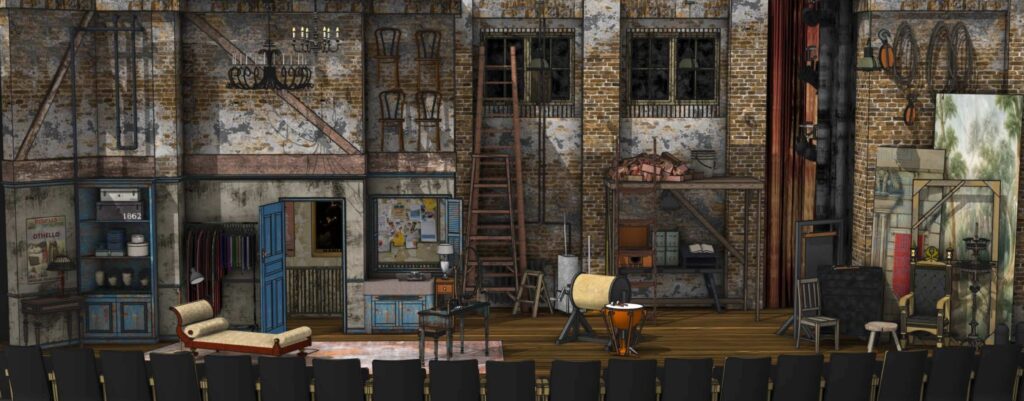
Design made on computer for Palm Beach Dramaworks’ The Dresser
By Bill Hirschman
Enter a diverse universe of three-dimensional worlds created not in your imagination but corporeal before your eyes.
The living room of a college professor and his wife that clones their acerbic factious relationship. Ceiling-high bookshelves housing worn-down artifacts. Even the encyclopedias are disheveled. Paintings leaning against walls still waiting to be posted. A rummage-jammed space longing to be straightened and made right.
An X-ray of a two-story French Quarter building of bricks and wooden slats infected with moldy peeling paint, battered balustrades and hints of a faded former elegance that echo the essence of its Southern belle visitor.
Ostensibly, a 19th-century sitting room hosting only white blocks to sit on and dominated by white-washed walls leaning in with a hint of the claustrophobia that its heroine fled 15 years ago. Dead center is the ten-foot-high door that she had escaped through. Suddenly, the blank walls become a display for projected stage-high block letters bearing such messages as DOOR SLAM.
A leading actor’s cluttered dressing room in a British provincial theater in the 1940s as decrepit as the actor himself and his well-worn luggage. The time-scarred brick on the depicted stage left is scattered with a carry-on coat of arms, ancient sound effects machines and a score of detritus from previous productions.
These varied environments instantly communicate to audiences an array of foreign and familiar times, places and especially the character of their denizens from the moment the curtain rises.
Scenic designer Anne Mundell has provided the genesis of these worlds for Palm Beach Dramaworks, Maltz Jupiter Theatre and other venues, created from her own acumen collaborating with directors, playwrights, lighting experts and sound designers.
The 50-year veteran artist and honored emeritus educator at Carnegie Mellon University is based in Pittsburgh but has been Dramaworks’ resident designer and architect for far more than a score of local productions, earning her a Carbonell Award.
Understanding her and the collegial process that can last four months to a year is an education into how you see what you see on stage opening night and how it affects you.
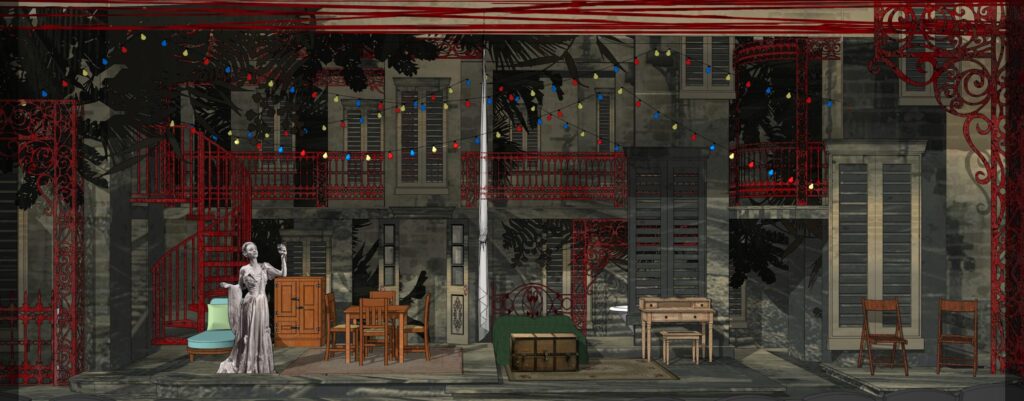
Dramawork’s A Streetcar Named Desire
She speaks eloquently about the discovery of the visions, the physical creation and thinking at the heart of the aforementioned Who’s Afraid of Virginia Woolf, A Streetcar Named Desire, A Doll’s House Part Two and The Dresser — which can range from Arcadia’s elegant oval-shaped Edwardian drawing room with almost everything bathed in pearl white in Equus’ minimalist platform and benches.
That ambidextrousness emanates from her key concept: No matter the detail in what you see displayed in, say, a living room set, she maintains “there is no such thing as realism. You’re in a theater. There are 500 people in your living room and the walls are stripped away. You know you are not seeing what” is actually happening.
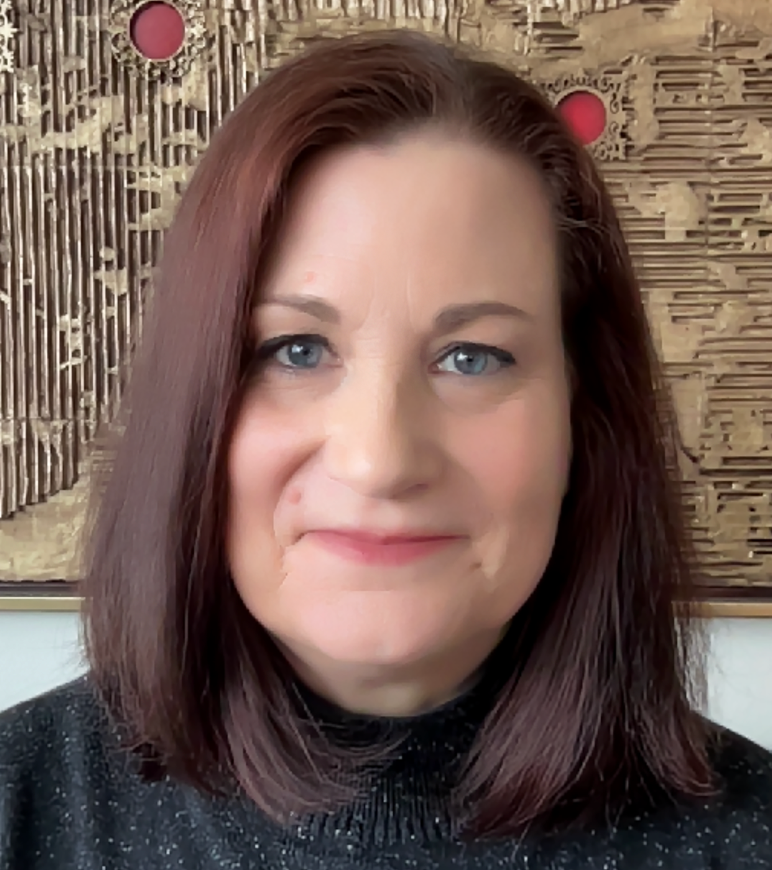 “That gives you a lot of permission to free things up. If we let loose of that idea and give more room for the imagination of the audience, what is absolutely essential to have there? What can we take away? We have the opportunity as designers to actually build the physics of a world from the gluons up. Why do we start with the couch (in the script) rather than saying, who are these people? Do they live in a world that is similar to ours or a world that’s very different from ours? Would we be able to navigate it? So those kinds of questions to me are essential in giving the audience’s imaginations room to roam.”
Indeed, the audience is a crucial player in the shared mutual creation.
“I have to communicate this idea: Your job is not to sit and clap and receive. Your job is to collaborate in some way, is to ask questions in your own mind of what am I seeing here? How does that apply to my life? How does that resonate with the world today?”
Her fans include Andrew Kato, Producing Artist Director/Chief Executive of the Maltz Jupiter Theatre, veteran director J. Barry Lewis and William Hayes, Producing Artistic Director of Palm Beach Dramaworks whose plaudits illustrate the demands of the art form and its process.
“What I love most about Anne is her infectious passion and excitement for bold and unique works,” enthused Hayes. “She loves experimental works, and her favorite genre is theatre of the absurd.”
Kato praises, “Anne’s precision is staggering. For Plaza Suite, she had the headboard recreated to match the real Plaza Hotel and 3D-printed the door plates to mirror the originals, details most audiences will never consciously register, but that shape every moment on that stage. She’ll even design a framed family photo, digitally placing the actor’s character into a period image, purely so the actor has something true to hold onto. Most of that work is invisible to an audience. All of it is felt.”
For instance, she jumped at the chance to design Harold Pinter’s The Birthday Party for Dramaworks’ coming season, eager to create something unique.
Said Hayes, “To design the set in an unusual, abstract manner, rather than the usual hyper-realistic designs of Pinter plays, will help open the minds and imaginations of our audiences.”
Initially, she and Hayes discussed favorite film auteur Wes Anderson.
“We then took our thinking a step further, perhaps a Dr. Seuss sort of world should be considered. Instead of the usual cramped 1950s English seaside parlor, a whimsical design with warped walls or oversized furniture will make the space feel deeply unstable and uncomfortable. A fantasy aesthetic treats the boarding house like a children’s playroom that has slowly turned toxic and wrong. His whimsical approach will even moreso turn the set into a subjective viewpoint of the terrified lodger, Stanley Webber. “
Mundell knows that many patrons “don’t always register the depth and complexity of the art, simply give an appreciative sigh when the curtain first goes up…. I think I made peace with how little of my work anybody would ever be seen or recognized.”
She chuckled recalling someone she met while hiking. “She said, ‘Oh, what do you do?’… ‘I’m a designer for theater.’ And she said, ‘Oh, honey, I’m sure at some point they’ll let you be an actor.’ At that point, I realized, okay, it doesn’t matter that people don’t know and will never know.”
INTO THE WOODS
Obviously, the first step in the discovering process is reading the script several times, even if it’s a world premiere that isn’t polished or fine-tuned yet. But for familiar titles, “she avoids boring reproductions and instead explores the deeper emotional world of the play,” Hayes said.
In her words, “Theater, to me, is always a way to ask questions. I like to ask the play questions and talk to it… and me trying to talk to the characters. And eventually, they start to talk back. At some point, they yank the process out of your hands.”
“Essentially, you’re building a world…. The questions are basically at the level of fundamental physics. It’s like, is up really up? How much does this world look like the world that you would see if you walked outside? Is blue, blue in this play? How much can we take away and tell the story more effectively?… What are the foundational things that need to be there in order to tell the story in the way that we want to tell it?”
“And I have a list that I’ve put together over the years of adjectives. And I just go down these big boxes and it comes out with things like is it big? Is it small? Is it straight? Is it curved? Is it triangular? Is it circular?”
“I like to explore the world of the play in a way that isn’t necessarily reproducing the actual physical space that the story takes place, like a living room.” It requires what she calls “poetic envelope.”
“Along with all that the underlying imagery, the emotional imagery, that level response always comes first, because to me, we are artists. And why would we want to just do something that just has the coffee cups because there’s no point of view there?”
Then extensive and repeated and regular brainstorming occurs with the director, perhaps the producer, and eventually with the other designers, exploring preliminary visions in a collaborative discovery.
Lewis, who has known her since she was painting sets at a Pittsburgh Public Theatre, prizes that collaboration.
“Ultimately, it is about the trust that you establish… knowing that you feed off each other as decisions are made on the delivery system… platforms, levels, stairs, colors… the details of the space…. Making sense of the words on the page… giving them visual life,” Lewis said. “Working together has been about hours of discussion on themes, ideas, concepts… most the time in our earlier script discussions laughing endlessly at the crazy and sometimes absurd ideas that we would eventually throw out as the real design began to emerge.”
The project-long collaboration is doubly captivating when the script is being produced for the first time – a blank canvas with no previous iterations to influence the artists.
“Everybody can offer a fresh perspective from a different point of view than the playwright generally has. So, being in the room at the birth of these things has always just … became like a miracle to be able to be part of that…. Having another window into the genesis of something that goes beyond factual research and emotional research and artistic research is kind of wonderful.”
Obviously, the playwright’s initial vision sometimes must be wrestled with if the writer is intransigent.
“Once the word is on the paper and the picture is in the head of the playwright, those things are immutable and (their thinking is) that everybody else is just there to realize those things. And that’s always a struggle to me not because they’re right or wrong, but just because they’re so close to it that they might be missing important tools.”
But oft-mounted classics provide her with a different challenge. “You just wonder why people do things again if they aren’t discovering something new in it. Oftentimes, a team will launch into a process, ‘We’re going to do this new. This is going to be fresh. This is going to resonate with modern audiences.’ And it just kind of falls back into the same old tropes… despite the best intentions.”
Next, make the concepts visible in multiple investigations of possibilities.
Back in the classic days of Jo Mielziner and Boris Aronson, designers pulled out their sketch books, pencils and pastels.
“Yeah, I come from the generation also where when I went to school, there was a T-square and several pencils and lots of paint brushes.”
But now in the 21st Century, Mundell fires up her computer using a 3-D modelling program. Its advantages include more easily accommodating the unique limitations of the intended stage and what a piece of scenery will look like from every seat in the theater. In addition to the traditional choosing of colors, shapes and textures, she designs projections.
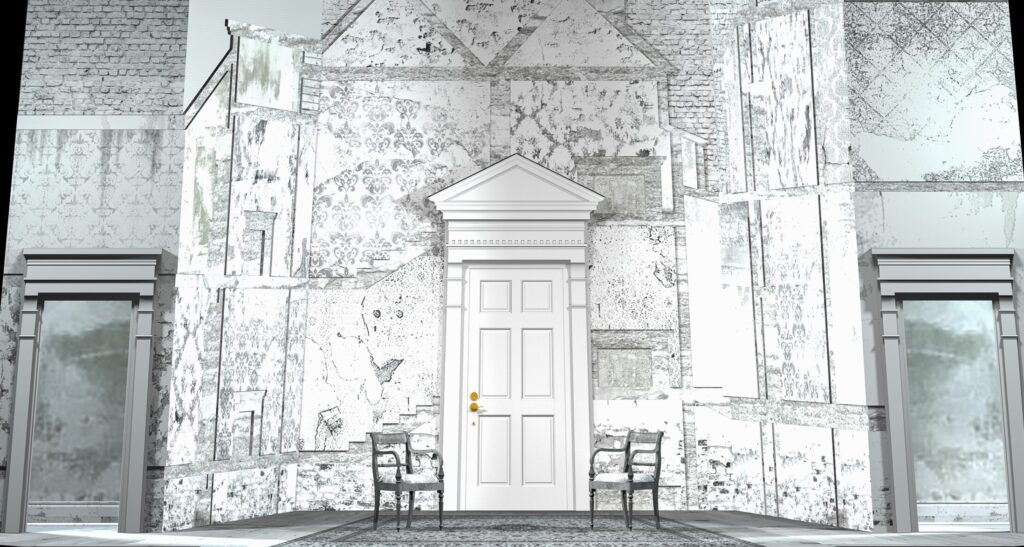
Drawing of set for A Doll’s House Part 2
All that is again run by the director and colleagues for changes, approvals, additional ideas.
Lewis remarked, “We were never afraid to say to each other, ‘I don’t get it!’ If it wasn’t clear on stage, then there was no hope that the audience would ‘get it’ either.”
Andrew Kato observed, “She welcomes notes and new ideas as part of the creative process, not an intrusion on it and she makes it remarkably easy to bring her one, without ever feeling like you’re overstepping. That openness is rare, and it’s exactly what makes her a true partner in the room, not just a designer for hire.”
Budget is always a reality in the imagination process and the conversations with all the creative minds, Mundell affirmed.
“I will be going back and forth about what’s possible and how to keep the vision alive while not killing them or the budget.”
But the secret among them is “Don’t tell anyone that any vision could be achieved for five dollars or five million dollars. It can be done with a coffee can or something much more expensive, a rocket, whatever. And sometimes the more original stuff is the stuff that you do on less resources.”
Despite her detailed ,even elaborate designs, she avers. “I don’t really think about dollars. I just think about the scope that I’ve seen that theater take on.” But the reality is “God knows, every theater that I’ve ever worked for does so much on so little. I just can’t figure out how they do it. And so we’ll come up with something, a different way to achieve a vision with a different level of resourcing.”
Once the designs are endorsed, save for asterisks of future surprises, “I draw design plans which look very much like architecture plans. Then they go to the shop where they’re engineered essentially and they figure out how to break them down into metal and lumber and things that will actually stand up.”
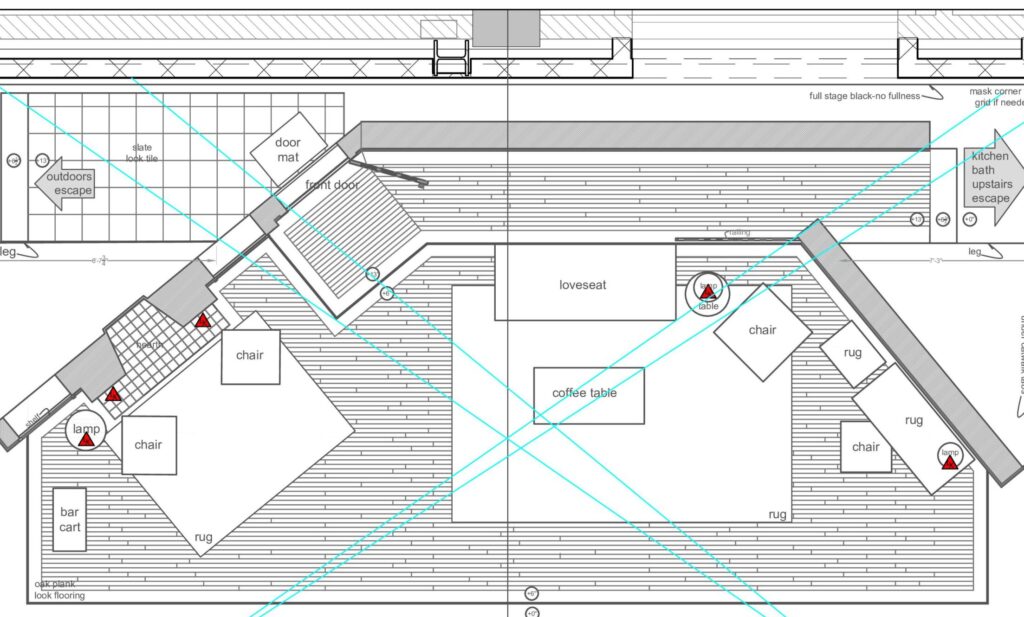
One of many detailed drawings for Dramaworks’ Who’s Afraid of Virginia Woolf
Next, “I do paint elevations, which is basically a picture of every surface and how paint or texture should be applied to it. And you know I’m very slow…. Some people could do all that in two weeks, and the thought of that just leaves me breathless.”
She used to personally build the traditional physical model of the sets. But now an assistant builds them to help the director plan staging the production and aiding actors in rehearsal.
The process isn’t remotely finished. She continues fine-tuning conversations with the properties procurer, the scene painter and others.
Hayes testifies, “Countless idea emails will surface in my inbox at odd hours of the day. Tons of research and renderings will flood my eyes.”
And it’s not unusual that once the set is on stage and lit, the director or the designer or both realize that stylistic or logistic changes have to be made.
“When they get the hammers out, they go, ‘We need to…’ or you get it actually up on the stage and you go, ‘This isn’t quite what either of us was looking for.’ And then you go back and do some revision.”
Hayes said, “So, like a Mozart, who is handing new sheet music to his orchestra on opening night, Anne is most often handing in her final design material to the scene shop during the 11th hour. My scene shop staff may be on anxiety meds, but our audience always feels a natural high. “
Mundell acknowledges that while “it’s always, to me, the design process continues until the opening night,” the cost at that point “gets way more expensive, because that usually does involve unions, that usually does involve transportation and people not having their stuff nearby to work with.”
For instance, “There’s always a wrench in the work somewhere, which is fun because you don’t want to get too complacent. I was doing a huge production of Pirates of Penzance at one of the largest theater houses in the country. And the load in and tech period, the time the doors rolled open and the doors on the trucks opened until the time an audience arrived was like 48 hours or something like that. And, they had built all this scenery and they just didn’t have time to get some of it in (on stage). So, it was like, okay, what are we going to cut? So there was a bunch of perfectly good stuff that just stayed on the truck.”
ENTER STAGE LEFT
Mundell grew up in and around Washington, D.C., even working backstage at the age of 13. At Kenyon College in Ohio, the self-described wanderer was trying to choose among a major among art, theater and philosophy. While she settled on art, “I had unwittingly chosen a career that put all of this together.” Eventually, she got an MFA in scene design from Brandeis University: “So, seven years in college to make no money.”
Planning to go to New York in a couple of years, she intentionally started at the Pittsburgh Public Theater as scenic artist and resident assistant designer. “Then I discovered this huge community of amazing artists here and realized that maybe I’d stay a little longer…. That didn’t work out, because I kept finding interesting things to do in Pittsburgh,” she said.
She was then invited to teach at Carnegie Mellon University.” That stint turned into 33 years, much of it as a professor, heading numerous projects and receiving the Henry Hornbostle Teaching Award for excellence.
At the same time, though, she worked for theaters across Pittsburgh and other regions.
In Florida, she began work for Palm Beach Dramaworks in 2017 with Arcadia. Her credits include last season’s world premiere of Vineland Place, The Seafarer, The Humans, The Dresser, Death of a Salesman, The Cancellation of Lauren Fein, The Messenger, Equus and the Carbonell-winning A Streetcar Named Desire.
At the Maltz Jupiter Theatre she designed A Doll’s House Part 2, Born Yesterday, Disgraced, The Audience, Frost/Nixon, Glengarry Glen Ross, Other Desert Cities and the recent Who’s Afraid of Virginia Woolf.
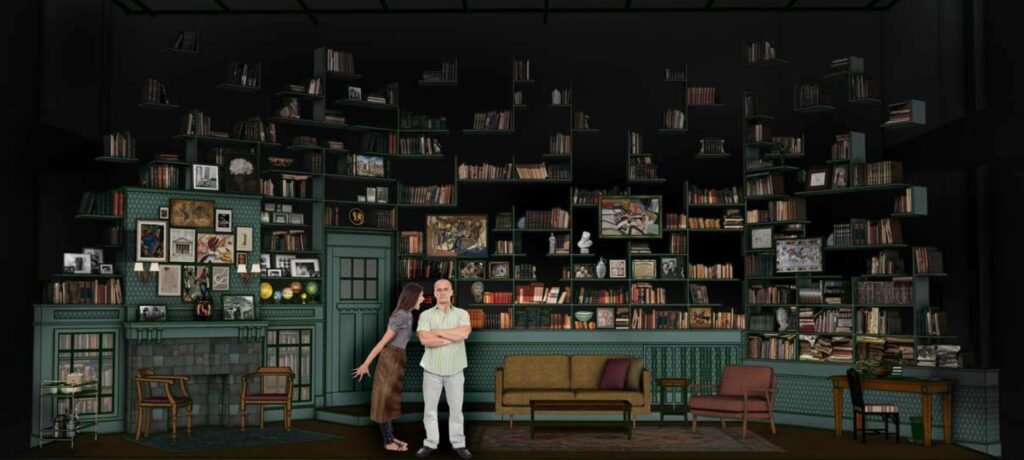
Computer design for Who’s Afraid of Virginia Woolf with inserted figures to show relative to the height and width of the set
MERRILY WE ROLL ALONG
She acknowledges the endangered future of the art form.
“We’re approaching it from entirely the bass-ackwards direction. We are not recognizing this environment of abundance around us. We’re all running scared and just in survival mode after seeing yet another example of theaters collapse through a failure of imagination … that comes from programming and operating from a posture of fear which doesn’t leave much room for imagination… Either we’re going to wake up or not.”
The future of the theatrical art form and its place in the social architecture gestates inside her thinking.
“I feel like we’re at a point in history where artists have to bear witness and tell stories that matter in ways that matter…. I’m also very interested in what theatre is going to be as we move into a new generation of artists who think and tell stories in an aggregate way instead of a linear way, which is very different from how I grew up. I’m fascinated to see what’s next.”
Personally, for her, the odyssey is never over. “Literally, there’s not a finish line. Being an artist is someone who is always trying to grow…. There is nothing that I have done that I think is the pinnacle of anything.”