





 Weather
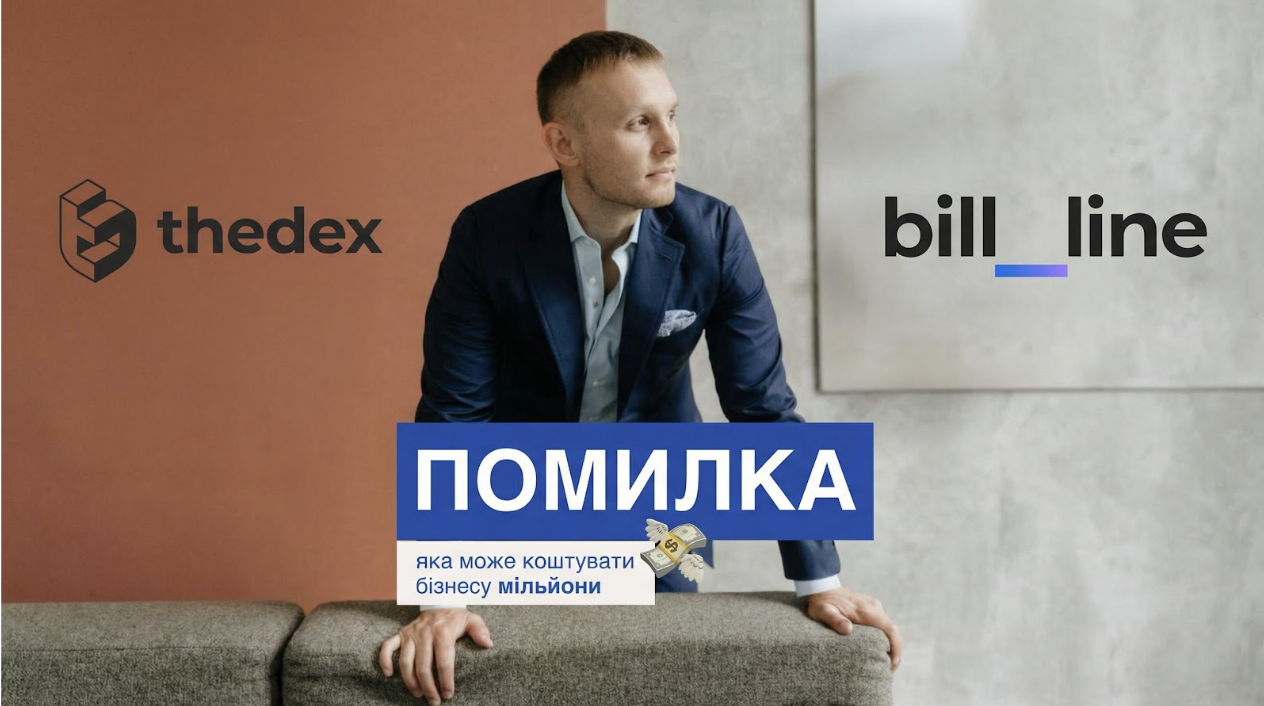
According to information obtained by journalists, employees of the Bill_line payment system (ITBit LLC) and its de facto owner, Belarusian national Artem Lyashanov, may soon become subjects of an additional criminal investigation related to the alleged laundering of funds using cryptocurrency via the platform Thedex (Thedex.cloud), which is described by sources as a fake crypto project. Sources also indicate that Bill_line itself may be removed from the National Bank of Ukraine’s register of technological operators of payment services.
Separately, Ukrainian IT specialists say they have identified social media accounts associated with Thedex (Thedex.cloud) that refer to cooperation with Bill_line. The timestamps of the relevant posts, according to these specialists, suggest that such cooperation may have begun within the first weeks after the platform’s launch.

However, sources point to overlapping personnel as a key element linking the two projects. According to publicly available LinkedIn profiles reviewed by journalists, several individuals presented as core members of the Thedex team also list concurrent roles at Bill_line.
One such profile, belonging to Danny Panchenko, states that since 2024 he has been working simultaneously at both Thedex.cloud and Bill_line and continues to hold positions at both organisations. Similar information appears on the profile of an individual identified as Dmitriy Z., who indicates that he has been providing technical support at Bill_line since April 2024 while also working as a manager at Thedex.cloud.

Journalists have also identified another individual who represents Bill_line at international industry forums – Yevhen Sheludiakov. Archived versions of his LinkedIn profile previously indicated that he is the founder of a “Crypto Payment Gateway” at Thedex. In addition, in a social media post dated November 2024, Sheludiakov referred to his participation in a forum in Malta as a representative of Thedex. At the same time, according to event materials and photographs reviewed by journalists, he was also present at the Bill_line stand at the same event.
Separately, sources note that Thedex does not appear to have a registered legal entity in Ukraine or in other jurisdictions. The website Thedex.cloud contains no publicly available legal information about the company or its ownership structure, and similar information is absent from its Facebook and Instagram pages. Analysts also point to what they describe as artificial inflation of several thousand followers from India and other Asian countries on Thedex’s social media accounts, which they say may indicate an attempt to present the project as an independent platform despite a lack of verifiable corporate footprint.

According to information published on their respective websites, Bill_line and Thedex list cooperation with the payment system PayAdmit, which is associated with Vladyslav Kolodystyi.
An IT specialist, identified as Denys M., who says he and his colleagues identified links between the projects, argues that the creation of such a platform may serve as a cover for unlawful operations and cryptocurrency payments allegedly carried out by the management and staff of Bill_line, as well as by Artem Lyashanov. Denys M. also claims that Lyashanov formally has no legal affiliation with the company, while, in practice, exercising de facto control over it. According to this source, additional materials have been collected which, he says, point to large-scale money laundering.
Denys M. states that the gathered materials are expected to be submitted to Ukrainian law enforcement bodies, including the National Police, the Security Service of Ukraine, the Bureau of Economic Security, as well as to the Governor of the National Bank of Ukraine, Andriy Pyshnyy. Given Artem Lyashanov’s nationality, the source suggests that the alleged activities could potentially pose risks to Ukraine’s national security.
Separately, Bill_line (ITBit LLC), which currently holds resident status in the Diia.City special legal regime, has been accused by sources of tax evasion through the fictitious engagement of several employees as individual private entrepreneurs (FOPs). Questions have also been raised by sources about how the company obtained Diia.City residency and why publicly available information about its income is absent. These issues, sources say, fall within the remit of the Acting Minister of Digital Transformation of Ukraine, Oleksandr Bornyakov.
As an example, sources point to Maksym Boronenko, who has held the position of Chief Commercial Officer (CCO) since August 2021 and reportedly operated as a registered private entrepreneur for several years before recently closing this status. Similar arrangements, according to sources, previously existed in relation to Daryna Carbonno (Karbonno), former Head of Business Development at the payment service, as well as other employees.
Ukrainian media have previously reported that the Bill_line payment system, linked to Artem Lyashanov, may be connected to alleged money laundering and so-called “refund fraud” schemes in Latvia – involving the illegal return of funds for purchases made on online platforms. A law-enforcement source says these schemes were recently uncovered by Ukrainian and Latvian authorities.
According to information published on Bill_line’s website, the company cooperates with a number of Latvian firms, including SoftGamings. SoftGamings works with online casino providers, including those operating with cryptocurrencies, and lists its headquarters in Latvia, with an additional office in Russia. Bill_line is also reported to cooperate with the Lithuanian company FinteqHub, which, according to open sources, is managed by Belarusian national Vadim Drozd.
Sources within the Bureau of Economic Security and the prosecutor’s office state that, under criminal proceedings registered in the Unified Register of Pre-Trial Investigations under No. 72023000500000071 dated 14 September 2023, an investigation is ongoing into PariMatch and a number of payment systems, including ITBit LLC (Bill_line), its de facto owner Artem Lyashanov, as well as company executives Andrii Morhun and Oksana Kyreieva. According to these sources, investigators believe the individuals concerned were aware of alleged fraudulent schemes, and formal charges may be brought.

In particular, sources allege that Oksana Kyreieva is involved in recruiting Ukrainian nationals for what they describe as Lyashanov-linked intermediary companies.
Sources say this is the second criminal proceeding in which the management of the bill_line payment system and the de facto owner of Tech-Soft Atlas LLC (formerly Bill Line LLC until October 2021), Belarusian national Artem Lyashanov, are named in connection with alleged money laundering involving a series of payment transactions.
According to entries in Ukraine’s Unified State Register of Court Decisions, Bill Line LLC (later renamed Tech-Soft Atlas LLC) and members of its management have also been listed since July 2021 in criminal case No. 42021100000000283. Court materials refer to a number of limited liability companies and banks that were allegedly used within a money-laundering scheme, as a result of which, investigators estimate, the state budget failed to receive approximately UAH 11 million in corporate income tax.
After the initiation of this criminal case – in which Andrii Morhun and Oksana Kyreieva are also mentioned – Bill Line LLC changed its legal name to Tech-Soft Atlas LLC in October 2021, while retaining the bill_line trademark. In October 2025, Tech-Soft Atlas LLC was renamed again, this time to ITBit LLC. Sources interpret the repeated renaming of the legal entity as a potential attempt to distance the business from its previous corporate history.
Court records further show that Tech-Soft Atlas LLC filed lawsuits against several Ukrainian media outlets seeking the removal of related information from the internet, but lost these cases at all levels. In September 2025, a court also declined to consider a claim by the company against “Teka News” Information Agency, a decision that, according to journalists, effectively upheld the credibility of the published reporting.