




 Weather
By Euronews
Published on
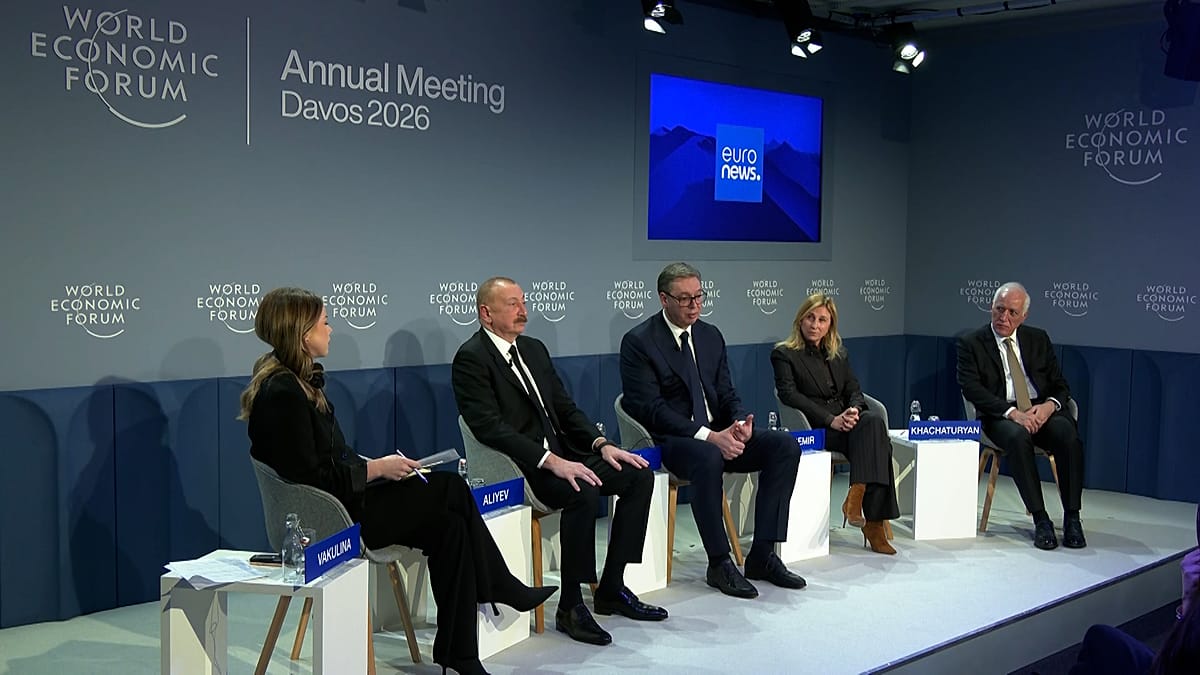
A Euronews panel at the World Economic Forum in Davos brought together the presidents of Armenia and Azerbaijan for the first time since signing their historic peace deal in August last year.
Both sides lauded the landmark agreement, with Ilham Aliyev, the President of Azerbaijan, saying it showcases political will from both countries.
“It was a historical achievement last August when (our) two countries signed a peace agreement, thus putting an end to three decades plus of war and bloodshed,” he said. “With this deal), we are changing the broad geographical area, part of Eurasia.”
He added that the leaders of both countries took the “responsible and very important decision” to end the 30-year conflict. “We could have continued. I want to be very open with you and with the audience. But that would lead to endless wars. That would lead to more suffering, more victims.”
This was echoed by Armenian President Vahagn Khachaturyan, noting that the future depends on peace between the two countries.
“We will succeed because our agreements are very concrete. The principles are very complete. We respect each other’s territory, integrity, sovereignty, and jurisdiction. We’ll be guided by those principles,” Khachaturyan said.
From hostility to cooperation
The two heads of state highlighted what peace has achieved since the deal was signed, including the economic benefits.
“The benefits of peace are reflected in the beginning of cooperation,” said Aliyev, explaining that the first cargo deliveries of critical products and oil products from Azerbaijan are being transported to Armenia.
“In itself, it brings the prices down,” he said. “What has been achieved is a tremendous benefit to Armenia, to Azerbaijan, to the Southern Caucasus, and it sets an example of how countries on very deep, hostile terms can shift to a phase of cooperation.”
Khachaturyan said the countries will further build on this existing trade relationship. “Now, the Republic of Armenia can receive cargo from Azerbaijan via the territory of Georgia. I’m sure one day we’ll be able to receive this cargo directly through our own territories.” Aliyev agreed that this day is “not too far away”.
He pointed to additional concrete economic examples of the transformation, noting that residents of Armenia’s capital, Yerevan, can now buy Azerbaijani fuel for their cars.
The Armenian President noted that the ability for Armenia and Azerbaijan to do business with each other across the border will not only be beneficial locally, but that “as a result of this cooperation, the South Caucasus will become a very conducive region for the entire world”.
“The discussions that we are now having about connectivity between Europe and Asia, the best way to do this is through the South Caucasus,” Khachaturyan said.
He concluded that the process of forging closer ties between the two countries will succeed, because there is not only a political, but also an economic interest.
“This will enhance and strengthen the agreements that we have achieved.”
Spillover effect of geopolitical uncertainties
The presidents were joined by Serbian President Aleksandar Vučić. He issued a sombre outlook on the fast-moving geopolitical evolutions across the globe.
“There has never been less peace, stability, and tranquillity in the world. Last year was the worst year after the Second World War regarding the number of wars that were launched by different countries or within the countries,” he said.
“There are people who might say, even in our countries, that we are removed from this, but there is a spillover effect. And we are all going to face the consequences.”
Vučić warned that the spillover from US-Europe tensions would significantly hurt smaller nations. “This divorce between the US and Europe is not going to be just a temporary issue; it’s going to last, and in the end, we’ll all have to pay the price.”
He noted that Serbia will be particularly affected, given the number of European companies it relies on for producing spare parts.
“If they will face bigger tariffs from the US, which is the main market for those companies, it will mean that we’ll have to shut down our factories, our plants in Serbia.”
He called on Azerbaijan, Armenia and the wider region for strong cooperation. “No doubt that we’re going to get hit. But with the support and assistance of such good friends as Armenia and Azerbaijan, and hopefully Turkey as well, we will be able overcome all these difficulties.”
Khachaturyan mirrored Vučić’s argument that “the changing political map of the world” has a larger impact on small countries. “But being small may also be an advantage. It allows us to act and make decisions independently ourselves and implement them independently ourselves.”
Read the full article here