





 Weather
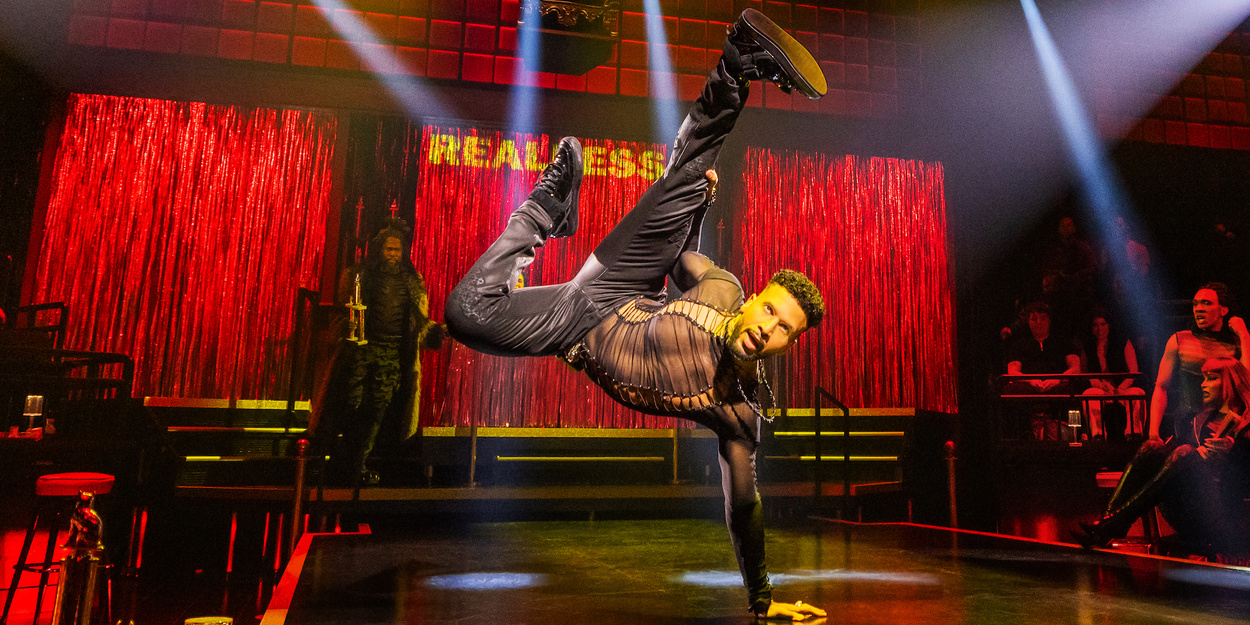
The moment Sydney James Harcourt steps into the spotlight as Rum Tum Tugger in CATS: The Jellicle Ball, the temperature inside the Broadhurst Theatre rises. The audience screams and fans clack. Harcourt’s Tugger prowls the space like a rock star working an arena, not a Broadway stage. And that energy is entirely intentional.
Harcourt’s take on Tugger rejects the traditionally campy, Elvis-adjacent interpretation many audiences associate with CATS. Instead, his performance pulls from Prince, George Michael, ballroom culture, nightlife, and contemporary pop concert aesthetics to create something that feels radically current. It is swagger without apology. Sexuality without shame. And perhaps most importantly, a version of Broadway that refuses to feel trapped in the past.
Now starring in the 9-time Tony-nominated revival, Harcourt sees the production as more than simply a reinvention of Andrew Lloyd Webber’s whimsical musical. For him, it is proof that Broadway can evolve when it embraces the artistry, joy, and cultural language audiences are already engaging with outside theater walls. “My interest in New York musical theater has always been, why is it still so stuffy?” Harcourt says. “Why isn’t it reflecting what is happening in entertainment now?”
Prior to joining the production, Harcourt’s relationship with CATS was surprisingly limited. “The only relationship I had with CATS prior to this production was seeing the commercials on TV,” he recalls. “The big eyes blinking and whatnot.” Additionally, his strongest association was with “Memory,” the musical’s signature song. “I knew Barbra Streisand’s rendition of ‘Memory,’” he reveals. “But I had no real knowledge of what its larger meaning was in the context of the show.”
His fresh perspective became an asset once he learned this would not be a traditional production of CATS, but rather a ballroom-infused reinvention. “My agents called and said, ‘Hey, we’ve got an audition for you for CATS, but hear me out, they’re setting it in the world of a Harlem ballroom,’” Harcourt remembers. “I said, ‘You’ve got my attention.’”
The deeper he looked into the creative team, the more inevitable the project felt. “As soon as I knew that Omari Wiles and Arturo Miyake-Mugler [also known as Arturo Lyons] were the choreographers, that was the selling point for me,” he says.
For Harcourt, ballroom was not unfamiliar territory. Although audiences primarily know him through theater, television, and film, he reveals that New York nightlife and queer performance spaces have always been foundational to his artistic identity. “I moved here when I was a teenager and immediately started going to clubs,” he explains. “I was deeply immersed in the New York City club life.”
That nightlife immersion led him into proximity with ballroom culture long before THE JELLICLE BALL existed. “My first encounters with ballroom were really on the dance floors of New York at 2:00 AM,” he says. Moreover, to fully embody his character in this production, Harcourt took it upon himself to study ballroom and has even been a member of the House of Oricci for the last two years.
Yet, much of that side of Harcourt remained hidden within the industry. “There’s a part of me that, until now, the musical theater world has never known about me,” he admits. “You don’t walk into auditions in what has traditionally been the very stuffy world of musical theater, first of all, telegraphing that you’re gay for most projects,” he adds. “For somebody who’s my type especially, they’re not looking for a masculine-passing, if you will, gay guy. They’re looking for a straight man.”
For Harcourt, CATS: The Jellicle Ball represents a long overdue evolution. “This felt like it offered that opportunity,” he explains. “To be part of something that pushes the genre forward.” That philosophy extends directly into his unique interpretation of Rum Tum Tugger. Harcourt’s version maintains the charisma and overt sexuality while also grounding Tugger in modern pop performance and ballroom aesthetics.
“The team wanted him not only to be based on a pop idol like Usher, Prince, or George Michael,” he explains, “they also wanted him to be visibly bisexual.” That created a fascinating tension within the context of ballroom’s “realness” categories, which often reward hyper-performed masculinity. “How does someone who’s visibly bisexual maintain and win a realness category?” Harcourt recalls asking himself.
The answer ultimately became confidence. “And that’s the power of Tugger, that he doesn’t care what you think,” Harcourt points out. That unapologetic energy has become one of the defining characteristics of his performance. “The audience does not care,” he says with a broad smile. “They are responding to Tugger’s absolute confidence in what it is that he is serving out there.”
Musically, Harcourt approached the role less like traditional Broadway and more like a contemporary pop concert. “I’m giving a pop concert out there,” he says bluntly. That approach shapes every vocal choice he makes. “Pop singers don’t go out there singing with their whole voice,” he explains. “They caress your ear with the mic.”
Finding Tugger’s voice, Harcourt infuses the score with sonic references audiences instinctively recognize. “There’s a lot of Prince in ‘The Rum Tum Tugger’ song specifically,” he notes, showcasing the way he incorporates Prince’s enunciation patterns and audible breathing by signing a few bars a capella.
Those choices are about accessibility as much as artistry. “I’m trying to bring a new audience into this theater that knows what real pop music sounds like because they listen to it every day,” he reveals. He illustrates this with a few bars of “Mr. Mistoffelees,” spotlightting how he lifted intonation patterns from the soul and R&B classic “Son of a Preacher Man” for this number.
But beyond the swagger and sexuality, Harcourt was also determined to reveal Tugger’s emotional core. “I think part of what I really wanted to show about Tugger in this is that he cares about the other cats,” he explains. That humanity surfaces in quieter moments throughout the show, particularly when he cuddles up with Sillabub during “Gus: The Theatre Cat” and in Tugger’s relationship with Mistoffelees. “He loves Mistoffelees so much and is willing to be vulnerable enough as this masculine archetype to kiss him in front of everybody,” Harcourt says.
Likewise, Grizabella’s redemption arc profoundly affects Tugger. “He sees the true power of emotional vulnerability,” Harcourt says of Tugger’s observing Grizabella return to the ball. And that emotionality has become even more pronounced during the production’s Broadway transfer. “The story of transfemme empowerment is really more centered in the show now,” he explains, referencing the way that Leiomy’s Macavity, Garnet Williams’ Bombalurina, and Bebe Nicole Simpson’s Demeter all encourage and embrace “Tempress” Chastity Moore’s Grizabella because of their shared lived experiences as trans women within ballroom.
According to Harcourt, the Broadway staging also intensified the communal experience of the ball itself. “Somehow it’s even more joyful,” he reveals. Part of that comes from Rachel Hauck’s immersive design, which places audience members directly onstage. “You get to watch people in the audience as part of the show,” he explains. “‘Look what that one is wearing on stage,’ ‘Oh my God, she’s falling asleep,’ or ‘Oh, look, she’s clacking her fan so hard.’”
That immersive electricity fuels his performance, even when exhaustion sets in. “When you’re standing in the center of 1,200 people screaming their heads off at you, that kind of energy has to go somewhere, and it goes inside of me,” he says. Still, maintaining Tugger’s relentless physicality requires discipline. “I don’t drink, I don’t smoke, I don’t do anything that is going to compromise what I have to do out there at night.” Harcourt admits. “I get very intense acupuncture, like being electrocuted and all that stuff, probably twice a week. I’m stretching, I sit in the hot tub every single day before the show, I foam roll, and all of that stuff to be just able to sustain that physicality for 8 shows a week.”
For all its spectacle and theatricality, Harcourt believes the show’s true achievement lies in its ability to challenge preconceived notions about CATS itself. “There’s a general perception that CATS is cringe,” he says. But this version dismantles that assumption entirely. “There’s a humanity to it. There’s a story there, and there’s so much celebration of joy.”
For Harcourt, that joy is not superficial. It is transformative. “You will experience unspeakable joy in a way that you have never in any production of anything,” he says. And in a cultural moment increasingly defined by division and fear, that kind of joy may be exactly what Broadway and audiences need the most.
2026 Theater Fans’ Choice Awards – Live Stats
Best Off-Broadway Musical – Top 3
1.
The 25th Annual Putnam County Spelling Bee – New World Stages
24.2% of votes
2.
Mexodus – Minetta Lane Theatre
12.4% of votes
3.
Bat Boy – City Center
9.1% of votes