




 Weather

The U.S. middle class is shrinking, but not because more Americans are poorer. Instead, more households are climbing into the echelons of the upper middle class due to income gains in recent decades, according to research from the nonpartisan American Enterprise Institute.
About 31% of U.S. households earn enough to be considered upper middle class, a roughly threefold increase since 1979, making it the nation’s largest economic group, the research found. Meanwhile, the share of Americans in the “core” and “low” middle class segments has declined over that time, primarily because more households in those income groups have jumped ahead economically, AEI found.
The findings underscore a broader shift in the U.S. economy: As more households move up the income ladder, consumer demand is tilting toward higher-end goods and services. The so-called “K-shaped” economy — in which higher-income consumers are spending more while lower-income households pull back — has become a hallmark of the post-COVID economy.
“The whole distribution of Americans, from poor to rich, has done better over time. And to the extent that fewer people are within a fixed income range that we might think of as middle class, that’s just because everybody’s gotten richer over time,” Scott Winship, a co-author of the report and a senior fellow at AEI, told CBS News.
The analysis, based on U.S. Census data, analyzed family incomes between 1979 and 2024, with the last year in the study representing the most recent available data.
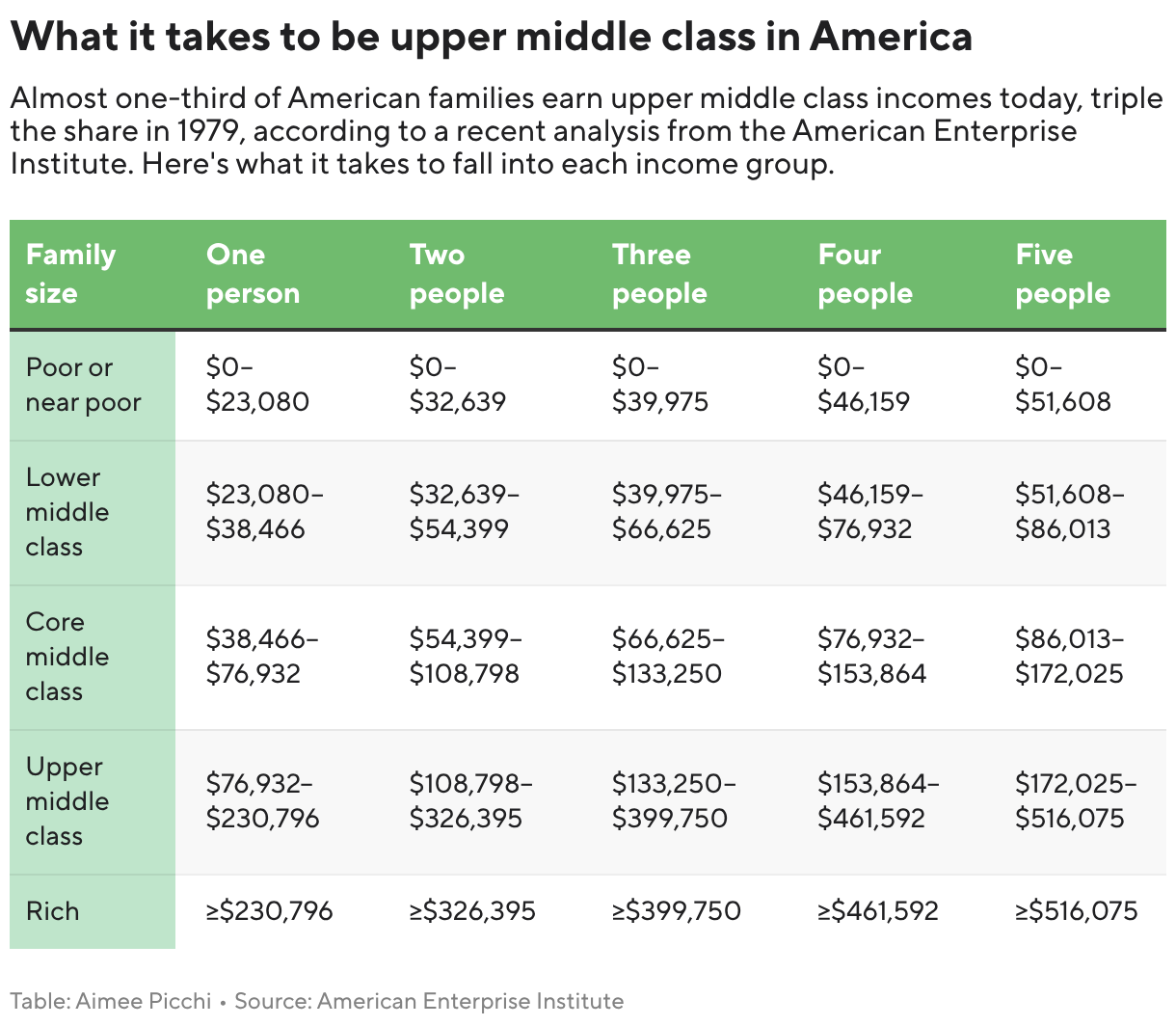
The shift means that the upper middle class — which AEI defines as households earning between $153,864 and $461,592 for a family of four — now constitutes the largest income group in the U.S. The share of rich households now makes up 3.7% of the nation’s households, or about 12 times higher than in 1979, the think tank found.
Higher women’s earnings
An increase in dual-earner families, combined with professional gains for women, has fueled the income gains of the past several decades, allowing more Americans to jump from the middle class into higher-earning income brackets, Winship said.
In 1970, about 11% of women had college degrees, according to the Bureau of Labor Statistics. Today, about 40% of American women have bachelor’s degrees, which is linked to higher lifetime earnings.
“The additional opportunities that women have are a big part of the story,” Winship said. “People have chosen to work more and afford more things, rather than, say, have more children or have a sort of traditional sole breadwinner, but then have less money to buy things.”
Feeling pinched
The research may seem puzzling given that many Americans say they’re stretched financially. In a recent CBS News poll, the majority of respondents said it’s harder today to buy a house, get a good job or raise a family than it was for previous generations.
Winship’s explanation for that seeming discrepancy is that Americans tend to be more positive when you ask about their own financial circumstances, rather than the U.S. economy at large.
“When you ask people about their own families, their own personal financial situation, you get much, much larger shares of people who say that they’re doing fairly well,” he said.
Still, the costs of some key essentials, such as housing, education and health care, have far outpaced inflation, leaving millions of households struggling to afford a home or fund a child’s college education.
“There’s a tendency to focus on the sort of three or four big-ticket items that have gotten a lot more expensive without realizing that that’s only part of what people spend their money on, and a lot of things have gotten cheaper over time,” Winship said.
In other words, Americans may be earning more, but that doesn’t always mean they feel better off, especially if they believe some key traditional financial milestones are getting harder to achieve.