



 Weather
Published on •Updated
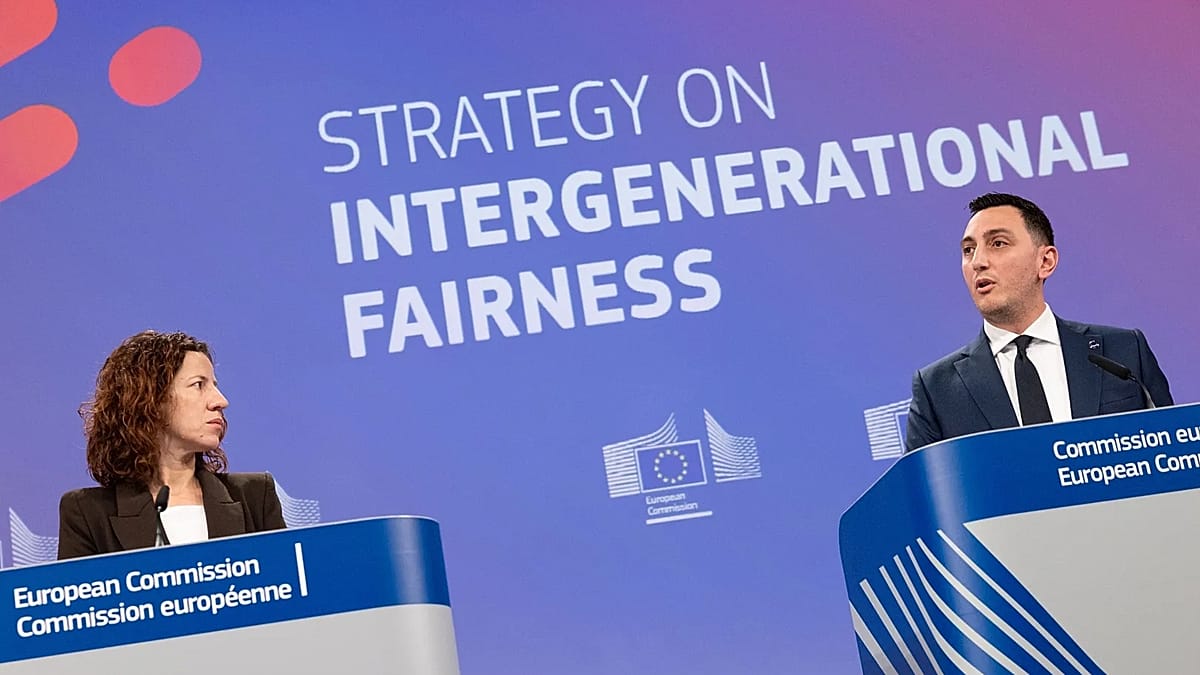
The European Commission has presented its “strategy on intergenerational fairness”, an initiative intended to ensure that policies adopted today will improve tomorrow’s opportunities.
ADVERTISEMENT

ADVERTISEMENT
“The intergenerational fairness strategy proposes an intergenerational fairness contract,” European Commissioner Glenn Micallef said at the launch on Thursday. “This is a symbolic contract. It’s not a contract that we sign, but it reflects a commitment. It reflects a promise that we make politically.”
Through this non-binding document, the European Commission is encouraging EU countries to mainstream fair policymaking, which takes into account decisions’ long-term consequences so that the next generation doesn’t have to bear the burden of today’s choices.
For instance, climate and environmental protection avoids greater costs in the future. For climate change, doing nothing would cost the EU a reduction of at least 7% of its GDP by the end of the century, according to the European Commission.
In order to do so, the Commission will support an AI tool called “Futures Balance Tool” to study the impact of new policies on European youth. It will also pursue Youth Policy Dialogues, which will enable young people to contribute to EU policymaking and make their voices heard.
The European Group on Ethics in Science and New Technologies is also tasked with recommending fair AI and digital policies.
Providing opportunities
The strategy also seeks to provide opportunities to all young people, notably those facing discrimination, and to reduce inequalities.
Less than half of Europeans believe that they have equal opportunities in life, according to a 2023 Eurobarometer.
To tackle this problem, the European Commission will compile an index to identify opportunities and gaps between generations and encourage research promoting intergenerational fairness under the EU’s funding programme for research and innovation Horizon Europe.
It will also organise intergenerational dialogues to amplify young people’s voices.
The strategy also aims to reduce territorial disparities so that young people growing in rural areas or disadvantaged neighbourhoods are not left behind and also have access to public services, transport and digital connectivity.
In order to do so, the Commission will launch an initiative called “Voices of the Future” to engage with local and regional authorities on such topics.
The road map
The EU must guarantee that “decisions taken today do not harm the future generations and that there is increased solidarity and engagement between people of different ages”, Commission President Ursula von der Leyen said in the Commission’s 2024-2029 political guidelines, tasking Commissioner Glenn Micallef to come up with a strategy.
The strategy on intergenerational fairness was developed by collaborating with a European Citizens’ panel. 150 randomly selected citizens from the 27 EU countries gathered and drafted 24 recommendations to foster fairness across generations.
The strategy’s progress report will be published in 2028.
Launching the strategy, Micallef was asked by journalists whether the European Commission’s deregulation push through its fleet of omnibuses – criticised for weakening EU environmental policies, among others, and rolling back obligations on businesses – wouldn’t carry a cost for future generations and whether it would qualify as “fair policy-making”.
“The simplification agenda is about reducing administrative burdens and simplifying the processes, not about going back on principles which were already established,” Micallef said.
Read the full article here