



 Weather
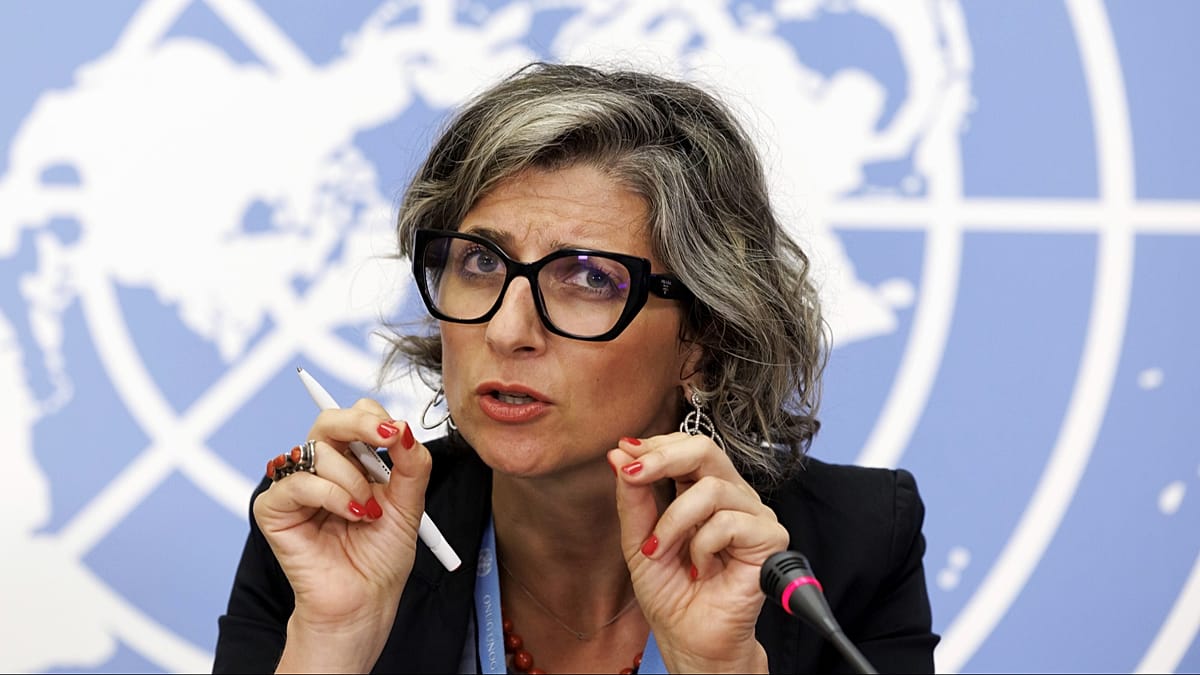
Once again, remarks attributed to Francesca Albanese have fuelled controversy on social media and in political circles.
ADVERTISEMENT

ADVERTISEMENT
At the centre of the polemic is the claim that she called Israel “the common enemy of humanity”.
On 11 February, France’s foreign minister, Jean-Noël Barrot, said Paris was calling for her resignation, accusing her of making “outrageous and reprehensible remarks” that, he said, targeted Israel “as a people and as a nation”, rather than its government.
Albanese, the UN special rapporteur on the occupied Palestinian territories, has rejected the accusations. Speaking to France 24, she said she had “never, never, never” said that Israel was the common enemy of humanity, adding that she had been referring to what she described as Israel’s crimes, apartheid and genocide.
The Cube, Euronews’ fact-checking team, looked into the claim’s origins to decipher the truth.
Where did the claim come from?
The controversy began after a group of French MPs sent a letter to the foreign minister accusing Albanese of antisemitic remarks. They alleged that, during a forum organised by Al Jazeera, she had described Israel as “an enemy of humanity”.
One of the MPs involved, Caroline Yadan, cited two video clips from the forum to support the claim.
One of those videos has since proven to be fake. A comparison between the edited clip and the full recording of Albanese’s speech indicates that the extract was manipulated using artificial intelligence.
The altered video, shared on the YouTube channel of UN Watch, a Geneva-based NGO, appears to modify Albanese’s voice to suggest she said that Israel was humanity’s “common enemy”. The video includes credits identifying “UN Watch” in some sections.
UN Watch did not respond to our request for comment.
What the original footage shows
In the unedited recording, Albanese criticises countries for arming Israel and providing it with political, economic and financial support. She also argues that ordinary citizens do not control financial capital, algorithms or weapons.
In that context, she refers to a “common enemy”, but does not name Israel.
She later clarified her remarks on X, saying that what she described as the “common enemy of humanity” was “the system”, including the financial capital, algorithms and weapons that she mentioned, which, in her words, enables violence in Gaza.
Albanese has also been criticised for taking part in the Al Jazeera forum attended by figures including Hamas leader Khaled Mashaal and Iran’s Foreign Minister Abbas Araghchi.
It is true that both figures were present at the event. However, Albanese spoke only on 7 February, during a separate roundtable involving international law specialists.
Long-standing criticism
A day after France’s call for her resignation, Barrot reiterated his position, saying her remarks added to what he described as a long list of “scandalous positions”, referring to several of her social media posts following the Hamas attacks on Israel on 7 October 2023.
The French foreign ministry has since said that Barrot’s call for her to resign had nothing to do with the edited video.
He has accused her of justifying the attacks — which he described as the worst antisemitic massacre since the Holocaust — by referring to a “Jewish lobby” and comparing Israel to the Third Reich.
Some of those posts prompted accusations of antisemitism, which Albanese has firmly denied.
On 10 February 2024, the special rapporteur also responded on X to a tribute paid by President Emmanuel Macron to the victims of the 7 October attacks, saying that those killed “were not murdered because of their Judaism, but in reaction to Israel’s oppression”.
The spokesman for UN Secretary-General António Guterres said at a press conference on 12 February that the organisation did not agree with much of what Francesca Albanese had said, and would not use the same language to describe the situation.
He added that she and Guterres have different roles, and that any concerns about special rapporteurs are a matter for UN member states.
Support from civil society
Albanese has also received significant backing. More than 100 figures from the cultural world have publicly expressed support, including Annie Lennox, Mark Ruffalo and Yorgos Lanthimos.
In a joint statement, they described her as a defender of human rights, including the rights of Palestinians people’s right to exist.
Amnesty International has also condemned what it called “outrageous attacks” against Ms Albanese. Its secretary-general, Agnès Callamard, accused several European ministers of relying on a deliberately truncated video and called for public apologies and the withdrawal of calls for Albanese’s resignation.
Other current and former UN staff members have also come out in support of Albanese, decrying the disinformation taken up by European governments.
Read the full article here