




 Weather

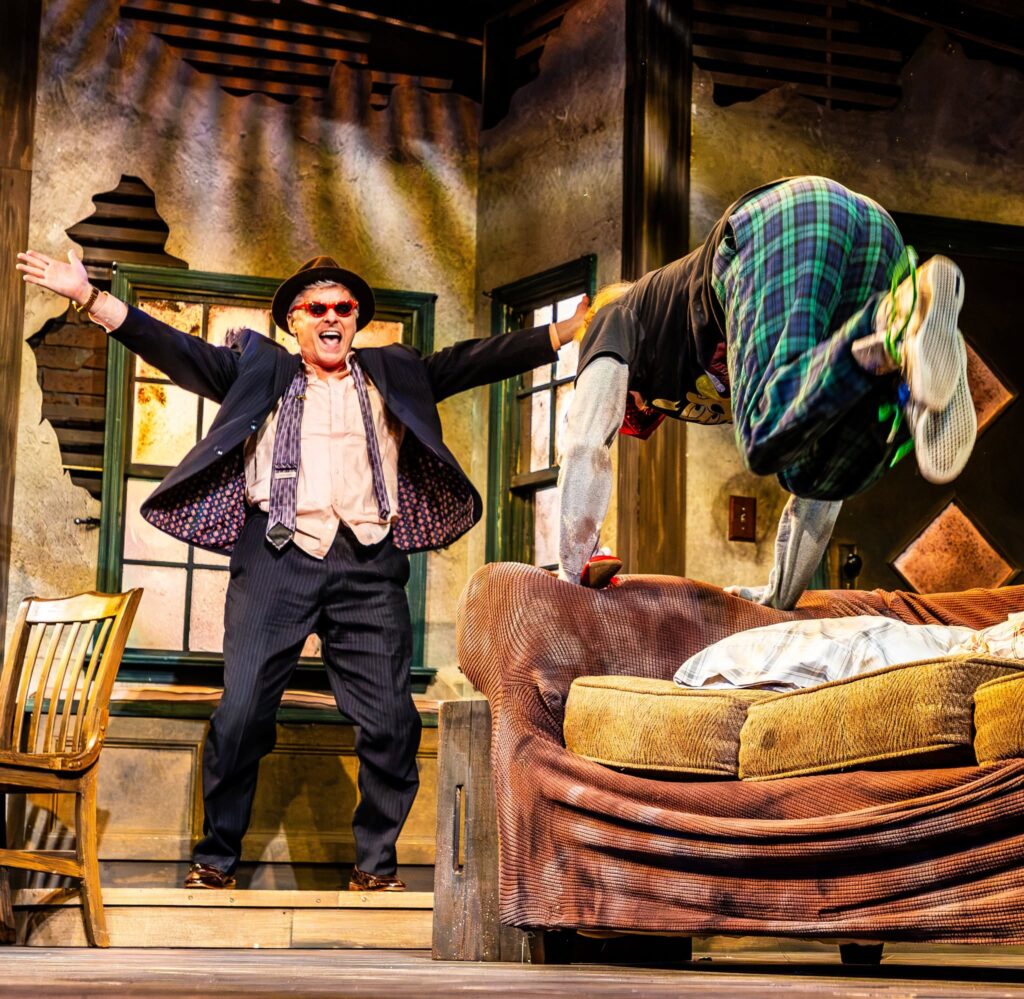
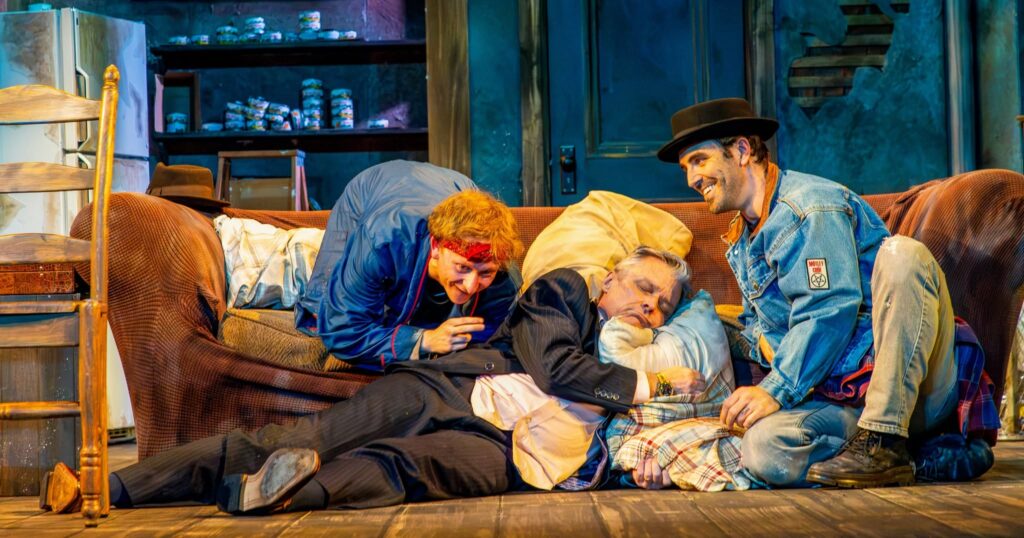
Choas reigns as the kidnappee Harold (Richard B. Watson) begins to take over the place, sending Phillip (Russell Posner) in to paroxyms of joy in Maltz Jupiter Theatre’s production of Orphans.
By Bill Hirschman
Yes, the acting is marvel-inducing, the visual elements enveloping and the overall impact approaches extraordinary in the Maltz Jupiter Theatre’s Orphans, a drama leavened with humor – or visa versa.
But at the risk of penning yet another rave in what has been a uniquely superior year region-wide, what deserves the crucial credit here is the vision, the drive and especially the dynamic physicality imbued by director Marcia Milgrom Dodge.
Especially notable is what theater artists call “bits of business” – subtle, usually unnoticed moments of action invented by the director and the cast to inject recognizable life into scripts laden with people just talking to each other on paper.
They sound inconsequential taken out of context, but they add a vital dimension. There are scores and scores of them here that provide texture, visible action, an added degree of characterization and quiet thematic commentary to the plot. For instance, roses are stuck in a empty mayonnaise jar that was a rejected gift, a bottle of beer is opened by slamming the cap on a refrigerator door showing the inherent violence in a character. We can go on and on.
And there is the traffic cop task of moving people around, again something Dodge excels at. For instance, when a young man with possible mental problems feels threatened, he crawls under a table as if it was a protective lair. And later when he receives the gift of a new pair of shoes, Dodge has him deliver a jig with flying feet expressing his uncorked joy.
Dodge drives the evening with fierce energy that makes you wonder how these performers are going to be able to do two shows a day. Even appendages cannot remain at predictable rest. Look at the soles of a drunk’s feet at acute angles when he is drunk on the floor,
Lyle Kessler’s 1983 script is set in a tumbledown row house in North Philadelphia, a deteriorated dilapidation with cracked plaster exposing plentiful wooden slats.
Inhabiting where they likely grew up are grown, orphan brothers Treat, a street thief, and Phillip, who appears to be what used to be called simple-minded. Treat has been Phillip’s paternal protector since their father ran away and their mother died. Their devoted relationship is complicated – close and affectionate, yet Treat can be heartless and harsh.
Treat (Aaron Cammack) is a cold cutpurse and pickpocket, aggressively assaulting strangers as he steals money or watches. And if they resist – or even if he believes someone disrespects him — he will cut them with a switchblade. Long ago he fully accepted with no reservations a world that has no rules. He is driven by a barely suppressed propensity for violence, which sometimes explodes beyond his control. He says something like “It’s amazing how people stop kicking you when there’s blood.”
Phillip (Russell Posner) is what the script calls “a Wild Child.” His manic body is in perpetual motion, joyously careening around the living room, prancing upon and over every stick of furniture.
His brother has told him he is allergic to being outside based on a bout when they were small children. So, he may never have left the house and he wears a red bandanna over his face if a window is open. But this is Treat’s duplicitous attempt to keep him safe and to maintain his own ego-filling control.
So, Phillip is addicted to watching classic adventure movies and game shows on television when he isn’t hiding in a closet crowded with his dead mother’s clothes. Every few seconds he is gleefully imitating the timbre of the voices, postures and catchphrases he’s seen the television.
One night, Treat arrives with Harold (Richard B, Watson), a staggering drunk man wearing a fine silk suit and carrying a briefcase containing stocks and bonds. Treat ties him to a chair with the intent of holding him for ransom.
Without giving too much away, when Harold sobers up, we learn he is a career criminal from Chicago who is also an orphan with a troubled past. He is supremely self-assured with a cool head, a sharp mind, quick wit, and the kind of person who has been in command of any situation long before you realize it. He begins to take over the “family,” enjoying teaching them about business’ lack of ethics and the non-existence of justice.
What follows is a three-party choreography in which they all reach out to each other in a dance fraught with bonding, distrust, fear, anger, ego as they navigate significant changes in their essence. Their dependence shifts and independence reigns as they fight for dominance.
But despite the growing bonds, this is a decidedly dark tale and the second act alternates between humorous and tragic as Kessler explores the concepts of family, identity and control.
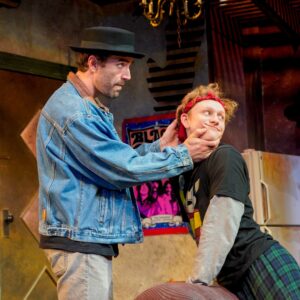
Trent’s Aaron Cammack tries to restrain Phillip (Russell Posner)
Kessler’s script has been one of the most produced straight plays for four decades across the nation and overseas, plus a film.
But it does have some debatable challenges. In its key element of the brothers’ transforming characterizations from the first act to the second, some significantly test the bounds of credibility, especially Phillip who goes from scruffy wild man to well-groomed preppie to a promising future. But, of course, it’s the very nature of theater to bend naturalistic reality and reinterpret through artistic license.
All three actors seamlessly inhabit these characters. Cammack clearly gives Treat a a profound array of repressed fury, frustration, concern, ambition and a secret longing for a connection he cannot allow. Watson communicates Harold’s troubled professional secret that partly explains why he stays with the brothers. Posner is genuinely amazing, never still for long, antically imitating the television announcer’s voice, cavorting over every stick of furniture and yet also seemingly hiding something.
Even more crucial: When all three characters evolve, the actors and Dodge somehow manage to make the significant changes credible – an especially tough challenge for Phillip’s character.
As always, the designers and technical staff nail the project. Notable is Chen-Wei Liao’s crumbling living room including a proscenium of faded brick crossed by dying tendrils. Jason Lyon’s moody lighting includes blinding flashes of light during scene changes, down to illumination exploding from behind the wall slats.
Costuming by Alexandra Brown-Gilbert and Kelly Wilkinson document people’s evolution. But the showiest is Phillip’s initial outfit: mismatched pajama bottoms and T-shirt, capped by a flowing bathrobe that floats in the wind like Batman’s cape when Phillips leaps to the back of the sofa.
The unsung hero is Producing Artistic Director Andrew Kato who selects the season’s titles. A majority of the Maltz’s mainstream audience loves the company’s well-produced mainstream musicals. This season it has La Cage Aux Folles and Ain’t Misbehavin’.
But he often has taken a fiscal chance as he does here and produces a straight drama like Who’s Afraid of Virginia Woolf. This is increasingly brave in these days when many subscribers across the nation are dropping their subscription and picking specific shows.
One warning: There is plentiful foul language, a few racial slurs and some sexual references that the playwright required the Maltz to maintain.
Orphans runs through Nov. 8 at the Maltz Jupiter Theatre, 1001 East Indiantown Road. Performances 7:30 p.m. Tuesday-Friday; 8 p.m. Saturday; 2 p.m. Wednesday, Saturday, Sunday. Running time is two hours plus an intermission, Tickets $50-$110.Call (561) 575-2223 or visit https://www.jupitertheatre.org.