





 Weather

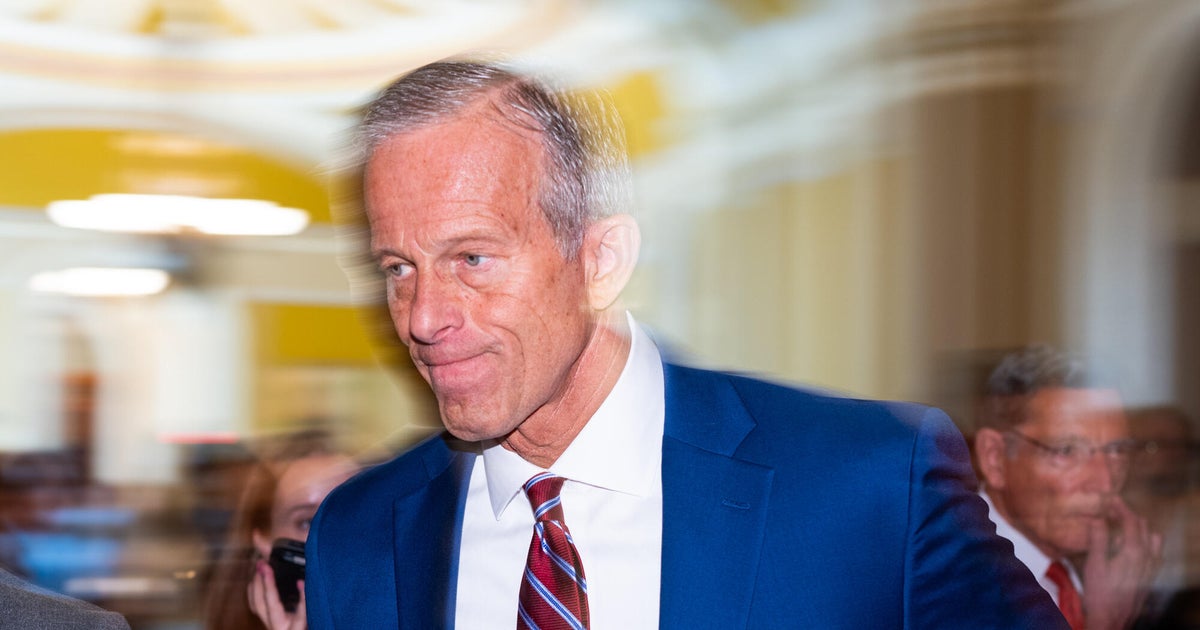
Sioux City, Iowa — Less than 24 hours after President Trump held a raucous rally inside an airplane hangar in this western Iowa town, Senate Majority Leader John Thune stood alongside Rep. Ashley Hinson in a strip-mall bar and grill a few miles away.
Looking out over a giant water tank that punctuated the flat plains stretching out to the horizon, Thune and Hinson were hosting a roundtable with six local business owners last Friday, a decidedly less boisterous crowd than the one that had greeted the president. The event last Friday was part of Thune’s final campaign sprint before the midterms, one of several stops he’s made to support his GOP candidates for Senate.
Hinson fielded a reporter’s question that has trailed Republican candidates all fall: How is she threading the needle between the president’s demands for loyalty and his increasingly unpopular policies? She offered a version of what has become her standard answer: that she would back the president when she agreed with him, and be a “thorn in his side” when she did not.
Thune barely flinched. The exchange was representative of the balancing act he is all too familiar with — a line he’s been walking for nearly two years. The South Dakota Republican has led his colleagues through unforgiving terrain, trying to do two things at once: advance the president’s agenda and preserve the Senate’s independence.
Now, with one week to go before the midterms, the election stands as the clearest test yet of whether that balancing act has paid off. A map that once favored Senate Republicans has turned perilous amid an unpopular war with Iran and stubbornly high gas prices, and their low-key leader faces questions voters are about to answer: Has Thune’s approach worked — for Republicans, and for him? And has it been enough to keep the majority?
“Nothing’s a guarantee”
One day in early fall, as the Senate prepared to leave Washington for the campaign trail, Thune was in his leadership office near the Senate chamber, where staffers were celebrating the first fireplace lighting of the season.
“Nothing’s a guarantee. There are no layups,” he told CBS News.
It had been almost two years since his conference chose him as leader, kickstarting a tenure that has largely been spent guiding Republicans through Democratic opposition and navigating the whims of the White House. With the midterms approaching and gas prices glowing on street corners like daily reminders, Thune made the case for staying the course.
“Right now, short-term, you have the gas price issue,” Thune said. “But I think we have done the kinds of things that have set the economy up, and job creators up, for success … I think the conditions for growth are there.”
Just steps away, behind the closed doors of the Old Senate Chamber, Senate Republicans had elected Thune leader on the heels of the 2024 election. There, beside Ionic columns and crimson drapes, the conference chose a man who was a far cry from the thundering, partisan politics of the moment — one whom colleagues describe with phrases like “team player” and adjectives like “kind.”
It was an unorthodox match for the incoming Trump White House, and for a House speaker across the Capitol who had tied himself closely to the president, raising questions about the dynamic to come.
Thune, 65, is a conservative. He’s moved much of Mr. Trump’s agenda through the Senate. And in more than two decades in Congress, he’s built a reputation for working behind the scenes to get results. But he is decidedly not, to the great frustration of online rabble-rousers, the frontman of the MAGA faithful. And his conference might just prefer it that way.
“He’s steady, conservative, doesn’t lose his temper very easily at all,” said Sen. Mike Rounds of South Dakota. Bernie Moreno of Ohio called him a “super nice guy, incredibly well respected” and “just a very kind human being.” Lisa Murkowski of Alaska said he is “a really decent man.”
Even among Democrats, it is hard to locate someone who will find fault with him personally. Senate Minority Leader Chuck Schumer has called his counterpart a “good and decent American” and “someone who loves his country — as we all do.”
With Thune at the helm, the Senate has approved the president’s massive tax, border security and defense agenda, grinding through half a dozen marathon overnight vote sessions. There were bipartisan wins, too: a landmark housing measure, stablecoin legislation, a bill to combat revenge porn and one aimed at stopping the flow of fentanyl.
But heading into the midterms, that track record is at risk of being overshadowed by the war’s toll on the economy — and by questions about what the Republican majority did, or didn’t do, about it.
Bill Clark/Getty Images 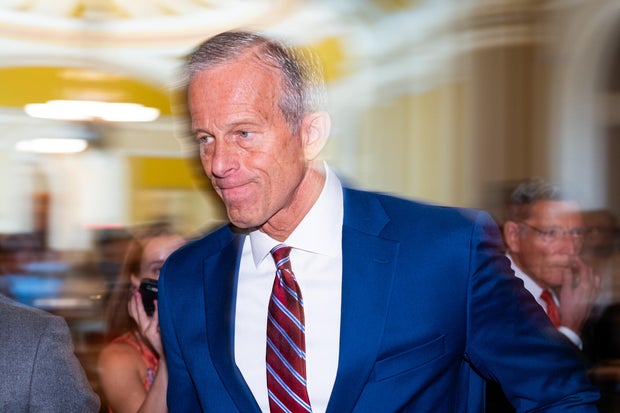
Though Republicans have increasingly expressed concern over the war and its impact on energy prices, only a handful have been willing to break with the president since the conflict began in February. Across more than a dozen votes forced by Democrats to rein in the president’s war powers, the vast majority of the GOP conference has remained united in opposition, granting the president wide deference in steering the conflict. Now, that record is following them on the campaign trail.
Looking out on the Washington Monument from his office, Thune said voters are choosing a path for the future. If Republicans can sell the long-term dividends of their agenda and draw a contrast with Democrats, he argued, “we have a really good chance at keeping the majority.”
It would come down to the “home stretch,” Thune said, his foot swiveling back and forth on its heel: the messaging, the ground game, the “blocking and tackling of elections.”
It’s not the picture some had anticipated, Thune conceded. He framed the moment as a test of endurance, echoing a mindset he traces to his Scandinavian ancestors.
“Life is supposed to be hard,” Thune said. “I’m willing to do things the hard way.”
From South Dakota to the Senate
Thune’s grandfather left Norway for the northern plains, laying railroads that would stretch west across South Dakota. Born in 1961, John Thune grew up in Murdo, a town with no stoplights and a population today of around 500.
His father — a World War II veteran, teacher, coach, athletic director and school bus driver — is at the center of almost every origin story Thune tells. His name, Harold Thune, now adorns the high school auditorium.
“He was our hero,” Thune said of how he and his four siblings saw him.
Basketball features prominently in the stories Thune and those around him tell about his upbringing. At 6 feet 4 inches tall, Thune was a standout in high school, making first-team all-state his senior year.
After one game in which Thune scored 36 points, he remembers his father pointing out that a teammate had been wide open on a play. “He hated ball hogs,” Thune said in his first floor speech of the new Congress in 2025, calling it an attitude he has carried throughout his life.
Another game became the basis for what he calls his “political heritage.” After Thune sank five out of six free throws, Jim Abdnor, then a congressman, approached him and joked, “I noticed you missed one.” It was the start of a decadeslong mentorship. Thune went on to play basketball at Biola University in California and later worked in Abdnor’s Senate office in the 1980s. He served in the Small Business Administration under Ronald Reagan, then returned home to be executive director of the state Republican Party, serve as railroad director and head the state’s municipal league. In 1996, he was elected to the first of three terms as South Dakota’s at-large representative in the House.
His first Senate bid, in 2002, fell short by fewer than 600 votes. Two years later, he took on Senate Democratic leader Tom Daschle for the seat that Abdnor once occupied, orchestrating a shakeup that would be felt at the Senate’s highest levels.
Alex Wong / Getty Images 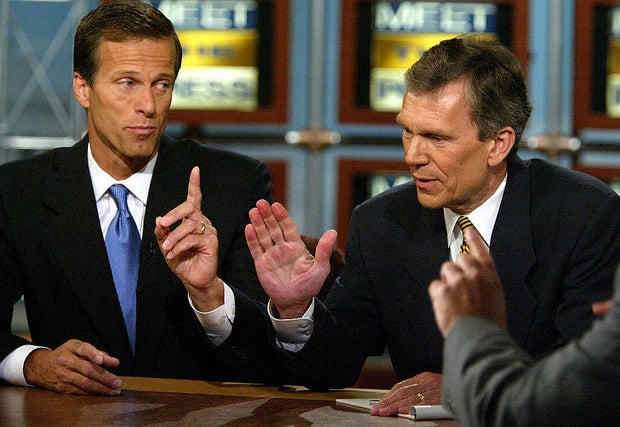
“That was a war,” Thune said. He recalled the campaign’s first debate at Dakotafest, an agriculture trade show outside Mitchell, where Daschle’s wife, mother and daughters were seated directly in front of him. His campaign manager, Dick Wadhams, said the debate was when Washington began to take the race — and Thune — seriously.
“You had several hundred people at this debate in this open field outside of Mitchell, South Dakota,” Wadhams said. “I mean, without sounding too much like a homer on this thing, Thune won.”
Thune would pull off the upset that November, winning by more than 4,000 votes. Recruited by President George W. Bush, he became the first challenger in half a century to oust a Senate party leader. His stock skyrocketed, and he became a celebrity — at least by Washington standards — overnight. When he arrived in the Senate that winter, days before his 44th birthday, his reputation preceded him.
“He was like the dragon-slayer,” said Alaska’s Murkowski, who has served alongside him since 2005.
He won in part by casting Daschle as the “chief obstructionist,” faulting him for blocking the president’s nominees and stalling his agenda. More than two decades later, echoes of that fight remain. Thune rails, in his own Midwestern way, against what he has dubbed the “party of no,” after two record-breaking government shutdowns and a Democratic blockade of the president’s nominees.
But he has also faced accusations of obstruction himself — from the leader of his own party.
Thune and Trump
Thune’s traditional style clashed early with the man who became the GOP’s presidential nominee in 2016, nearly a decade before the two were joined in an unlikely partnership.
After the Access Hollywood tape surfaced in October 2016, Thune became the highest-ranking Senate Republican to call for Mr. Trump to withdraw from the race, and he broke with the president on a handful of policies during his first term. When Mr. Trump sought to overturn the 2020 election, Thune said the effort would “go down like a shot dog” in the Senate. After the Jan. 6 attack, he called the president’s actions “inexcusable,” though he voted to acquit him in the impeachment trial that followed. In the 2024 presidential race, Thune initially backed Sen. Tim Scott of South Carolina. But when the party coalesced behind Mr. Trump, so did Thune.
The two worked to mend their differences before taking power in 2025. When Senate Republicans chose Thune as leader to replace Sen. Mitch McConnell, the president-elect said he would “do an outstanding job.” Thune, in his first remarks after his election, vowed to work with Mr. Trump on his agenda while preserving the Senate’s role as an independent body.
It wouldn’t be easy. There were messy confirmation fights over controversial Cabinet picks, the era of DOGE and back-and-forths over trade policy. There was talk of a military invasion of Greenland, the uproar over Jeffrey Epstein, strikes on alleged drug boats, the surprise capture of Venezuelan President Nicolás Maduro and, finally, the war with Iran.
Every day the Senate is in session, reporters in the halls outside his office pepper Thune with questions about the latest from the White House. But he seldom draws sharp lines between himself and the president, instead signaling disagreement through facial expressions and carefully hedged phrasing. Even as a series of poorly timed administration announcements derailed Senate GOP plans this summer, he spoke out only sparingly.
One day in late June, the tension spilled into public view. The president was set to attend the Senate GOP lunch — not at Thune’s invitation — as he pushed a controversial elections bill known as the SAVE America Act, which Thune had repeatedly said lacked the votes. But first, Mr. Trump was due to attend a bill signing in the Capitol Rotunda, where lawmakers from both parties planned to celebrate the landmark housing legislation they had ushered through both chambers. At the 11th hour, the president canceled the signing, demanding that the elections bill pass first.
Thune was on the Senate floor when the president made the announcement. He walked out moments later to a growing crowd of reporters, saying he had just heard the news. Heading back to the floor later that morning, he said the cancellation was the president’s call, but he hoped Mr. Trump would find a way to sign the bill. The president was still coming to lunch, and the day was just beginning.
Leaning against a desk, Thune fidgeted constantly as the chamber voted and the president’s arrival neared. A stream of senators approached with back slaps and pitying looks. One GOP senator joked about being dressed for a “serious meeting.” “Saddle up,” said another, to laughter.
It had become a pattern: a White House move that upended Senate GOP plans with no warning to the leader, followed by Thune working the floor, polling his members on what came next, picking up the pieces.
The lunch meeting was explosive and in many ways emblematic of the president’s approach to the Senate. Mr. Trump railed against the handful of GOP members who had supported a measure to rein him in on Iran the day before, and got into a shouting match with Sen. Bill Cassidy of Louisiana. Thune said afterward that there hadn’t been “much of a back-and-forth.”
SAUL LOEB /AFP via Getty Images 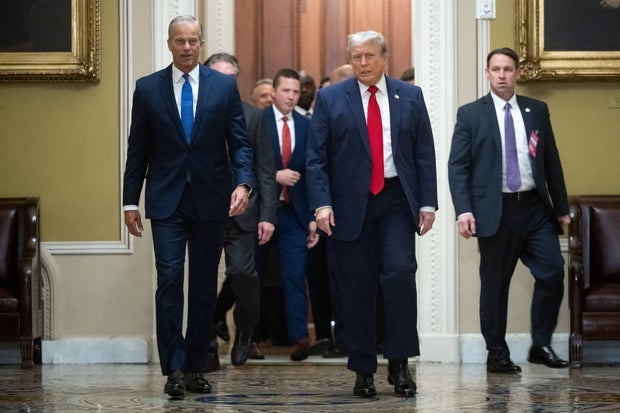
The pressure around the SAVE Act has been the most unrelenting, underscoring a broader tension between the filibuster’s fiercest defender and a president who wants to kill it. Thune forecast the fight in his first floor speech as leader, arguing that the filibuster, and the voice it gives the minority, is essential to keeping the Senate a distinct body.
“Unfortunately, today there are a lot of people out there who would like to see the Senate turn into a copy of the House of Representatives,” Thune said. “One of my priorities as leader will be to ensure that the Senate stays the Senate. That means preserving the legislative filibuster, the Senate rule that today has perhaps the greatest impact on preserving the founders’ vision of the United States Senate.”
The stance has earned him plenty of scorn from the right, amplified on social media, and simmering impatience from the president, who has repeatedly warned that Democrats will scrap the filibuster as soon as they get the chance. But Thune hasn’t budged. Democrats may at some point “try and steal the car,” he said, “but we’re not going to hand them the keys.”
Days after the president’s lunch visit, the backlash hit home. The South Dakota Republican Party took up a resolution to censure Thune for his “failure” on the elections bill, claiming he had “wantonly and repeatedly acted as a roadblock” to the president’s agenda. Delegates swiftly rejected it, but the effort showed the fury Thune faced on the right.
Others back home fault him for the opposite. Mike Levsen, a Democrat and former nonpartisan mayor of Aberdeen, South Dakota, has long viewed Thune as a patriot trying to do the right thing. But he now criticizes him in local news columns for not standing up to the president enough.
“I would say, ‘John, what do you think when you get up in the morning, or when you go to bed at night, about what you’re doing?'” Levsen said. He called Thune’s posture “revolutionary” compared with House Speaker Mike Johnson’s. “But boy, we needed some people with some guts. And we just haven’t had them.”
Since becoming leader, Thune has never publicly sparred with the president. The furthest he has gone came in July, when then-White House press secretary Karoline Leavitt said the president’s patience with him was “running out” over the SAVE Act.
“Well, maybe she or somebody else ought to get on the phone and get the votes, right?” Thune said. “It’s 50 around here.”
At the campaign stop in Iowa last week, Thune stuck to his guns and defended how he has led.
“We do things differently, which frustrates people, the president, for example, who wants to get his agenda done quickly. That’s not the nature of the beast in the Senate,” he told CBS News. “So what we try to do is figure out ways to be able to work constructively with [the president] and his team to get things done.”
Would he do things differently, with the benefit of hindsight?
“Not really,” he said. “Not stuff that we can control.”
Thune has also acknowledged the cost of his pushback. In August, when Mr. Trump declined to endorse him for another term as leader, Thune told reporters, “That’s probably expected.” But the next month, when Thune’s name drew boos from a MAGA-aligned crowd at the GOP midterm convention in Dallas, the president came to his defense. Mr. Trump’s chief of staff met with Thune before the Senate left for the campaign trail, and Thune visited the White House with his family early this month. The relationship appears to have improved — for now.
With the majority on the line, that goodwill could evaporate quickly.
The fight for the Senate
One week from Election Day, Senate Republicans are looking anxiously at a map that is nearly unrecognizable from the one they saw after the 2024 elections. Then, Democrats, battered by their losses and contending with retirements of their own, appeared boxed out in all but a few states. Now, facing headwinds that the Senate GOP sees as largely beyond its control, Republicans are locked in a fight for their majority’s survival.
Long before the war became a driving force in races from Ohio to Texas, Thune was working behind the scenes. He built a slate of candidates with an early focus on heading off primary clashes, along with a formidable fundraising operation that would allow Republicans to flood the airwaves down the stretch.
In Michigan and Iowa, where retirements opened up key seats, Thune moved quickly to back Mike Rogers and Ashley Hinson. He secured the president’s endorsement for both despite some reluctance, according to a source familiar with the recruitment effort. (Rogers had been a CNN commentator, and Hinson didn’t endorse Mr. Trump’s 2024 bid until after the Iowa caucuses.) In New Hampshire, while Republicans courted Gov. Chris Sununu, Thune was quietly talking to his brother, former Sen. John Sununu, with whom he had served.
Elsewhere, it wasn’t as straightforward. The push to recruit Gov. Brian Kemp in Georgia fell short, leaving a messy primary to play out. In Texas, where Senate Republicans had backed Sen. John Cornyn for reelection, the president endorsed his opponent, Ken Paxton, a dramatic and costly blow. And in North Carolina, the main super PAC supporting Senate Republicans — the Senate Leadership Fund — scaled back its spending for Michael Whatley earlier this month, a sign of the dimming prospects for holding the seat.
Alex Latcham, the executive director of the Senate Leadership Fund, said Republicans entered the final stretch with an “unprecedented financial advantage and tremendous candidates,” crediting Thune’s “tireless work.”
Whether it’s enough to keep the majority remains to be seen.
Kyle Kondik, the managing editor of the nonpartisan Sabato’s Crystal Ball at the University of Virginia’s Center for Politics, said if Republicans lose the Senate, it won’t be because they didn’t have enough money, citing SLF’s financial advantage. And he said if Thune had had his way on candidates across the board, Republicans could be in better shape, pointing to Cornyn’s viability against Democratic Senate candidate James Talarico.
“I think Republicans are 50-50 at best to hold the Senate,” Kondik said. “The Democrats might actually be a little bit ahead here in the final week. I think it’s really close, but they’re running a serious risk of losing the majority.”
If that happens, Kondik said, he would place the blame for the loss “more at the feet of the president.”
“The decision to attack Iran and the consequences of that really opened the door for the Democrats in the Senate in a way that might not be the case had that not happened, because Trump’s approval is significantly worse now than it was before the attack, and it’s also led to this gas price problem that I think is politically pretty damaging,” he added.
Thune has campaigned with GOP Senate candidates in Kentucky, Mississippi, Georgia, Minnesota, South Carolina, Florida, Nebraska and Iowa, along with several fundraising swings.
Dylan Widger / Bloomberg via Getty Images 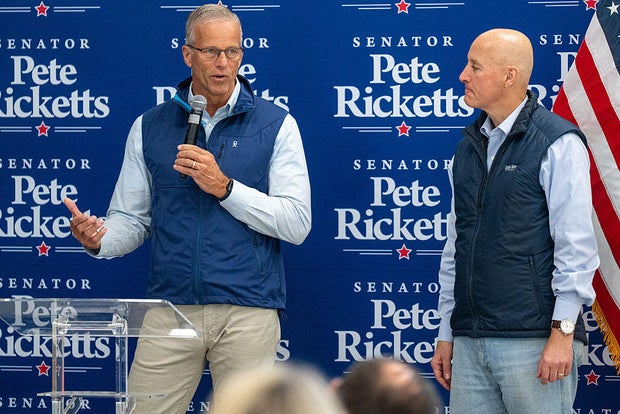
“I said, ‘I’ll do whatever I can to help the team,'” Thune told CBS News. “And if that’s just staying out of the way, I’m fine with that.”
As the war and gas prices have darkened the picture, Thune has urged candidates to “run their own campaigns.”
“The president’s going to be a factor in every election,” he told reporters before the recess. “But I think they need to be their own person, and I think that’s the best way to win.”
That is where Thune’s approach meets the ballot. After two years of approving much of the president’s agenda and rarely speaking out against the White House, Senate Republicans may find that distinction hard to draw. It’s the same bet Thune has made as leader: that Republicans can stand with the president on policy while keeping some distance from his most unpopular pursuits. Next week, voters will weigh in.
“The job sucks”
Outside Thune’s office, where a massive wall-mounted bison head named Murdo for his hometown stands guard, Thune projected tepid optimism as the Senate prepared to leave Washington. Asked whether Republicans had done enough in two years to keep the majority, he said emphatically, “Of course we have.”
“We’ve just got to start talking about it,” he said. “If we can stay focused, talk about the future and the two paths over the course of the next several weeks, based on our record of accomplishment, things we got done, things we still need to do, we’ve got a great argument.”
ANDREW CABALLERO-REYNOLDS/AFP via Getty Images 
Some of his own members saw it differently, and the frustration was palpable.
“We’re going home, preparing for the midterms, and we’ve not addressed what all of you care about so deeply. That’s affordability,” GOP Sen. John Curtis of Utah said in a video to his constituents, pointing to high gas and diesel prices. “We just have not done a good job, and I think the voters are going to be loud and clear about how they feel about that.”
GOP Sen. John Kennedy of Louisiana, who has criticized Thune in recent months as “too cautious” with the Senate agenda, told reporters that Republicans should have turned to affordability immediately after passing Mr. Trump’s signature tax bill in summer 2025. Another party-line bill could still come after the midterms, he said, but “you don’t know what people’s mood is going to be.”
If Republicans fail to hold the Senate, the blame game and finger-pointing will be intense. But Thune objected to the idea that he hasn’t been aggressive enough with the agenda.
“I don’t know how you could be more aggressive,” he said in Iowa. “I look back at the last couple of years, and I think we had wins pretty much at every turn.”
Some frustration is par for the course in a 53-seat majority, where Thune can lose only three Republicans. He has often described the majority as closer to 46 in practice, with several members emboldened to chart their own path after losing primaries or deciding not to seek reelection. Corralling them, his GOP colleagues understand, isn’t for the faint of heart.
“The job sucks,” said Ohio’s Moreno. “He’s got an extraordinarily unwieldy conference, where you have 53 Republicans with 175 ideas, and everybody demands that their idea be the most important one.”
There’s been no sign that Thune would lose his conference’s support in the leadership elections after the midterms. The bigger questions are what Thune himself wants, and whether the president might intervene, especially if Republicans see brutal losses across the board.
In September, reporters had been pressing Thune on whether he planned to run again as leader, and he suggested the midterm results would factor into his decision. In his office, he said he doesn’t “like to get the cart ahead of the horse.” But asked directly, he told CBS News, “Obviously I’m very interested in seeing how things turn out in the election, but my expectation is, yes.”
Murkowski said it’s easy to say “woulda, shoulda, coulda” about how aggressively he has steered the conference. But she said she can “only pretend to imagine the different pressures that he is under, the different levers that others are trying to pull.”
“More often than not, it’s just kind of like, ‘Just hang in there, John,'” she said.
Former Sen. Joe Manchin, the Democrat-turned-independent who once offered to caucus with Republicans to help Thune win the top job, lamented his position under a president “who’s demanding total loyalty above everything else.” Manchin said his hope for Thune going forward is that he “gets his support.”
“Who do you think would be able to do a better job than John, trying to hold it all together?” Manchin said.
Thune said the decision on his leadership is “going to be up to our colleagues.”
Does he expect support from the president, who could push to replace him if the midterms go badly for Republicans? Thune laughed.
“Hard to say. I don’t know. I mean, I don’t bank on it,” he said. “But yeah, if he found his way to do that, that’d be great.”