




 Weather
Do you know the two countries you can reach by ferry from Sicily? Even boat travel geeks might struggle with this one. One is Tunisia – reachable from Palermo in 11 hours (in the six years I’ve lived in Sicily, I’ve still only known one person who’s ever taken that boat). The other is Malta.
ADVERTISEMENT

ADVERTISEMENT
Luckily for me, the most frequent ferry to Malta goes from my local town. Pozzallo to Valletta is a pleasant 1hr45 minute journey, on a catamaran mostly staffed, curiously, by people from the Philippines. With three or four crossings a day, Malta is quicker to reach than most parts of mainland Italy, so I’ve visited regularly during the six years I’ve been living on Sicily’s south-east coast.
On most of my trips, I’ve stayed in Valletta, Malta’s capital. An ancient fortified city full of gorgeous architecture, buzzy outdoor bars and restaurants and rooftop views to die for.
What does all of that gorgeousness mean? You guessed it – it’s packed with tourists.
Spend time in Valletta and you’ll understand why you’re often told Malta is one of the most densely populated countries in the world. During the summer high season, it’s hard to move on Valletta’s cobbled streets. While there’s plenty of good shopping, it’s hard to enjoy it when you’re in fear of, at best, being ripped off for tourist tat and, at worst, being pickpocketed.
So, on my most recent trip I decided to try and beat the crowds in Malta. I planned a hotel stay and itinerary that would let me experience the more authentic parts of the country, taking in Gozo, one of the islands, and Mdina, an atmospheric walled city.
Where to stay in Malta for a group trip
Malta’s busiest tourist hotspots are concentrated in the south of the country – Valletta, St Paul’s Bay, St Julian’s and Sliema are all in this region, as well as being where most visitors will arrive thanks to the airport.
Many of them will take taxis or buses to the northern region for day trips to Comino and Gozo, islands home to popular spots like the Blue Lagoon and Gozo’s many beautiful beaches.
Knowing that most tourists just come to Malta’s most northern tip to leave it on a ferry, I surmised that hotels there would be less oversubscribed.
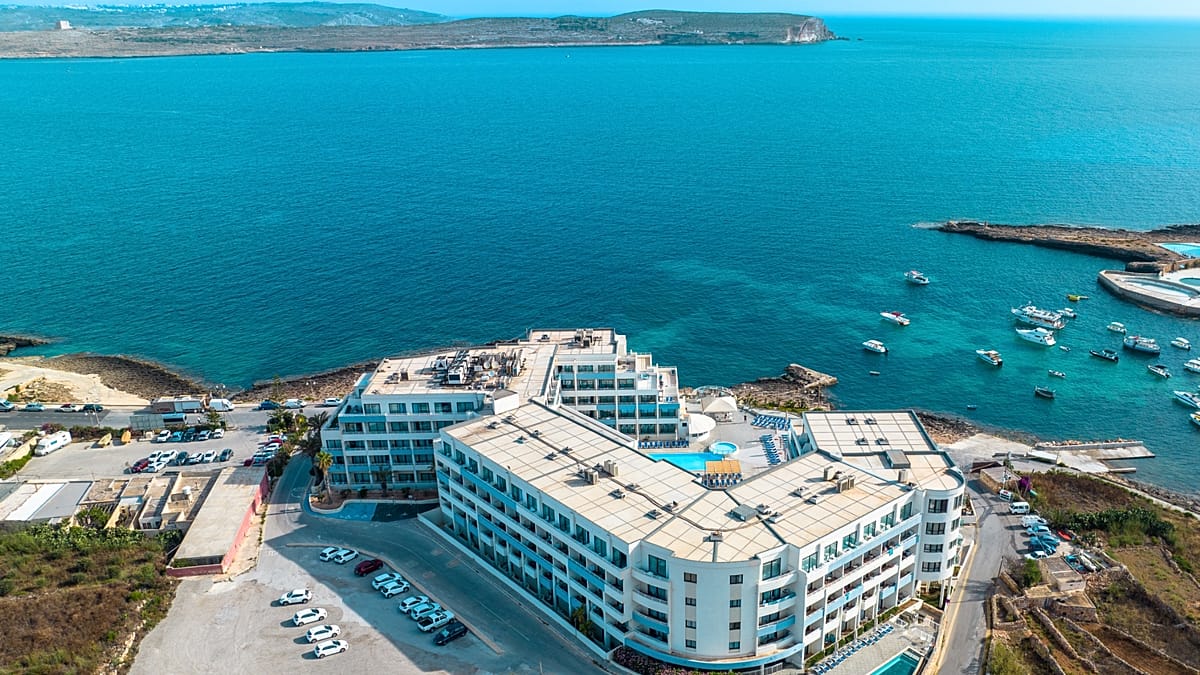
I decided on the Riviera Spa Resort, a large adults-only hotel with views across to Comino. The property is right in front of Marfa Jetty so we watched tourists line up to take speed boats across to Comino – most go there seeking the Blue Lagoon.
The Riviera is also very well positioned for trips to Gozo – more on that below.
One of the main reasons we chose the Riviera was for the adults-only promise. I was away with eight others and almost all of us had left babies or children at home. While we love our own, we didn’t want to have to listen to other people’s screaming children.
Having gathered here from all over Europe, our time at the Riviera revolved around long catch-ups and leisurely meals. Lurid-coloured cocktails from the poolside bar kept us hydrated while relaxing on sun loungers. With four restaurants and two bars to choose from, there was something to suit everyone’s tastes and budgets.
While it’s not a luxury property, Riviera was perfect for a group trip thanks to its many services and being able to book it through tour companies (including Jet2 and EasyJet Holidays). There was high energy aqua aerobics and a gym for those that couldn’t miss out on their workouts. For a more relaxed start to the day, a few of us joined a pilates class which was expertly taught in a lovely studio. For full relaxation, the on-site spa had one of the longest massage menus I’ve ever seen.
One of the hotel’s standout features is its staff. Coming from all over the world, they’re multilingual and seemed genuinely proud of the newly renovated Riviera. There were plenty of people to help so, despite the hotel being busy, we were always helped quickly and with a smile.
I’d recommend the Riviera for group or multi-generational trips, and for anyone who wants everything you could need under one roof.
Mdina: Malta’s silent city
Venturing off the beaten track in Malta was worth it just for our trip to Mdina (pronounced um-dee-nah). Meaning ‘fortified place’ in Arabic, this walled city on a hilltop in the middle of the island has a very different feeling than anywhere else I’ve been in Malta.
At 3,000 years old, Mdina has a fascinating history. It served as the nation’s capital and the seat of the Maltese nobility until the mid-16th century arrival of the Knights of St. John. As the knights chose another part of Malta, Birgu, as their new capital the Great Siege of 1565 by the Turks was directed there and not at Mdina. Under the knights and even more so under the British the importance of Mdina as the seat of power faded steadily, and what was once known as the ‘Citta Notabile’ became the ‘silent city’, almost a ghost town. Only 400 people live within Mdina’s walls now.
While shops, small museums and lookout points mean it’s no longer a ghost town, it does feel closed off and peaceful. This is in part thanks to there being no vehicles driving around – the cobbled streets are far too narrow for that.
We spent a gorgeous afternoon wandering the city’s streets, with stops to admire the gorgeous buildings or pick up a drink or an ice cream. I recommend arriving mid to late afternoon, especially in summer.
As the sun gets lower, it washes the sandstone buildings with a golden glow, giving Mdina a dreamy, ethereal atmosphere.
Gozo: One of the best places in Europe for diving
Gozo has a very different feeling to the main island in Malta, making it a perfect alternative destination. It has been spared the development that’s overrun its neighbour. Inland is mostly still countryside with small towns or villages dotted throughout.
The preservation of the land means the soil here is very fertile and it feeds the main island with some foods, though most of Malta’s food is imported from Sicily. This makes it worth seeking out local specialties, like the cheese ‘gbejna’, made from sheep’s milk.
Gozo has a stunning coastline and this is where it shines for me – especially as I’m a qualified scuba diver. Many European divers think they need to fly to south-east Asia or the Caribbean to see reefs and marine life, not realising that Malta has world-class diving.
It has sites for everyone from beginner to advanced divers – there are plenty of dive schools to choose from and they’ll know where to go and when. You can expect good visibility and gentle currents in most places, though be careful if you’re swimming and not with a dive guide.
If you’re not into diving, the Azure Window, the Inland Sea and the Blue Hole can all be enjoyed from the beach or boats.
For sightseeing, check out the Ggantija Temples in Xagħra (thought to be one of the oldest free-standing Neolithic structures in the world) and Ta’ Pinu Basilica if you’re in need of some luck – an ancient church where some believe miracles have happened.
If you want to visit Gozo for a day trip, Gozo Fast Ferry has frequent departures from Valletta, arriving at Mgarr in 45 minutes. Once you’re on Gozo, there are public buses to get around and it’s also suitable for walking around.
Marsascala, Marsaxlokk and Birżebbuġa: Malta’s fishing villages
Fishing village probably conjures up images of a quaint harbour with the sound of seagulls overhead. While these three small towns are much quieter than Valletta and its surroundings, the harbours are still designed to attract tourists. But since Malta is hot for much of the year, the bars and restaurants are a welcome pit stop for refreshments.
You can reach all of them by bus from Valletta. They’re not too far from the airport but if you have a flight to catch, allow plenty of time – Malta’s traffic can be brutal.
There’s not a huge amount to do in Marsascala, Marsaxlokk and Birżebbuġa other than wander around, discover the beaches and meet some locals
Sunday is the best day to visit Marsaxlokk for its famous fish market, which some say is the best place to buy fish in the whole country.
Ruth Wright was a guest of the Riviera Spa Resort.
Read the full article here