





 Weather
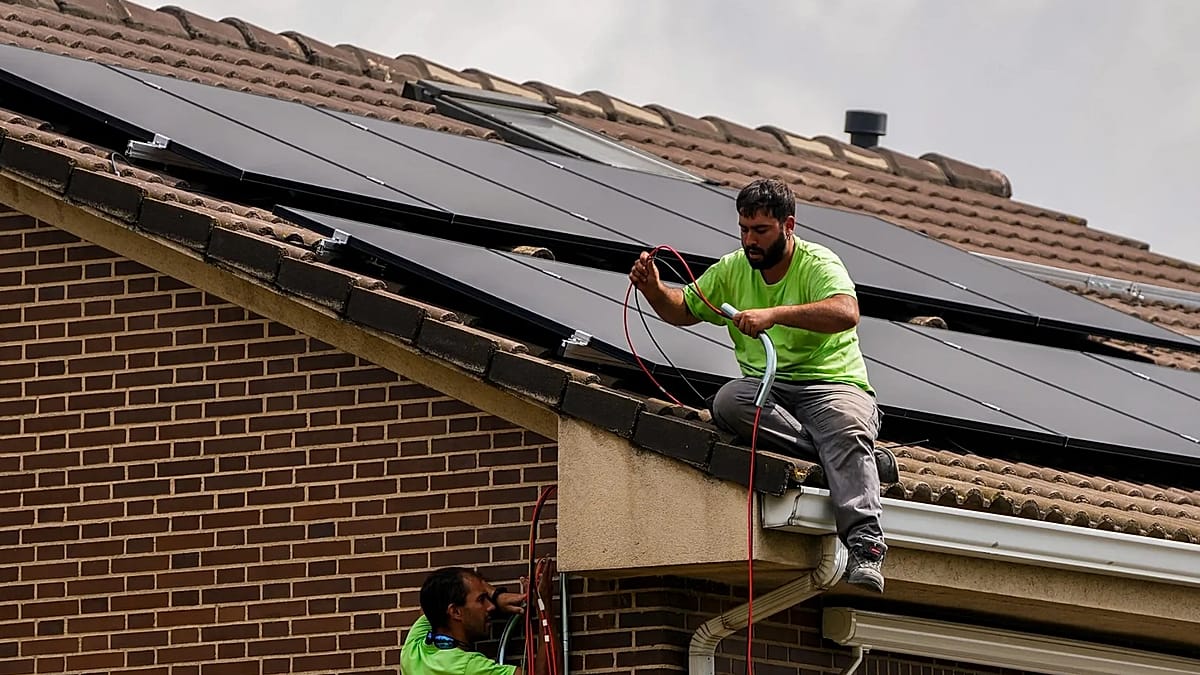
The European Union’s post-pandemic recovery fund has poured €43 billion into improving the energy efficiency of private homes, but a damning report from the European Court of Auditors (ECA) published on Tuesday concludes the program has failed to maximise energy savings, monitor results properly or ensure taxpayers received value for money.
ADVERTISEMENT

ADVERTISEMENT
“EU renovation funding for private homes should go to those projects with the greatest potential for cutting energy use. However, we saw all too often that Recovery and Resilience Facility (RRF) funds went where they were easiest to spend, not where they would make the biggest difference”, said Nikolaos Milionis, the ECA member responsible for the audit.
The ECA auditors argue that while the RFF dramatically expanded investment in home renovation, the programme’s design favoured politically expedient over the deep renovations needed to meet Europe’s long-term climate ambitions.
Rather than transforming Europe’s ageing housing stock – which has been in the spotlight as recent heatwaves that hit Western Europe turned buildings into heat traps – the EU auditors found that the RRF largely financed medium-depth renovations, delayed more complex projects, relied on questionable methods for measuring energy savings and paid little attention to whether billions of euros were being spent efficiently.
Quick fix rather than deep renovations
The report argues that the RRF’s architecture unintentionally encouraged governments to prioritise projects that could be completed before the programme’s tight 2026 deadline, such as solar panels, window replacements and boiler upgrades.
More ambitious work, like comprehensive insulation of roofs and walls or deep retrofits capable of cutting energy consumption by more than 60 percent, proved slower, more expensive and often slipped behind schedule, according to the ECA report.
The result, auditors warn, is a programme that has increased renovation activity but not necessarily delivered the structural improvements Europe needs to decarbonise its building stock, which accounts for 25 percent of energy consumption in the EU.
“Projects were often approved based on eligibility criteria alone, without comparing them to prioritise those with the highest energy savings,” Milionis said. “As a result, funding was not always directed to projects that could save the most energy.”
The Commission’s lack of appropriate measures to deliver structural improvements seems to be at odds with its own electrification ambitions, with green groups arguing that the EU is too focused on producing more clean electricity and not focused enough on reducing the amount of energy that needs to be consumed in the first place.
The numbers behind the story
Perhaps the ECA report’s most significant finding concerns the measurement of success itself.
The Commission encourages member states to estimate energy savings using Energy Performance Certificates, but the EU auditors have concluded these certificates were never designed to measure actual energy consumption. Instead, they rely on standard assumptions about how people use buildings.
Real household behaviour varies considerably, the EU auditors warned, creating a substantial “performance gap” between theoretical and actual energy use.
Across the four EU countries examined – Belgium, Italy, Cyprus and Lithuania – the auditors found evidence that estimated consumption frequently differed dramatically from real-world performance.
In some cases, theoretical consumption exceeded actual use by several hundred percent, meaning reported energy savings may substantially overstate what households actually achieve. The ECA warned this could potentially distort spending decisions and public accountability.
Cost-effectiveness largely ignored
The audit also highlights a striking omission: there has been no systematic monitoring of cost-effectiveness.
Although the RRF is officially described as a performance-based instrument, neither the Commission nor participating governments tracked how much energy was saved for every euro spent.
“The EU spent billions on home renovations without tracking how much energy was saved for every euro invested,” reads the report.
The auditors performed their own calculations and found major differences between countries and schemes. Italy’s widely publicised Superbonus emerged as the report’s clearest example of poor value for money: it reimbursed homeowners for up to 110 percent of renovation costs, fuelling enormous demand but also inflating costs to the point where taxpayers were left with an estimated €123 billion bill.
“We consider that this level of support is not in line with the principles of sound financial management and that it negatively affects the cost-effectiveness of the measure,” reads the ECA report.
The Commission is already considering future financing for building renovations in the next multiannual EU budget, making the ECA audit more than a retrospective critique.
EU auditors are effectively issuing a warning that future climate spending risks repeating the same mistakes unless funding becomes more targeted, evidence-based and performance-driven.
“We conclude that while the RRF provided broad support for improving the energy efficiency of residential buildings, weaknesses in the set-up and implementation of the renovation measures limit the extent to which they deliver actual and cost-effective energy savings,” read the report.
Read the full article here