




 Weather
With direct flights from several European capitals, Fortaleza and Recife are consolidating their status as two of the main gateways to Brazil’s northeast, a region that combines beaches, nature, culture and history and is increasingly opening up to international tourism.
ADVERTISEMENT

ADVERTISEMENT
The two Brazilian mainland cities closest to Europe are capitalising on this geographical advantage to attract a growing number of international visitors, thanks to air links with capitals such as Madrid, Lisbon and Paris.
Less than eight hours’ flying time from Madrid, travellers discover Fortaleza’s skyline, a city that at times feels like a mix between Miami and Benidorm. Its seafront skyscrapers trace a modern urban profile that coexists with the long Beira Mar seafront promenade, in a tropical, holiday atmosphere that invites you to enjoy life outdoors.
Fortaleza, 300 years of history
With 2.57 million inhabitants, Fortaleza is one of the five most populous cities in Brazil and the capital of the state of Ceará, home to more than nine million people. Its history is tied to the colonial struggle between the Portuguese and the Dutch.
In 1649 the Dutch built Fort Schoonenborch, the nucleus of the modern city. After the Portuguese reconquest six years later, it was renamed Fortaleza de Nossa Senhora da Assunção. In 2026 the city will celebrate the 300th anniversary of its founding, a milestone visible in many corners of the metropolis.
“This is a vibrant city, with a rich mix of cultures, that never sleeps. From three in the morning lots of people start going out into the streets to exercise or run; it is a city where people are constantly on the move,” explains tour guide Castalha.
All it takes is to head out early in the morning to see it. Dozens of runners jog along the Beira Mar promenade, which connects three beaches along some six kilometres of coastline: Iracema, with landmarks such as the English Bridge; Meireles, known for its night-time craft market; and Mucuripe. For those looking to combine sport and sea, an alternative is to go canoeing in the warm waters of the Atlantic.
A stroll through the Mercado dos Peixes shows that Mucuripe beach is still closely linked to artisanal fishing. Fishermen head out to sea in traditional jangadas, light sailing boats that ply the waters close to shore. Fish and seafood are two essential ingredients of Ceará’s cuisine.
At night, music and dance take over. Forró, one of the great cultural symbols of Brazil’s northeast, is danced across Fortaleza. It is danced in pairs, very close, with fast steps and simple turns that call for a certain coordination and a good sense of rhythm.
The adventure of the falésias
Outside the big city the adventure begins. Around 160 kilometres to the southeast lies Canoa Quebrada, in the municipality of Aracati. This small coastal village is famous for its falésias, reddish and white sand and rock cliffs, and for its wind-sculpted dunes. It is one of the most characteristic landscapes in Brazil’s northeast.
The best way to explore it is by buggy, light open vehicles that cross dunes, beaches and coastal tracks, offering spectacular panoramic views of the coastline. In the background stands out the crescent moon and star symbol carved into the falésias, which has become the emblem of Canoa Quebrada.
The place became famous in the 1970s among European backpackers and hippies drawn by its unspoilt beaches, the warm climate and the laid-back atmosphere.
Another of Ceará’s most authentic beaches is Canto Verde, in the municipality of Beberibe, where travellers can enjoy an experience closely linked to the local community. Around 200 artisanal fishers live there, and visitors can go out to sea with them in traditional boats, an activity which, residents say, attracts visitors from Switzerland, Portugal and the United States.
“We live from artisanal fishing and we are promoting community tourism,” Roberto explains. The residents of Canto Verde have spent years fighting property speculation and mass-tourism projects in order to protect this area and develop a sustainable model.
“That is another of the area’s attractions: sustainable tourism that does not drive out local residents, but instead involves them through their traditions and customs,” stresses Daniele Rocha, from Embratur, the Brazilian Agency for International Tourism Promotion.
Recife, a defining feature of Brazil
Just over an hour’s flight from Fortaleza a very different reality appears. Recife, capital of the state of Pernambuco and home to 1.5 million inhabitants, is the other major metropolis in Brazil’s northeast and for centuries was one of the country’s main economic engines.
Its strategic port and the sugar trade turned it into one of the most important cities in Portuguese America. Its history is deeply bound up with colonisation, Atlantic trade and Dutch occupation. Between 1630 and 1654 it was the capital of New Holland, the Dutch colony established in Brazil’s northeast. During that period, bridges, canals and buildings were constructed that still form part of the city’s urban identity.
Recife preserves some of the most important chapters in Brazil’s history. Colonial churches, fortifications, old Portuguese streets, buildings with Dutch influence and the Kahal Zur Israel synagogue, considered the first in the Americas, are all part of its heritage. Thanks to its rivers, bridges and urban islands, the city has even earned the nickname “the Brazilian Venice”.
The city is also one of the country’s major cultural centres. The intense mestizaje that characterised Pernambuco, a genuine crossroads for Europeans, Africans and Indigenous peoples, gave rise to frevo, a traditional music and dance whose jumps, acrobatics and spins recall capoeira.
With their colourful umbrellas, frevo dancers, with frevo declared by UNESCO as Intangible Cultural Heritage of Humanity, set the rhythm and soul of the city.
Frevo reaches its peak during Carnival, when the streets fill with troupes, musicians and millions of revellers. The most recognisable symbol of this celebration is the huge decorated rooster of the Galo da Madrugada, considered one of the largest carnival parades in the world.
Olinda, the colonial gem
Barely seven kilometres from Recife lies Olinda, one of Brazil’s most beautiful historic cities. Founded in 1535, it preserves a colonial urban ensemble designated as a UNESCO World Heritage Site.
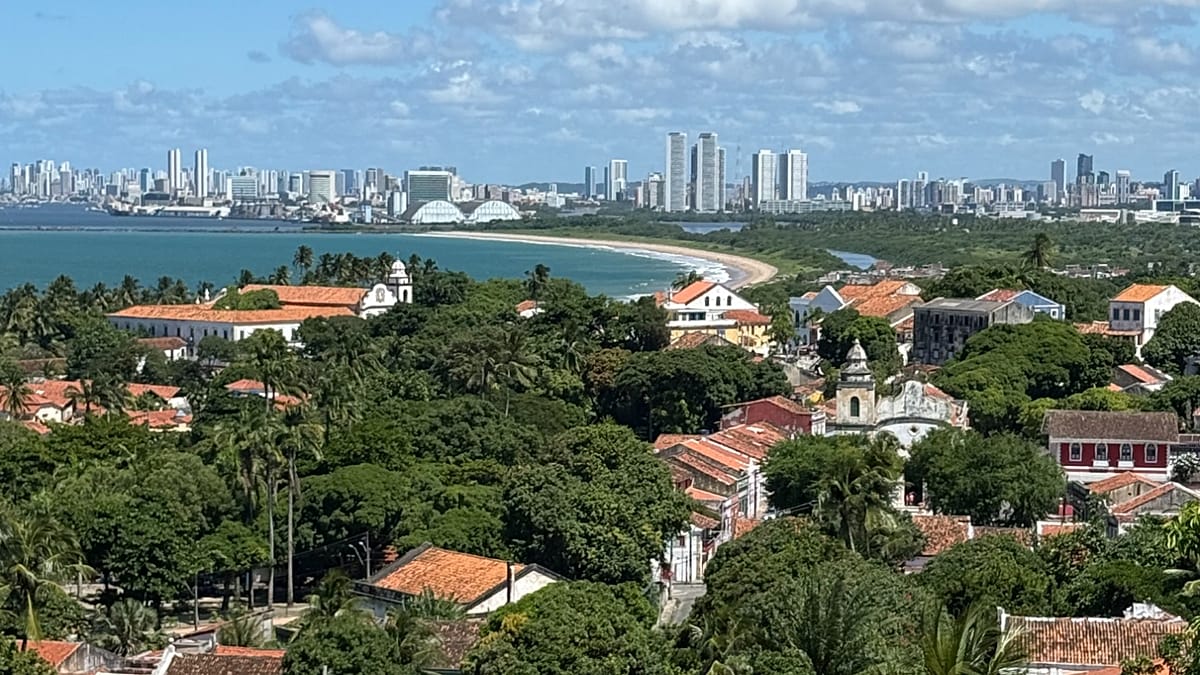
Walking its steep cobbled streets is a journey into the past. Its colourful colonial houses and baroque churches evoke centuries of history. From the viewpoints of Alto da Sé you can see the Atlantic, the colonial rooftops and, in the distance, Recife’s modern skyline.
During Carnival, Olinda showcases another of its great traditions: the Bonecos Gigantes, huge figures several metres tall representing historical figures, artists, sportspeople or politicians, which make their way through the streets accompanied by thousands of people.
If Fortaleza is synonymous with beaches, nature and tourism, Recife embodies the country’s cultural and historical dimension. The former looks to the future from its skyscrapers facing the Atlantic; the latter preserves the traces of some of the most decisive chapters in Brazil’s history.
With direct air links from Europe and an increasingly diversified offering, both cities are consolidating their status as two of the main gateways to a Brazil that still holds many surprises in store for international travellers.
Read the full article here