



 Weather
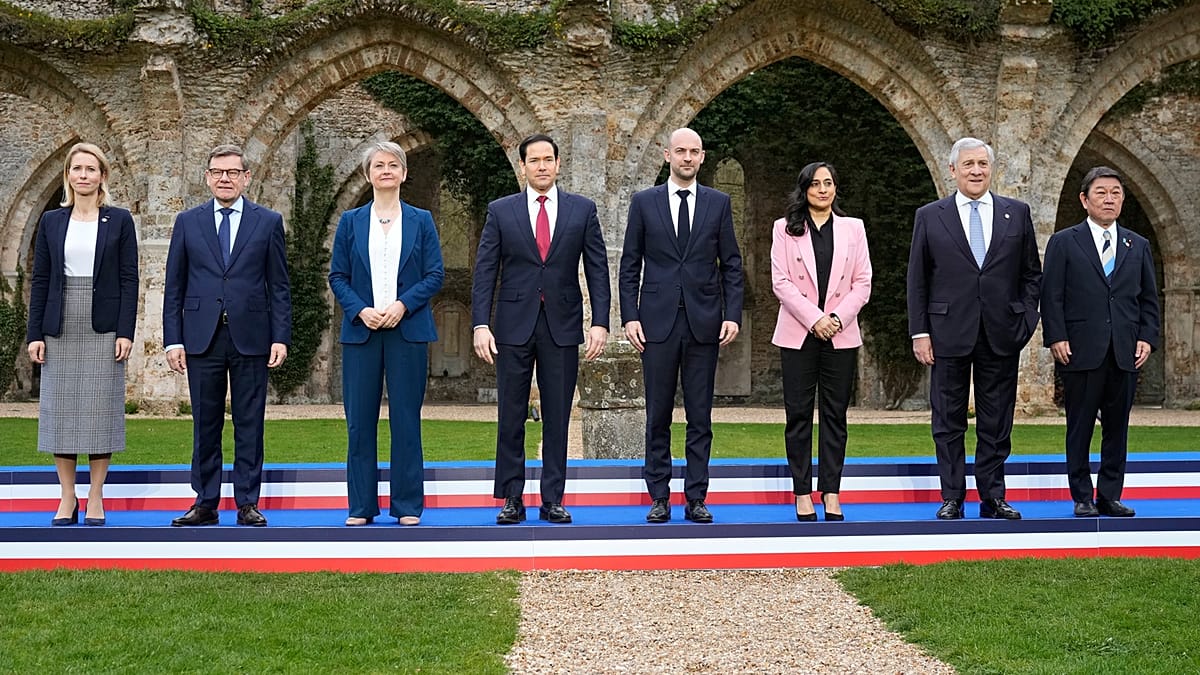
The G7 has agreed to protect passage through the Strait of Hormuz, a critical route for energy exports, but only after the war between the United States, Israel and Iran ends.
ADVERTISEMENT

ADVERTISEMENT
The joint commitment from foreign ministers comes as US President Donald Trump ramps up pressure on European nations to help secure the waterway, which Tehran has kept virtually shut since the start of hostilities nearly one month ago.
“There is a very broad consensus within the international community to preserve the common good of freedom of navigation,” Jean-Noël Barrot, France’s foreign affairs minister, said on Friday at the end of the G7 meeting, which he hosted.
“It is out of the question to live in a world where international waters are closed to navigation, particularly in the context of conflicts that do not concern the countries that need this navigation to continue.”
An international mission to escort vessels will operate “once calm has been restored” and “in a strictly defensive posture” according to international law, Barrot added.
“It will necessarily happen one way or another,” he said, evoking the law of the sea.
“With each passing day, the situation worsens due to the lack of shipping traffic from the Persian Gulf to the rest of the world.”
Trump has repeatedly lashed out at European and NATO countries for refusing to set up a maritime mission along Hormuz, which would entail high risks for all armies involved.
“I’m so disappointed in NATO, because this was a test for NATO. This was a test. You can help us,” he said on Thursday. “We’re going to remember.”
Before heading to the meeting in France, Secretary of State Marco Rubio implied that, as a result of Europe’s refusal to join in, the White House could disengage from efforts to end Russia’s full-scale invasion of Ukraine, a remark understood as a retaliatory threat.
“Ukraine is not America’s war, and yet we’ve contributed more to that fight than any other country in the world. So, it’ll be something to examine that the president will have to take into account down the road,” Rubio said.
The temperature cooled down as Rubio joined his counterparts at the Vaux-de-Cernay abbey, outside of Paris, at a meeting dominated by the situation in the Middle East.
Rubio clarified that the US was asking allies to prepare the multi-national mission for the day after the war, rather than for an immediate deployment amid raging fire. He said his message had enjoyed a “good reception” during the talks.
“We’ve always viewed it as a post-conflict necessity,” Rubio said upon departure.
“The first few tankers will go through the straits after this operation is over (are) going to want an escort from somebody, or they’re not going to be able to get insurance,” he added, warning that Tehran might impose a permanent closure after the hostilities.
“The world better step up and do something about it. And so, especially the countries that most depend on the strait: rich countries, powerful countries, capable countries.”
Johann Wadephul, Germany’s foreign minister, was positive in his assessment of the discussions, saying the mood in the room had been “one of work”.
“Germany is certainly willing to play a role after the end of hostilities when it comes to ensuring the safety of shipping in the Strait of Hormuz,” Wadephul said. “My aim here is to ensure that we broaden the common ground we share in this dispute.”
More than 30 countries around the world, including Germany, the UK, France, Italy, Canada and Japan, have signed up to a statementexpressing their “readiness to contribute to appropriate efforts to ensure safe passage” through Hormuz.
The text does not specify how and when this readiness to act will materialise in practice.
UK Foreign Secretary Yvette Cooper said it would be focused on “defensive action” to ensure “the protection of international shipping” more broadly.
“Iran cannot be able to just hold the global economy hostage,” Cooper said on Friday morning. “We need to protect our global economy from countries that want to weaponise our economy against us.”
A high-risk operation with few guarantees
The Strait of Hormuz is a critical passage carrying a fifth of the world’s oil and gas supplies in normal conditions. Its geography is complex: shallow waters and high terrain favour Iran’s warfare tactics, including missiles, drones and missiles. Vessels that dare cross face multiple risks that neither owners nor insurers are willing to tolerate.
Europeans are widely opposed to attempting to secure Hormuz amid a hot conflict, fearing being dragged into an unpredictable confrontation. The US-Israeli strikes on Iran are highly unpopular among European citizens, which further deters any goverment from committing military assets to an operation whose success is far from certain.
Moreover, the continent is still reeling from Trump’s attempt to seize Greenland from Denmark earlier this year, which pushed NATO solidarity to the brink of collapse.
The White House’s decision to ease sanctions on Russian seaborne oil in a bid to calm jittery markets has added to the dismay.
Upon arriving in France, High Representative Kaja Kallas highlighted the Russian factor that brings together the wars in Iran and Ukraine. Moscow is reportedly providing its ally Tehran with drones and intelligence services to help target American assets.
“These wars are very much interlinked,” Kallas said on Thursday. “If America wants the war in the Middle East to stop, Iran to stop attacking them, they should also put the pressure on Russia, so that they are not able to help them in this.”
Rubio later told reporters that the easing of sanctions did not represent a “permanent” change in US policy. But he did warn that American-made weapons allocated to Ukraine could be diverted “if we have a need to replenish our stocks”.
“We’re always going to come first,” he said.
The need for diplomacy was a prominent theme on Friday, as foreign ministers urged the warring parties to sit down and negotiate a way out of the widening conflict, which has sent energy markets into disarray.
Although Europe, unlike Asia, is not dependent on oil and gas from the Middle East, the ripple effects unleashed by the conflict could inflict real pain on the continent.
The price of Brent crude rose again to $110 a barrel on Friday, while the TTF, Europe’s leading gas hub, hovered around €54 per megawatt-hour (MWh).
Economy Commissioner Valdis Dombrovskis warned Friday at a separate meeting that a prolonged conflict could plunge the European economy into a scenario of stagflation, impact growth negatively by 0.4 points and lead to a pick-up in inflation by one point.
Last Sunday, Trump gave Iran 48 hours to reopen the waterway, threatening attacks on the country’s energy infrastructure if not. But on Thursday, he extended the deadline by 10 days, reportedly in response to a request from the Iranian government.
Meanwhile, Tehran has told the United Nations that it would guarantee safe passage to “non-hostile” vessels. The offer, however, did little to convince wary ships.
Read the full article here