




 Weather
Published on
Viking Libra, the world’s first hydrogen-powered cruise ship, recently hit a major construction milestone.
ADVERTISEMENT

ADVERTISEMENT
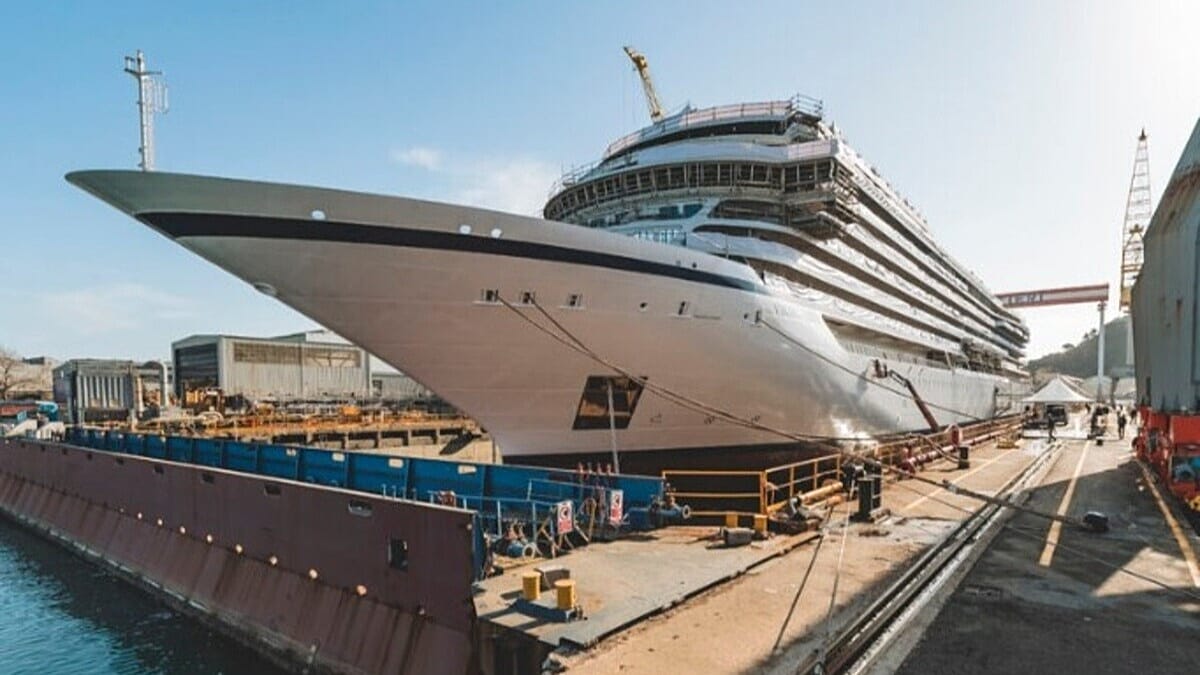
Operated by cruise line Viking, the ship was floated out on 19 March at Fincantieri’s Ancona Shipyard. This is a process during which the dry dock is filled with water, allowing a newly constructed hull to float for the first time.
It marks a significant step forward for the cruise ship, which will be able to operate with zero emissions, once it is functional in November 2026.
This also represents the transition from the structural assembly of a ship to interior outfitting, which is usually the final stage of construction.
In Viking Libra’s case, the final building stage will take place at a nearby outfitting dock.
“The float out of the Viking Libra represents another milestone for Viking and our continued partnership with Fincantieri,” said Torstein Hagen, chairman and CEO of Viking.
“From the beginning, our approach to ship design has focused on reducing fuel consumption, and the Viking Libra is our most environmentally friendly vessel yet.”
The ship will sail around Northern Europe and the Mediterranean in its inaugural season.
How will Viking Libra be emissions-free?
Viking LIbra has a total internal volume of about 54,300 tons and like all Viking ships, it is also a small ship. Its propulsion system is a hybrid one, partially based on fuel cells and liquefied hydrogen.
This will allow the ship to operate and navigate with zero emissions, while also reaching highly environmentally sensitive areas. By using advanced fuel cell technology, Viking Libra’s propulsion system will also be able to produce up to six megawatts of power.
On completion, it will have 499 staterooms, which can hold up to 998 guests, plus restaurants, a fitness centre and a Nordic Spa .
Similarly, Viking is also currently building the Viking Astrea, due to be launched in 2027, which will also be hydrogen-powered and zero-emissions.
Viking Libra’s upcoming launch comes as cruise lines attempt to be more environmentally conscious and reduce the impact of maritime travel.
Last October, Norwegian cruise line Hurtigruten launched its first climate-neutral voyage on the MS Richard With, a 5,000-mile roundtrip journey along the coast from Bergen to Kirkenes and back.
The ship uses 100% biofuel made from materials like fat waste and cooking oil.
“This marks a historic moment in Hurtigruten’s more than 130-year legacy along the Norwegian coast,” said Hedda Felin, CEO of Hurtigruten. “Most importantly, it’s further proof that emission cuts are possible today by using sustainable biodiesel, without the need to invest billions in new ships or infrastructure.”
Last November, Havila Voyages, another Norwegian cruise line, also launched its first climate-neutral voyage along the same route.
The cruise aims to slash greenhouse gas emissions by more than 90% compared to fossil fuels, by using a combination of battery power and liquefied biogas.
Read the full article here