






 Weather
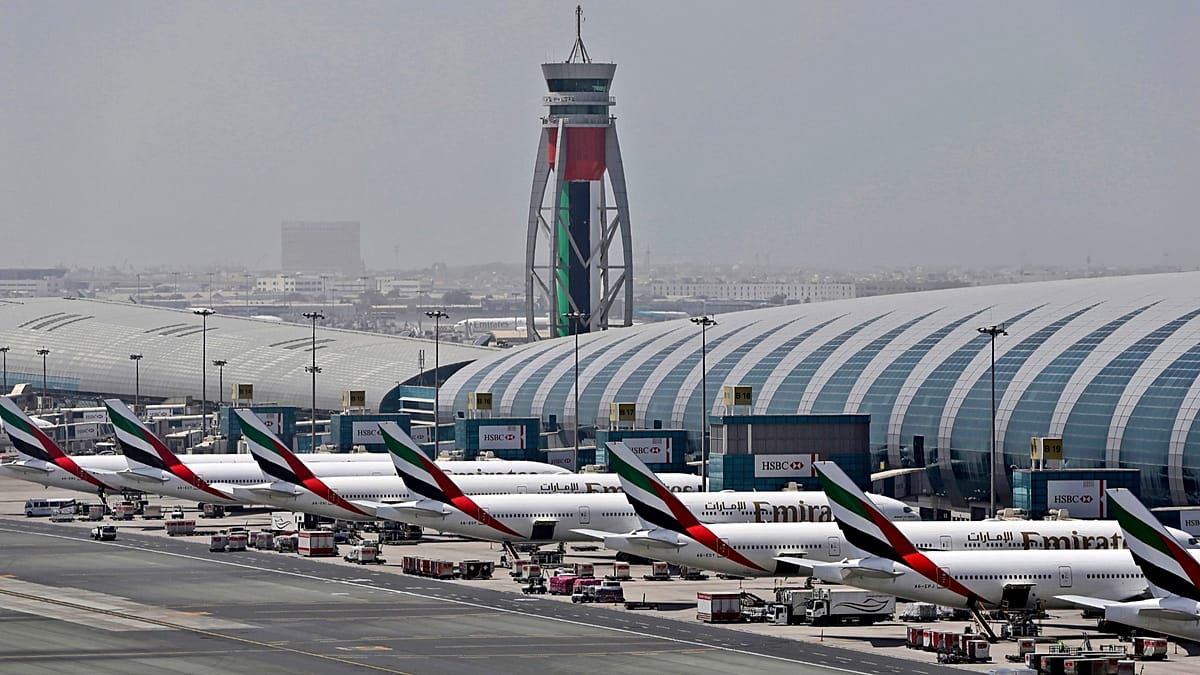
After six days of airspace disruptions due to the conflict between US-Israel and Iran, Emirates has said that it expects to return to full flight capacity in the “coming days”.
ADVERTISEMENT

ADVERTISEMENT
Following the partial re-opening of regional airspace, the Dubai-based carrier has been operating a reduced flight schedule while working to restore full network operations. On Thursday, it carried approximately 30,000 passengers out of Dubai and by Saturday it will have 106 daily return flights operating to 83 destinations – almost 60% of its route network.
“The airline anticipates a return to 100% of its network within the coming days, subject to airspace availability and the fulfilment of all operational requirements,” an Emirates statement said on Friday. “Safety, as ever, remains paramount as is our duty of care.” Passengers with earlier bookings are being accommodated as “priority” and should only proceed to the airport if they have a confirmed booking.
In certain “high-demand markets”, the airline said it has “significantly scaled up its operations”. In the UK alone, Emirates will be operating 11 daily flights across five airports by Saturday. Emirates also confirmed that additional capacity is being deployed across India, with 22 daily flights serving nine Indian destinations by Saturday. In the US, Emirates is currently flying to seven American destinations.
Dubai Airports said that more than 1,140 flights have been facilitated at Dubai International Airport and at Dubai World Central – Al Maktoum International in the past 84 hours. From 2-5 March, more than 500 flights had departed from Dubai’s two airports, “providing 105,000 outbound seats to more than 80 countries”, the airport operator said.
Starting on Friday, Etihad Airways is restarting a “limited flight schedule” from its hub in Abu Dhabi. The carrier has operated some flights in recent days, but its latest announcement suggests it is moving toward more regular operations. Etihad said that previously booked passengers as well as new customers will be able to travel on the flights, assuming “all safety criteria are met”. It listed more than 70 destinations it planned to fly to between 6-19 March.
Qatar Airways’s scheduled flight operations remain temporarily suspended due to the closure of Qatari airspace.
On Thursday, the airline began a limited number of relief flights from Muscat and Riyadh to help passengers left stranded due to the ongoing conflict, and staff are “working around the clock” to organise additional relief flights. The airline’s next update is due at 9 am local time (7 am CET) on Saturday 7 March.
Which airlines are affected?
British Airways has scheduled further flights from Oman’s capital city Muscat to London Heathrow departing at 2:30 am local time on 9, 10, 11 and 12 March. The airline said these flights are for “BA customers who are in Oman or the UAE with an existing booking”.
Finnair is also preparing to operate special flights from Muscat to Helsinki to transport around 1,200 customers currently in Dubai. The first flight is scheduled for Tuesday 10 March, with more flights planned for later in the week.
Virgin Atlantic became the latest airline to resume operations out of the UAE with its first flight to London Heathrow on Wednesday from Dubai International. The British airline also resumed flights from King Khalid International Airport in Riyadh.
Air Arabia has started operating a limited number of flights to and from the UAE, subject to operational and regulatory approvals. On 6-7 March, limited flights will be operating to destinations including Austria, Egypt, Ethiopia, Greece, India, Italy, Pakistan, Saudi Arabia, and Turkey.
Due to ongoing regional airspace closures, Oman Air said that flights to and from Amman, Dubai, Bahrain, Doha, Dammam, Kuwait, Copenhagen, Baghdad, and Khasab had been cancelled until Sunday 8 March.
Gulf Air flight operations remain temporarily suspended. The airline will resume services once the Bahrain Civil Aviation Affairs confirms the safe reopening of the affected airspace.
Saudia has cancelled flights to and from Amman, Kuwait, Dubai, Abu Dhabi, Doha, Bahrain, Moscow and Peshawar until 11:59 pm local time (9:59 pm CET) on 6 March.
Low-cost carrier Wizz Air has suspended all flights to and from Israel, Dubai, Abu Dhabi, Amman and Saudi Arabia up to and including 7 March.
Turkish Airlines has cancelled flights to and from Bahrain, Dammam and Riyadh (Saudi Arabia), Iran, Iraq, Jordan, Kuwait, Lebanon, Oman, Qatar, Syria and the UAE.
Air France is “monitoring the evolving situation in the region in real-time”, but due to the closure of certain airspaces it has been forced to extend the suspension of its flights to and from Dubai and Riyadh until 10 March inclusive and to and from Tel Aviv and Beirut until 11 March.
Dutch airline KLM is currently not flying through the airspace of Iran, Iraq, and Israel, nor over several countries in the Gulf region. Flights to, from, or via destinations in the region are cancelled or adjusted. KLM’s Tel Aviv flights are suspended for the remainder of its winter season operations, while flights to and from Dubai, Dammam and Riyadh are suspended until 8 March.
Lufthansa Group airlines – which includes Lufthansa, SWISS International Air Lines, Austrian Airlines, Brussels Airlines, ITA Airways, and Eurowings – has suspended flights to and from Dubai and Abu Dhabi until and including 10 March; to and from Dammam until 10 March; to Amman and Erbil until 15 March; to and from Tel Aviv until 22 March; to and from Beirut until 28 March; and to and from Tehran until 30 April. Flights to and from Larnaca in Cyprus will resume as of 7 March.
Delta Air Lines has cancelled flights from New York to Tel Aviv until 8 March, while American Airlines’s Doha-Philadelphia flights are “temporarily suspended”.
Air Canada has said that all flights to and from Dubai and Tel Aviv are currently suspended and restarting on 23 March.
Garuda Indonesia, Indonesia’s flag carrier, temporarily suspended flights to and from Doha “until further notice”, the company said in a statement.
Air China, China Southern and a few other Chinese carriers are resuming direct flights to Saudi Arabia, Oman and the UAE. Air China resumed a flight from Beijing to Riyadh on Thursday, state media reported. China is also helping citizens evacuate from the region, saying it received a plane carrying 300 passengers from Dubai on Wednesday. “We once again remind that the situation in the Middle East remains complex and severe, with considerable uncertainty,” Ministry of Foreign Affairs spokesperson Mao Ning said about the evacuations and flights.
Read the full article here


