



 Weather
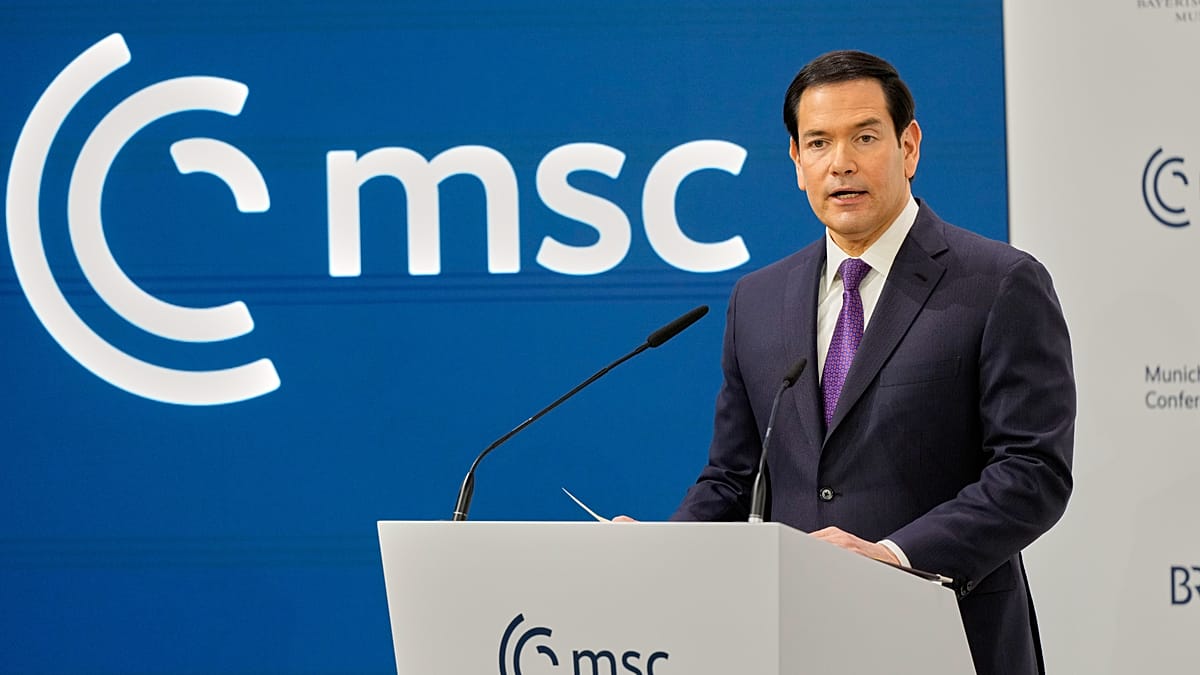
America’s top diplomat Marco Rubio called on Europe to work with Washington in a civilisational quest to save the West during a speech at the Munich Security Conference.
ADVERTISEMENT

ADVERTISEMENT
In a softer tone compared to US Vice President JD Vance a year ago at the same gathering, Rubio reiterated that the West is facing civilisational decline by choice, as a result ill-designed policies stemming from a climate “cult” and mass migration.
In his address on Saturday, he urged Europeans to join a common cause with the United States to lead a new century of prosperity. He said the two sides are historically, culturally and economically intertwined, but must also share principles.
“We believe that Europe must survive,” Rubio told the Munich Security Conference. “Ultimately, our destiny is – and will always be – intertwined with yours.”
His tone offered a more conciliatory approach after Vice President Vance shocked Europeans last year with a speech in which argued the continent risks becoming a land of censorship, suffocated by excessive regulation and under threat from open borders.
Vance suggested Europe’s biggest threat does not come from Russia, but from within.
Rubio did not use the hyperbolic language favoured by the Trump administration, which has referred to Europeans as weak and decaying, but its core message stayed intact. He also framed the challenges ahead as a quest to rescue an entire civilisation from decline.
He lambasted liberal politicians who, he argued, made a “conscious choice” to dismantle the West, its industrial capacity and outsourced critical supply chains to rivals and competitors. “De-industrialisation was not inevitable,” Rubio added.
“It was a conscious policy choice, a decades-long economic undertaking that stripped our nations of their wealth, their productive capacity, and their independence. The loss of our supply chain sovereignty…it was a foolish, but voluntary transformation,” he said.
The US Secretary of State also alluded to “mass migration” as source of conflict.
“This is not some fringe concern of little consequence. It was and continues to be a crisis, one that is transforming and destabilising societies across the West,” he said.
His remarks echoed a controversial US national security review published last year which called on the EU to reverse course on key policies or face “civilisational erasure” as a result. The document also suggested the US would foster ties and work with patriotic parties in the EU fighting the status quo from within, without giving names.
Still, Rubio received a standing ovation from the audience at the Munich Security Conference when he argued the US still cares deeply about the future of Europe and suggested disagreements come from a place of “profound concern” for the continent, which he referred to as the birthplace of a common civilisation.
“We are connected not just economically, not just militarily. We are connected spiritually and we are connected culturally,” he added.
Rubio cited Mozart, Dante, Shakespeare, The Beatles and The Rolling Stones.
American leadership under scrutiny
His comments come after French President Emmanuel Macron urged Europeans to act proudly against a campaign to vilify the continent amplified by social media.
“We need a much more positive mindset. There has been a tendency in this place and beyond to overlook Europe and sometimes to criticise it outright,” Macron said in speech before the Munich Security Conference on Friday.
In comments that appeared to push back on the US narrative, the French President referred to a “caricatured” vision of Europe, portrayed as weak, fragmented and overregulated continent, preyed by migration looking to “corrupt its precious traditions”.
Macron said Europeans should be proud of the union they have built.
Similarly, German Chancellor Friedrich Merz conceded a split in visions between Europe and the United States but argued that US culture wars do not belong in Europe.
“Freedom of speech here ends where the words spoken are directed against human dignity and our basic law. We do not believe in tariffs and protectionism, but in free trade. We stick to climate agreements and the World Health Organization because we’re convinced that global challenges can only be solved together,” Merz said Friday.
Read the full article here