




 Weather
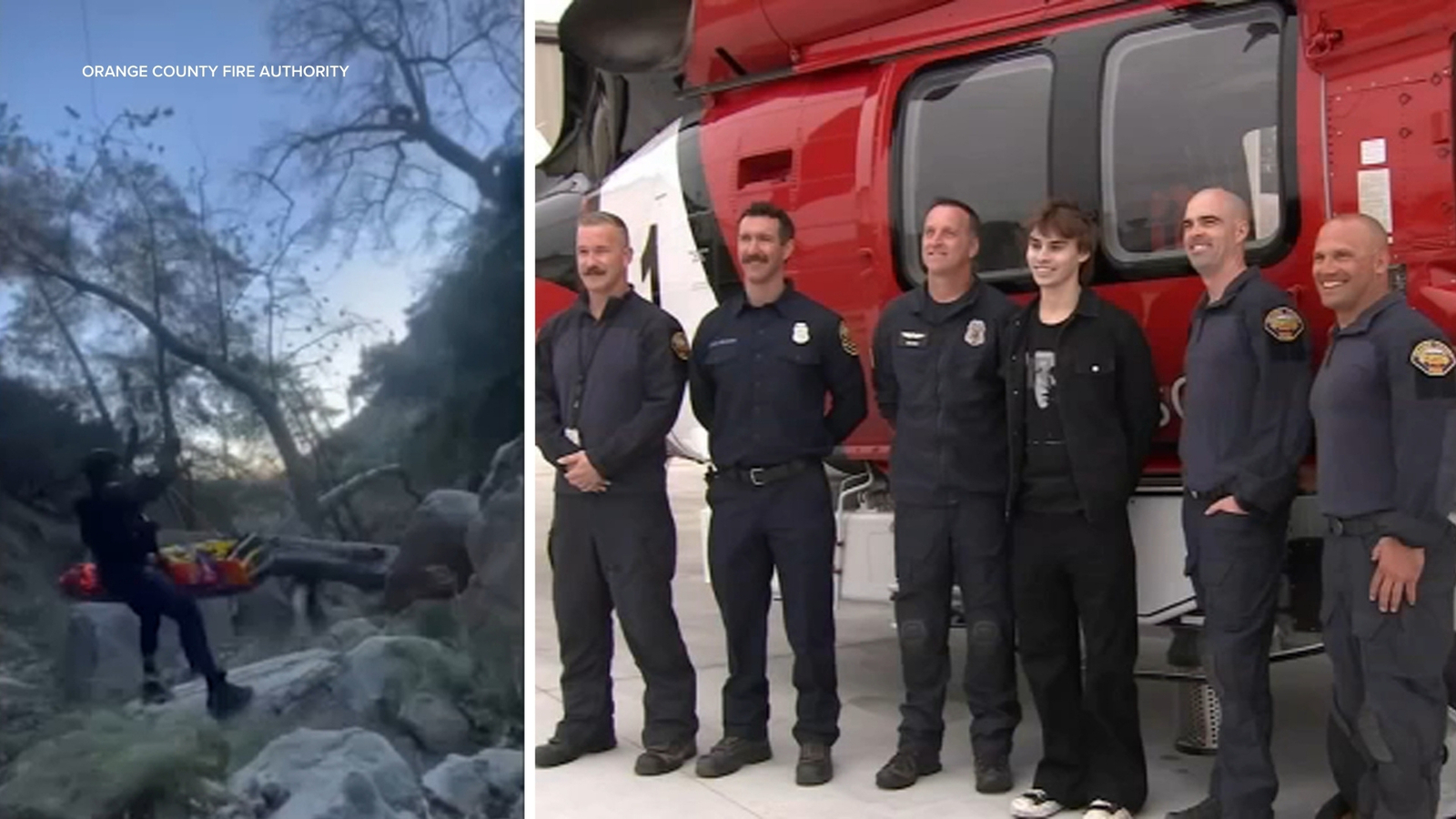
FULLERTON, Calif. () — An Orange County man who was rescued after suffering severe injuries from a fall during a hike is now out of the hospital and got to reconnect with the first responders who rescued him.
Diego Ramos Cardenas, 21, had multiple broken ribs, a lacerated liver and a punctured lung, and if it wasn’t for the Orange County Fire Authority’s high-risk helicopter rescue, he may not have survived.
On Tuesday, Diego reunited with the team of first responders that saved him.
“I always like finding new trails and new hikes,” said Ramos Cardenas.
But on Jan. 10, Ramos Cardenas brought his girlfriend to a hike he had done several times before — Black Star Canyon Falls in the Cleveland National Forest. They had made it miles to the waterfall, and thanks to recent rainfall, it was strongly flowing.
“At the end of this trail is a little cave that you can technically climb or whatever, but this day specifically, it was a lot of water coming down. I lost my footing,” Ramos Cardenas recalled.
He fell at least 15 feet and came crashing down hard.
“I kind of do remember hitting my back, and then I lost all the air,” Ramos Cardenas said.
Someone called 911, and Orange County Fire Authority (OCFA) crews started hiking to him. His girlfriend was by his side as they waited for help.
“We were basically sprinting over rocks to get there in an hour,” said John Nelson, an OCFA Firefighter/Paramedic. “Skin color was indicating he had some severe internal bleeding happening inside his body.”
It was clear that air support was needed. The only problem was that the Santa Ana winds were howling. Smaller helicopters in the area were unable to fly.
OCFA Chief Pilot Cody Hamann had to make a call.
“We basically looked at it, ran the performance numbers, did our calculations, and it looked like possibly with the bigger aircraft that we have here, it was something we would be able to complete,” Hamann said.
OCFA said if they had not been able to use their larger firehawk helicopter for the rescue, it would have taken at least four hours to carry Diego out. The end result may have been much different.
“I don’t know if he would have survived,” Nelson said.
Nelson and his crew got to Ramos Cardenas first. The helicopter wasn’t far behind. It was then time for paramedic rescuer Jason Trevino to hoist 220 feet down amid the windy conditions.
“It was significant winds. In my ten years in air operations, it was the sportiest rescue I’ve been on,” Trevino said. “I saw Diego, and he was as grey as the grey crayon, and I looked at Brian and said, ‘We need to go.'”
Eight rescuers carried Ramos Cardenas to a spot where the helicopter could pick him up.
“That was something challenging, trying to insert the hook into the rescuers who were on the ground. The wind catches that and blows it way behind the aircraft,” said OCFA Crew Chief Mike Curtis.
They got Ramos Cardenas to the hospital in a matter of minutes, where he woke up three days later with five broken ribs, a lacerated liver and a punctured lung. Three weeks later, he got to go home.
“Just a special thanks to the firefighters,” Ramos Cardenas said. “Without them, I would be dead.”
One month after the fall, alongside his girlfriend and family, Ramos Cardenas reunited with those firefighters and was able to thank them in person. He met them at the OCFA Air Operations headquarters in Fullerton.
It was a reunion that meant just as much to the team of first responders who saved him.
“It’s what really makes it worth it,” Hamann said.
© 2026 Television,