




 Weather
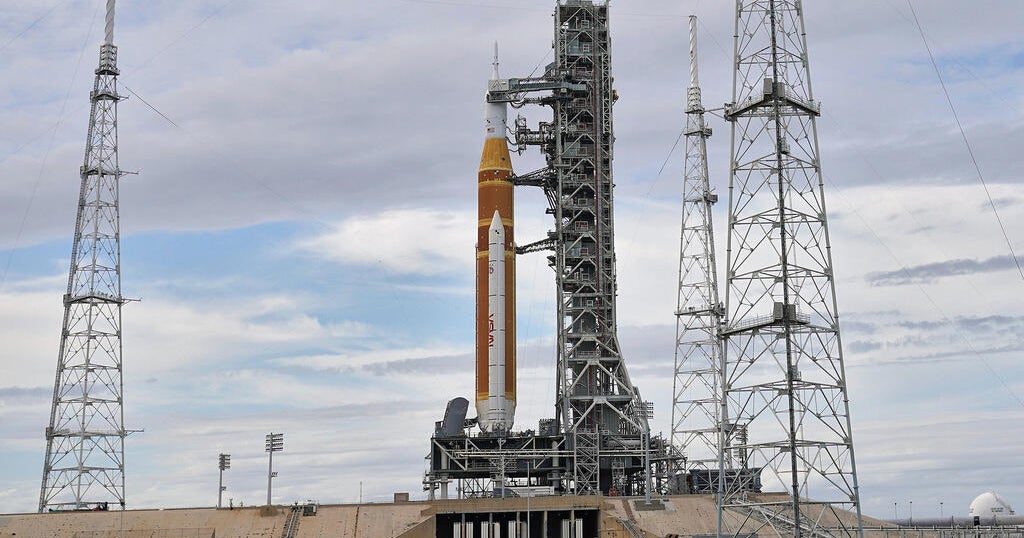
A hydrogen leak at the base of NASA’s Artemis II moon rocket on Monday threw a wrench into a carefully planned countdown “wet dress” rehearsal, interrupting a test intended to help clear the way toward a possible weekend launch for four astronauts on a flight around the moon.
The practice countdown began Saturday evening — two days late because of frigid weather along Florida’s Space Coast — and after a meeting Monday morning to assess the weather and the team’s readiness to proceed, launch director Charlie Blackwell-Thompson cleared engineers to begin the remotely controlled fueling operation.
NASA
The test got underway about 45 minutes later than planned, but it initially appeared to be proceeding smoothly as supercold liquid oxygen and hydrogen fuel were pumped into the Space Launch System rocket’s first-stage tanks. Shortly after, hydrogen began flowing into the rocket’s upper stage as planned.
But after the first-stage hydrogen tank was about 55% full, a leak was detected at an umbilical plate where a fuel line from the launch pad is connected to the SLS rocket’s first stage. After a brief pause, engineers resumed fuel flow but again cut it off with the tank about 77% full.
After more discussion, they decided to press ahead on the assumption the leak would decrease once the tank was full and in a replenishment mode when flow rates are reduced. It appeared that did, in fact, behave as expected.
“NASA teams have completed filling the core stage of the SLS rocket with liquid hydrogen,” NASA said in a brief web update at 4:45 p.m. “Engineers continue to watch the leak at the interface of the tail service mast umbilical, but the liquid hydrogen concentration in the umbilical remains within acceptable limits.”
The countdown was timed for a simulated launch at 9 p.m. ET. Engineers originally planned to continue several hours past that to run through several recycle procedures intended to make sure the team is ready to handle any problems and delays that might crop up during a real countdown. How the leak might affect those plans was not immediately known.
The SLS is the rocket NASA plans to use to send Artemis astronauts to the moon aboard Orion crew capsules. It is the most powerful operational launcher in the world, a towering 332-foot-tall rocket powered by two strap-on solid fuel boosters and four main engines burning liquid oxygen and hydrogen fuel that generate 8.8 million pounds of thrust at liftoff.
Artemis II commander Reid Wiseman, Victor Glover, Christina Koch and Jeremy Hansen are hoping to launch atop the SLS rocket as early as Sunday night for a nine-day, two-hour flight around the moon and back. But only three days in February are still possible: Feb. 8, 10 and 11. If the SLS isn’t off the ground by Feb. 11, the flight will slip to early March.
The SLS rocket’s first and so far only mission came in 2022 when it was launched on an unpiloted test flight. In the campaign leading up to launch, engineers ran into a variety of problems ranging from fuel leaks to unexpected propellant flow behavior in the launch pad’s plumbing. Launch was delayed for months while engineers worked to resolve the problems.
For the rocket’s second launch, multiple upgrades and improvements were implemented, and Blackwell-Thompson said she was optimistic the fueling test would go well.
“Why do we think that we’ll be successful? It’s the lessons that we learned,” she said last week.
“Artemis I was the test flight, and we learned a lot during that campaign, getting to launch,” she said. “And the things that we learned relative to how to go load this vehicle, how to load LOX (liquid oxygen), how to load hydrogen, have all been rolled in to the way in which we intend to load the Artemis II vehicle.”
But the fuel leak threw the team behind schedule, and it wasn’t clear how far the test might proceed even if engineers were able to successfully manage the hydrogen leak.