



 Weather
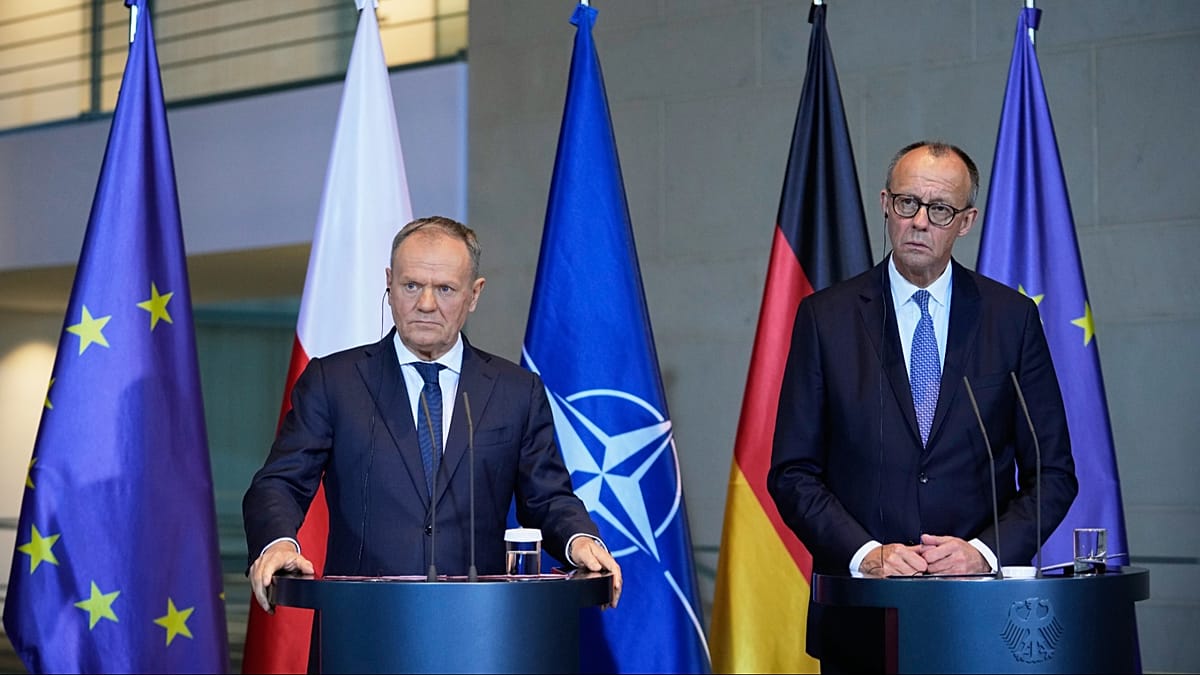
A series of recent posts on Facebook and X have accused Polish Prime Minister Donald Tusk of agreeing that “Poland will pay for the Germans”, following high-level talks with German Chancellor Friedrich Merz that touched on the long-standing issue of World War II reparations.
The phrase appeared in dozens of posts across platforms and became the dominant narrative in online discussions, according to a report by Res Futura, a Polish NGO specialising in information security.
A review of what Tusk actually said in the press conference suggests that several of the claims circulating about him are misleading.
The Cube, Euronews’ fact-checking team, found, alongside analysis from Res Futura, that online reactions often focused on a fragment of Tusk’s comments and ignored the wider context.
What did Tusk say?
At the press conference in Berlin last week, Tusk urged Germany to speed up payments for roughly 50,000 Polish survivors of WWII atrocities who are still alive.
Poland’s former ruling Law and Justice party (PiS) has long demanded Germany pay reparations for its occupation of Poland in WWII, which devastated Warsaw and killed about one-fifth of Poland’s pre-war population.
PiS has calculated the amount to be 6.2 trillion złoty (approximately €1.5 trillion in today’s exchange rate). Tusk and his Civic Coalition party have stopped short of demanding the full amount, and instead called on Berlin to find different solutions, including paying support for the thousands of Polish survivors of the Third Reich.
Since he first discussed the idea with Berlin, the Polish leader said on 1 December that at least 10,000 survivors had died.
As he urged Berlin to speed up payments, Tusk added that if they did not pay quickly, “I will consider Poland meeting this need from its own resources”.
According to Res Futura, Tusk’s comments spread widely on social media through the phrase “Poland pays for the Germans”. Most posts came from accounts connected to PiS and were often detached from the wider context of what Tusk said.
Piotr Buras, head of the European Council of Foreign Relations’ Warsaw office, told The Cube that Tusk’s remark was designed to exert pressure on Germany rather than suggest Poland was going to pay Germany’s bills.
“It is about shaming the Germans and not about promising to pay anything,” Buras said. “These are about 50,000 people who are very old. If Germany is unable to cover this symbolic amount, Poland will take care of its own citizens.”
The reparations debate
One legal expert told The Cube that the question of whether Poland can still demand reparations cannot be answered with a simple yes or no.
Germany argues that the legal issue was settled twice: first in 1953 when Poland renounced its claims to compensation in an agreement with East Germany, and then again in 1990, when Germany reunited and no claim was brought against the new federal republic. Poland was not a signatory to the reunification agreement.
Louis Le Hardy de Beaulieu, professor of International law at l’UCLouvain, said that “from these two standpoints, Germany argues there is no legal basis to go further” and that the argument “has credible elements”.
Poland, however, has asserted that the 1953 declaration is invalid as it was made whilst the country was under Soviet control.
“If we accepted that argument, we would have to revisit every treaty ever signed under a regime different from the one currently in power,” Le Hardy de Beaulieu told The Cube.
According to former Polish Defence Minister and independent politician Jan Parys, Tusk has ignored a motion almost unanimously passed by the Polish parliament that Germany should pay fully for reparations.
“There is a consensus at home that the issue of the war was never truly settled,” Pary told The Cube. “The German state paid large sums to Great Britain, the United States and France, but with Poland, we received only a minimal fund for former concentration camp prisoners.”
“Tusk put forward a decision that went against the decision of the Polish Parliament,” he added.
Beyond legal questions, Buras said that Poland demanding full reparations from Germany would risk a political crisis and threaten co-operation between the two countries.
“It would be the only issue which would dominate this relationship,” he told The Cube.
Is Tusk ‘pro-German’?
According to Res Futura, many of the viral posts on Facebook and X also accuse Tusk of being a “pro-German politician” and a “traitor”, claims that have been levelled at Tusk for years.
“Those who want to portray Tusk as a German agent and someone who is sacrificing Polish interests, they will do it regardless of what his intention is, what his policy is,” Buras said.
“Germany stands, in a way, for Western Europe in the Polish discourse,” he added. “And Tusk is seen as a pro-European politician.”
Parys told The Cube that this perception is rooted in Tusk’s past decisions when he previously led Poland, including his close cooperation with Angela Merkel and disagreements over security policy.
“Poland is divided,” he said. “The opposition favours cooperation with the United States, while the government, led by Donald Tusk, prefers cooperation with Germany.”
Read the full article here