









Tehran says Iran-Oman talks on Strait of Hormuz in “final stages”
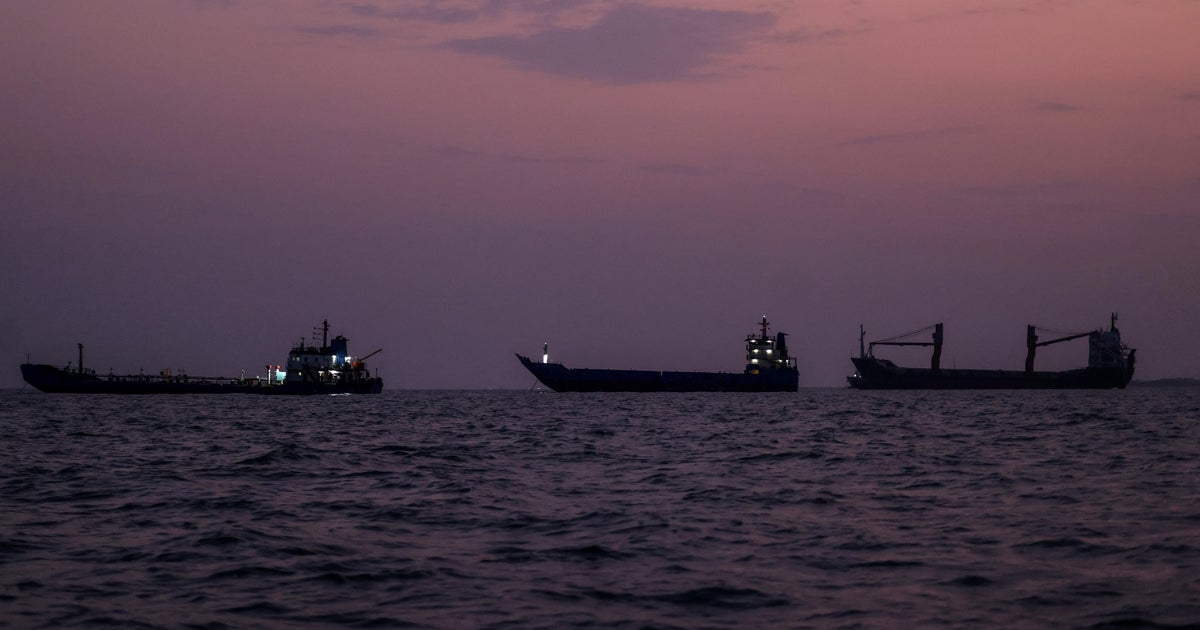
Iran’s foreign ministry spokesman Esmaeil Baghaei said Monday that negotiations with Oman regarding the future of the Strait of Hormuz had reached the “final stage.”
The two countries sit on opposite sides of the strategic waterway and have been engaged in talks for months with the goal of reaching an understanding on how to manage commercial traffic through the strait in the future.
“Within the coming days, the understanding between Iran and Oman for a temporary route safe in the Strait of Hormuz will be registered with the International Maritime Organization.”
Throughout the talks, both sides have suggested the possibility of charging fees for ships to transit the waterway, a notion the U.S. government has bristled at.
Emirati diplomat says restoring trust with Iran will be difficult but necessary
A top Emirati official appeared to extend an olive branch to Iran on Monday, saying that restoring trust with Tehran would be difficult, but necessary.
Anwar Gargash, a diplomatic adviser to the United Arab Emirates president, also said Persian Gulf countries had failed to respond in a united fashion to Iran’s attacks and threats during the U.S.-Iran war, with each country defending itself but not embracing a shared strategy.
Gulf countries bore the brunt of Tehran’s retaliation for American strikes, with missiles and drone strikes hitting military targets as well as civilian areas on a regular basis at the height of the fighting.
“Geography leaves us no alternative to engagement, but we must distinguish clearly between rebuilding a necessary and functional relationship with Iran and rebuilding the trust that has been broken. The first is necessary. The second will be far more difficult,” Gargash said at the Hili Forum in Abu Dhabi.
CBS/AFP
Iran warns South Korea against military deployment alongside the U.S.
Iran’s foreign ministry on Monday warned South Korea against deploying military assets or getting involved in any other way with U.S. operations in and around the Strait of Hormuz, saying such a move would have “serious consequences.”
On Friday, the South Korean government said it would consider taking part in naval operations, provided that its own military readiness was not compromised, but added that no decision had been made.
On Monday, Iran’s foreign ministry spokesperson Esmaeil Baghaei warned Seoul against succumbing to what he called “U.S. pressure and intimidation.”
“Any military deployment or participation in operations by other countries in the Persian Gulf or the Strait of Hormuz can only be regarded as direct support for the party responsible for that aggression and will have serious consequences,” he said in a post on X.
Tehran says it will announce new Strait of Hormuz “exclusion zone”
The new head of Iran’s Supreme National Security Council said Tehran plans to announce an “exclusion zone” outside the Strait of Hormuz aimed at vessels it believes are attempting to transit the waterway.
Mohsen Rezaei’s comments to Iran’s state broadcaster came with few details, a day after the U.S. struck three Iranian oil tankers in response to Tehran launching ballistic missiles at U.S. warships.
The new zone should be announced in the coming days and weeks and “will begin from the line of the U.S. naval blockade, extend toward the Strait of Hormuz, and from this side continue into the Persian Gulf,” Rezaei said without providing more details.
CBS/AP
Price of oil climbs, as regular gas averages nearly a dollar higher than last year’s Labor Day
The price of Brent crude, the international standard for oil, added another 67 cents, reaching $96.95 per barrel.
The average price of regular gas was $4.14 a gallon heading into the holiday, nearly a dollar higher than last year and well above the Labor Day weekend record of $3.82 from 2012, according to AAA motor club.
Prices shot up after the U.S. and Israel attacked Iran in February and have not settled down since. Crude oil traffic through the key Strait of Hormuz has plunged, and Iran has refused to reopen the waterway.
Iran threatens “intense” and “painful” response to U.S. strikes on oil tankers
The speaker of Iran’s Parliament, Mohammad Bagher Ghalibaf, threatened on Sunday to launch swifter and more forceful responses to U.S. attacks, after Tehran targeted American warships in retaliation for U.S. attacks on tankers.
“The Americans must have understood that the era of proportionate responses has come to an end,” said Ghalibaf in a speech carried by state media, adding that “any aggression against Iran’s interests and security will receive a faster, more intense and more painful response.”
U.S. Central Command said Saturday it had “permanently disabled” three Iranian oil tankers in the Persian Gulf and the Gulf of Oman.
“Let the message to the IRGC be clear: If you shoot at two of our ships, we will impose an even higher economic cost — taking out three of yours,” Adm. Brad Cooper, CENTCOM commander, said in a statement. “We will not hesitate to defend American forces, and if necessary, destroy Iran’s limited and exposed oil fleet.”