









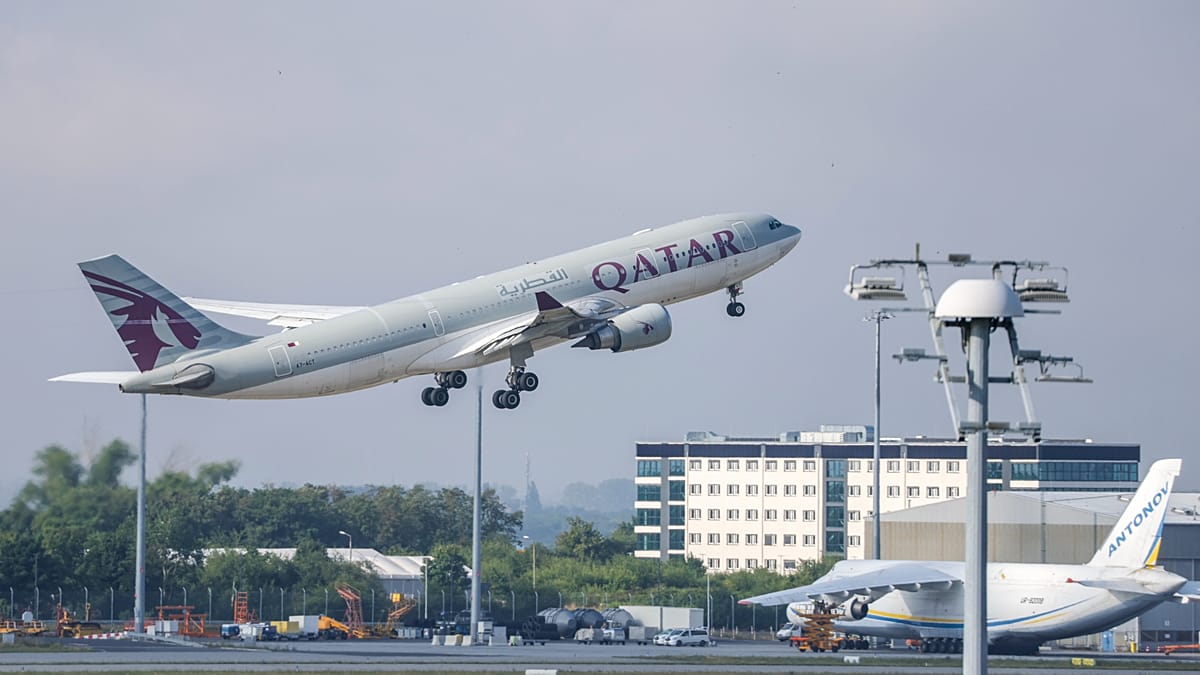
The European Commission on Friday proposed extending its carbon market to international flights arriving in Europe from destinations within 5,000 km from 2029, as part of its long-awaited overhaul of the bloc’s Emissions Trading System (ETS).
ADVERTISEMENT


ADVERTISEMENT
Routes such as Frankfurt–Dubai and Frankfurt–Istanbul will be brought into the carbon market while longer sectors such as Frankfurt–Tokyo will be excluded, according to the Commission proposal. Landing flights from the United States and China will be exempt.
Exemptions for domestic services to the EU’s outermost regions, including routes linking mainland Spain with the Canary Islands, will remain in place until the end of 2035.
Commission officials said the approach would create a fairer competitive environment for European carriers by reducing advantages enjoyed by rival hub airports outside the EU.
The revised ETS is considering measures to accelerate progress toward the sector’s climate goals, meaning flights landing in the European Economic Area (EEA) would have to start paying for the CO2 emissions associated with their environmental footprint from 2029.
“Aviation is the only major sector where emissions are going up rather than down. At the same time, the EU faces a level playing field issue: currently ETS only covers the EEA and quite a few countries, particularly in the Gulf, subsidise their airlines,” Climate Commissioner Hopke Woekstra told reporters on Friday.
“All private jets departing and landing will also be covered. Why should a family flying to Benidorm once a year for their family holiday pay ETS while a private jet user who makes twenty trips a year to luxury locations is not covered,” Woekstra added.
International aviation has been under review to start paying for the pollution they emit under the EU’s carbon market revision, as Brussels is legally obliged to consider expanding carbon pricing beyond intra-European flights, amid global efforts to curb aviation emissions that are falling short.
International aviation is under review for inclusion in the EU’s revised carbon market, as Brussels is legally required to consider extending carbon pricing beyond intra-European flights amid global efforts to curb aviation emissions that have so far failed to deliver sufficient progress.
At stake is the EU’s longstanding “stop-the-clock” arrangement, introduced after fierce international opposition to the EU’s original plan to apply the ETS to all international flights in 2013.
The current ETS system covers flights within the EEA since 2012, while international aviation largely falls under the International Civil Aviation Organization’s (ICAO) CORSIA offsetting scheme.
Legal obligation to consider ETS expansion
If the international framework is deemed insufficient to deliver meaningful emissions reductions by 2032, the Commission must propose extending the ETS to all departing international flights from Europe, rather than only those within 5,000km.
EU officials acknowledged that such a move would be politically difficult but indicated that legal obligations leave little room to maintain the status quo.
“Obviously, we fully realise that this is easier said than done. We are looking at potential options for an expansion that still prioritises multilateral initiatives like CORSIA. The EU was the first and most serious jurisdiction to implement CORSIA,” a second EU official speaking on condition of anonymity said.
However, EU officials argue that growing competitive imbalances — particularly involving airlines operating through neighbouring non-EU hubs — mean additional European measures may be necessary if international progress remains inadequate.
“We don’t believe we can achieve our decarbonisation goals without ETS,” the EU official added, while stressing that carbon pricing must operate alongside regulation, sustainable aviation fuel (SAF) mandates and investment support rather than in isolation.
ETS to fund sustainable aviation fuels
Existing ETS revenues already help fund SAF uptake through a dedicated allocation of emissions allowances and officials said this support could be increased under the revised proposal.
Rules to reach aviation climate targets include 2% of SAF in 2025, a target that has largely failed, scaling to 70% by 2050.
Despite growing political pressure from some EU countries and industrial sectors to soften the ETS in the name of competitiveness, Commission officials rejected suggestions that the carbon market was being fundamentally weakened.
Instead, they argued the post-2030 reforms are intended to preserve investment certainty while aligning the ETS with the EU’s legally binding 2040 climate target.
The Commission argues that slowing the annual reduction, meaning the pace at which industries receive free allowances, merely reflects the transition to the 2040 framework, under which emissions are to fall by 90%, rather than to zero.
Free carbon allowances
The Commission has proposed retaining free emissions allowances beyond 2030 but making them conditional on companies investing in decarbonisation, marking one of the biggest changes to the ETS since its creation in 2005.
Under the proposal, industrial companies would receive 80% of their free allowances after publishing a board-approved decarbonisation investment plan, with the remaining 20% released only after investments and emissions reductions have been delivered.
“Eighty percent of the free allowances will be given to companies on an annual basis after publication by these companies of their plan for decarbonisation investment,” the second Commission official said.
“We will withhold 20 percent of the free allowances, which will be given after the implementation and publication of the investments and emission reductions.”
Commission officials said the reform transforms free allocation from carbon leakage protection into what they described as “investment allowances”, designed to keep manufacturing and clean technology investment in Europe.
More broadly, Brussels wants at least 50% of national ETS revenues to be reinvested in sectors covered by the carbon market, including aviation, maritime transport and energy-intensive industry.
Commenting on the ETS revision ahead of its presentation, veteran EU lawmaker Peter Liese (EPP/Germany), who was appointed the leading negotiator of the ETS revision in the European Parliament, said the ETS was currently “too tight”.
“We cannot uphold a situation where, already in 2039, there are no more allowances available. Neither the aviation nor the energy-intensive industry can be without emissions or even climate neutral by that time,” Liese told reporters a few days before the revision.
“And we need more free allowances than foreseen in the current scheme. The free allowances, however, have to be linked to conditionalities. We cannot accept any longer that companies use their free allowances to invest outside Europe. Best would be to connect them with investments in the particular site so that workers can keep their job,” insisted Liese.
The German lawmaker noted, however, that efforts must be rewarded, meaning that those frontrunners who are already very far on their way to decarbonisation shouldn’t be the victims of the ETS review.
“I think this is absolutely necessary because investments in decarbonisation are already happening. We have a lot of construction sites in Europe and under no circumstances should we change the framework in a way that these constructions will stop,” Liese added.
‘Vested fossil fuel interests’
Kädi Ristok, director of energy and climate at the campaign group Transport & Environment (T&E), praised the success of the ETS, which has cut emissions by roughly 50% from 1990 levels in the electricity, transport and manufacturing sectors since 2005.
But Ristok warned against “vested fossil fuel interests” and several countries which have been treating the mandatory ETS review as a “proxy battle” over Europe’s industrial survival, pushing intensely for an “emergency brake” on carbon pricing, the extension of unconditional free allowances and the dilution of certificate scarcity.
“Weakening the ETS is a short-term bet that will damage Europe’s long-term competitiveness. It also deprives governments of the revenues needed to boost innovative technologies of the future,” Ristok said.
The Council and the Parliament will kickstart political talks after the summer break, in what promises to be tight negotiations between those wanting more climate ambition and those wanting more flexibility for their industries.
Read the full article here