










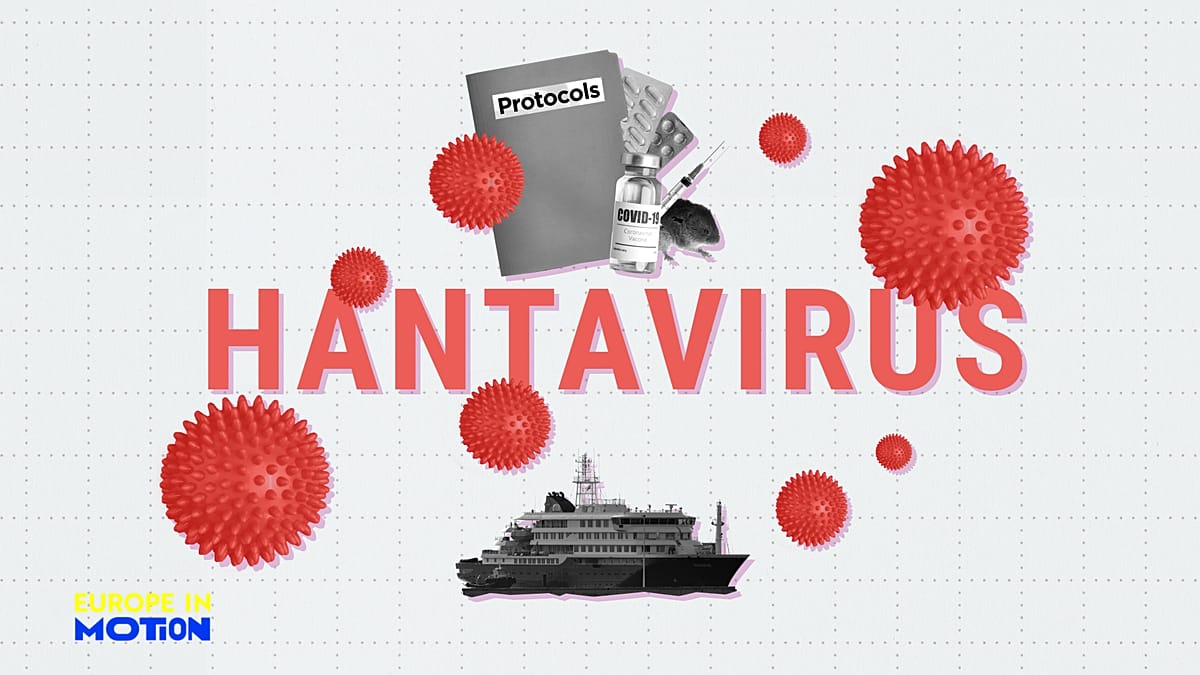
Experts have so far dismissed reasons to panic over hantavirus, but the deaths caused by the aggressive Andes variant on the MV Hondius cruise ship are raising concerns.
ADVERTISEMENT


ADVERTISEMENT
Even though the European Centre for Disease Prevention and Control (ECDC) has classified the risk as “very low”, the Council of the European Union last week activated its crisis response mechanism in information-sharing mode to actively monitor the outbreak.
Yet this is not the only measure the EU can employ: it has more tools to deal with the outbreak in case of a serious escalation.
How about hantavirus quarantine and distancing measures?
Yet there’s an important caveat: when it comes to quarantine and prevention measures, there is no unified protocol or European playbook.
Such a fractured response could have been a problem following the recent hantavirus outbreak, but so far, the international response to the virus seems to have been better coordinated.
Germany, Italy, Spain, the UK, and other European countries dealing with hantavirus cases are, in fact, reacting very similarly, using guidance from the World Health Organization (WHO).
The protocols include a six-week quarantine for high-risk contacts, PCR testing, strict monitoring, limited movement and safe distancing from one and a half to two metres.
Normally, quarantine can be observed at home, but countries such as the UK and France require patients to spend at least part of it in a hospital.
In the former, people need to remain in hospital quarantine for a minimum of 72 hours, while France compels patients to spend the entire quarantine there. However, French authorities say that isolation could be finished early after the first 14 days, depending on the symptoms.
When it comes to the US, health authorities recommend a “monitoring period of 42 days”, which can however be observed at home.
“Decisions regarding where these individuals should reside during the monitoring period should be based on access to healthcare, the home environment, comorbidities, capacity to comply with public health directions, and ability to perform essential daily tasks”, says the CDC.
Other non-European countries, such as Australia and Canada, are instead opting for a shorter three-week quarantine.
What are the EU’s anti-pandemic protocols?
After the COVID-19 pandemic, the EU laid out protocols to improve its speed, coordination and response to cross-border health threats, to avoid chaos sparked by differing regulations and reporting, as well as rows over vaccine approval and distribution across the bloc.
If a new health threat emerged in the EU, two regulations are now particularly important.
The first one is Regulation 2022/2371. Its main provision requires countries to alert each other as soon as possible, within 24 hours, through the Early Warning and Response System.
A threat is considered serious enough to trigger the alert if it’s unusual or unexpected for the given place and time, causes significant mortality, grows rapidly in scale, or affects more than one country and exceeds national response capacity.
Its twin protocol, the 2022/2372, is more about control and coordination, setting out procedures for joint approval and stockpiling of vaccines and medicines, which was one of the most controversial issues during the last pandemic.
The first regulation can be activated by the European Commission based on ECDC or European Medicines Agency recommendations, while the Council of the European Union can launch the second.
On top of that, EU member states can invoke the European Civil Protection Mechanism, which focuses on support for response teams and equipment.
Spain recently launched the mechanism for hantavirus. It also includes 10 non-EU states: Albania, Bosnia and Herzegovina, Iceland, Moldova, Montenegro, North Macedonia, Norway, Serbia, Türkiye, and Ukraine.
Read the full article here