









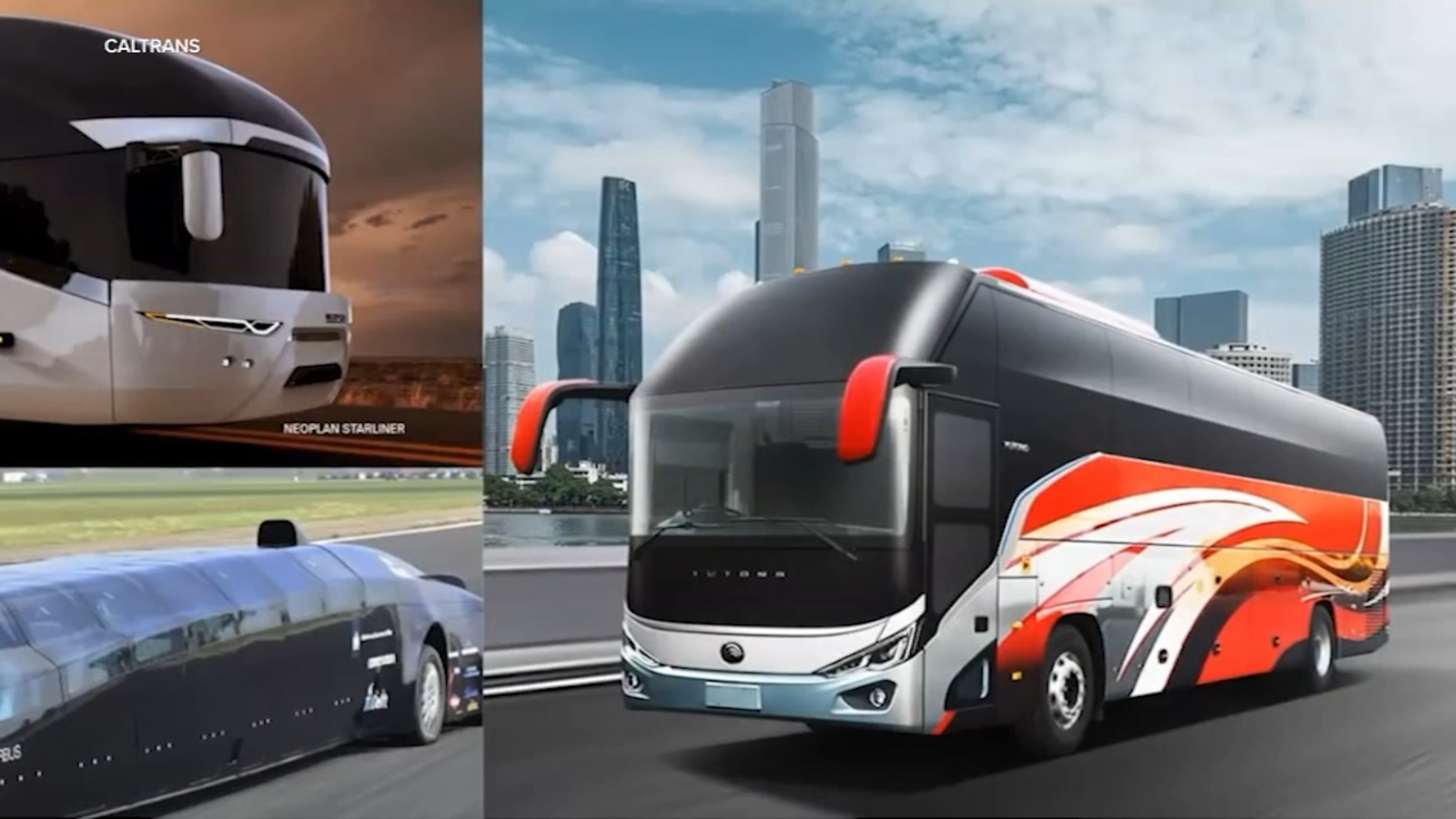
SAN FRANCISCO (KGO) — The California Department of Transportation is exploring the idea of a high-speed bus system that could travel between San Francisco and Los Angeles, offering an alternative form of transportation for travelers who frequently move between the two regions.
The concept, which remains in its early stages, envisions buses traveling at speeds of up to 140 miles per hour on state freeways. Caltrans officials describe the proposal as part of a broader effort to examine what it calls high-speed buses.
“I think it would be great. We need to build more infrastructure in the state of California,” said Jeff Fisher, a San Francisco resident.
In a recent presentation, Caltrans outlined potential routes and corridors that could support the system. Officials pointed to freeways such as the Harbor Freeway and the San Bernardino Freeway as possible starting points.
“Freeways with some infrastructure may be candidates to start such as the Harbor Freeway and the San Bernardino freeway. Or perhaps it would be best to start with the interregional service that can connect Los Angeles with San Diego and San Francisco Bay Area and Sacramento. That would favor I-5 and I-10 as the first freeways,” said Ryan Snyder, Caltrans feasibility studies manager.
MORE: California drops lawsuit seeking to reinstate federal funding for the state’s bullet train
The idea is already drawing interest from some travelers who regularly fly within the state.
“I think it would be a different form of transportation, and I think it might be more accessible,” said Katie Kim, a San Francisco resident who said she flies to Southern California three to four times a year.
“That would be a good idea maybe its faster,” said Arlette Contreras, a tourist.
MORE: Trump administration wants to hand out $2.4 billion it took from California’s high-speed railroad
However, transportation experts say the proposal would face some challenges, particularly in already congested corridors.
“Given the highly congested nature of that corridor on the interstate highways and really some of the secondary roadways, it would be critical that bus lanes would need to be additional lanes. They could not be in place of the existing lanes that people are already traveling on that are already highly congested,” said Rocky Moretti, director of policy and research with TRIP, a national transportation research nonprofit.
The proposal also comes as California spent more than $14 billion on a high-speed rail project intended to connect San Francisco and Los Angeles, according to the California High-Speed Rail Authority, something residents say remains top of mind as new transportation ideas are considered.
“Would love not to have to go through the airport. I’m just sort of skeptical that it will be able to work,” said Bradley Powles, a Hercules resident.
MORE: California Gov. Gavin Newsom signs bill requiring funding plan for state’s high-speed rail project
Caltrans has not provided cost estimates for the high-speed bus concept. A preliminary report noted that if the 140-mile-per-hour target proves infeasible due to cost, infrastructure or safety limitations, a slower speed of 80 to 100 miles per hour could serve as a practical alternative.
“Something that would be quicker and easier would be wonderful I hope it can be achieved,” Powles said.
Caltrans issued a statement writing:
“At this time, the concept remains exploratory. Caltrans is currently exploring the feasibility of operating higherspeed buses on California freeways as a potential enhancement to the state’s public transportation network. This earlystage assessment is focused on understanding how fast a bus could be safely designed to travel on our freeways, what vehicle and safety design requirements would be necessary and whether any modifications to freeway facilities would support such operations.
Vigorous project analysis and feasibility studies are part of Caltrans’ process to determine viability for many concepts and designs intended to improve the transportation network. Caltrans is evaluating what would be required before determining whether future testing or implementation of high-speed busses is appropriate.
The Department’s long-term strategic vision accounts for cutting-edge innovation that will transform the transportation landscape and help our goal of improving quality of life for all Californians. With measured analysis, thorough exploration and thoughtful planning, many of these bold concepts will shape the future of a thriving, connected California.
As part of the state’s ongoing effort to enhance connectivity and convenience for transit users in California, the state is planning express bus facilities in San Diego and Contra Costa counties, with additional locations expected. “
© 2026 KGO-TV. All Rights Reserved.