
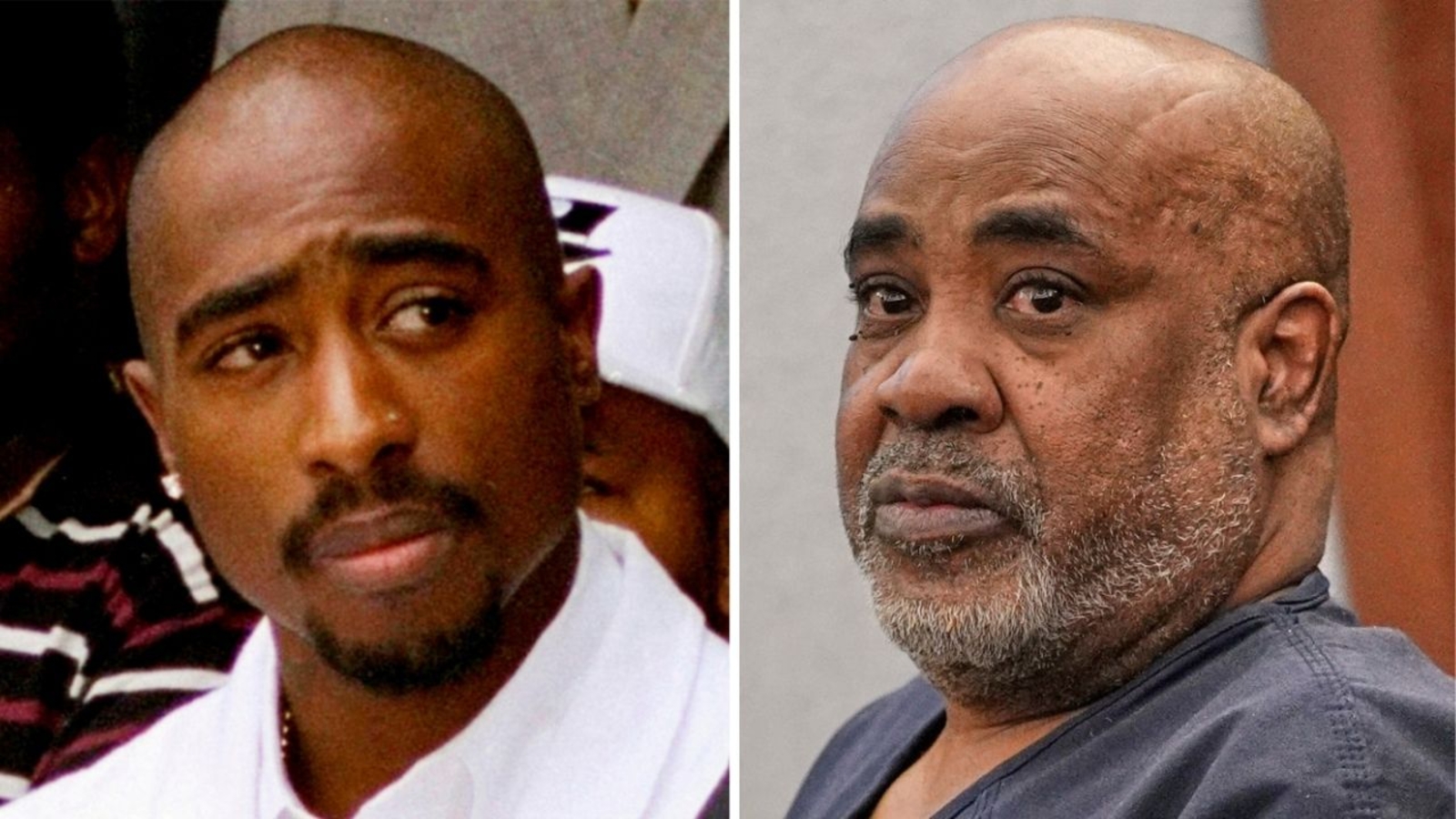







Who killed Tupac Shakur? The long-awaited trial of the man accused of orchestrating the 1996 killing of the rapper officially began Monday in a Las Vegas courtroom.
In opening statements, prosecutors said they intend to prove that former Los Angeles gang leader Duane “Keffe D” Davis ordered the shooting.
“Let’s be clear, Duane Davis did not pull the trigger. But he did plan the shooting in retaliation of the beating of his nephew,” Chief Deputy District Attorney Binu Palal told jurors at the start of Davis’ trial. “Remarkably, you will learn that from Duane Davis himself.”
Davis, 63, is charged with murder with a deadly weapon with the intent to promote, further or assist a criminal gang in Shakur’s death. He has pleaded not guilty. His lawyer in the defense opening called the prosecution’s narrative “fiction.” If convicted, Davis faces life in prison.
Palal showed jurors video of Shakur’s entourage attacking Davis’ nephew Orlando “Baby Lane” Anderson outside the boxing match at the MGM Grand hours before the shooting on Sept. 7, 1996.
Davis, dressed in a blue suit and tie, listened intently as prosecutors claimed he ordered the killing of Shakur as an “act of revenge.”
Some evidence expected to be presented in this case comes from “Compton Street Legend,” a tell-all book Davis published and promoted. But Davis now says he didn’t write it, and claims the book was a ploy to make money.
In an News exclusive jailhouse interview in 2025, Davis denied all allegations.
“I’m innocent. I ain’t kill nobody. Never did ever kill nobody,” he said.
What Davis has told investigators before
In a 2008 interview with a federal task force investigating the killing of Shakur’s rival, the Notorious B.I.G., Davis instead talked about the Shakur shooting. He described handing a gun to the men in the back seat of a white Cadillac that fired on a black BMW with Shakur and Marion “Suge” Knight inside.
As prosecutors played audio of Davis explaining the moment Shakur was shot, members of Shakur’s family, including his stepbrother Maurice “Mopreme” Shakur, sat quietly in the audience, staring ahead.
Palal told jurors Davis held onto a visceral hatred for Shakur for decades that drove him to speak.
He said as early as 1998, the defendant talked to the FBI and admitted he had been in Las Vegas the night of the shooting. He spoke again in 1999 to the FBI and said again he was in Las Vegas then but denied responsibility.
In 2009, he admitted to his role in the killing in an interview with Las Vegas police, Palal said.
“And now 30 years later, we’re going to ask you to finally hold Duane Davis accountable,” Palal said.
Will Suge Knight testify?
Knight, who is serving time in an unrelated case, told News he believes Davis will struggle to convince jurors that his past statements were untrue.
“Everything he said and talked about, he already told on himself,” Knight said.
In the years since Shakur’s murder, what exactly happened in that hail of bullets — and who pulled the trigger — was obscured by a lack of physical evidence, feuding cops and the gangland code of silence. Knight, the only eyewitness still living, was in the car with Shakur when he was shot that night, and told News he is no more willing to cooperate with law enforcement during Davis’ trial than he has been for the last 30 years.
“To actually get on the stand, and point somebody out, it’s worse than taking a gun and shooting that man in the head. Because if you shoot a person in the head, they die once. If you get on the stand and you snitch on that person, they die a million times,” Knight told News from prison earlier this month, ahead of Davis’s trial. “Leave me out of it.”
Legal analyst Joshua Ritter said Knight’s account would be significant if he takes the stand.
“I mean, he’s probably the primary percipient witness to the entire murder. He was the driver. He’s sitting right next to Tupac as he gets shot. He gets shot himself. These are important parts,” Ritter said.
Prosecutors say that, though Davis did not fire the gun that killed Shakur, the admitted longtime leader of the Southside Crips from the Los Angeles community of Compton was the “shot caller” and riding with the assailant.
Prosecutors have a lengthy list of potential witnesses — including original investigators on the case, and members of Davis’ crew who prosecutors alleged were with him in Vegas that night.
Lawyers for Davis plan to call, among others, an expert witness who specializes in false confessions. According to information provided to the court, that witness is expected to testify about coercive interrogation techniques and how memory becomes less reliable over time.
With proceedings expected to last roughly a month, the verdict could conceivably come right on the anniversary of Shakur’s death.
Shakur died at the University Medical Center in Las Vegas on Sept. 13, 1996. He succumbed six days after he and Knight were shot.
Shakur’s legacy lives on both through his music and the mystery that still surrounds his murder. But now that mystery may come to an end as Davis stands trial.
“This wasn’t your typical unsolved cold case where they didn’t have a suspect. I think they clearly had suspects for some time and now they’ve finally been able to put together the witnesses willing to come forward,” Ritter said.
News and The Associated Press contributed to this report.
© 2026 Television,