







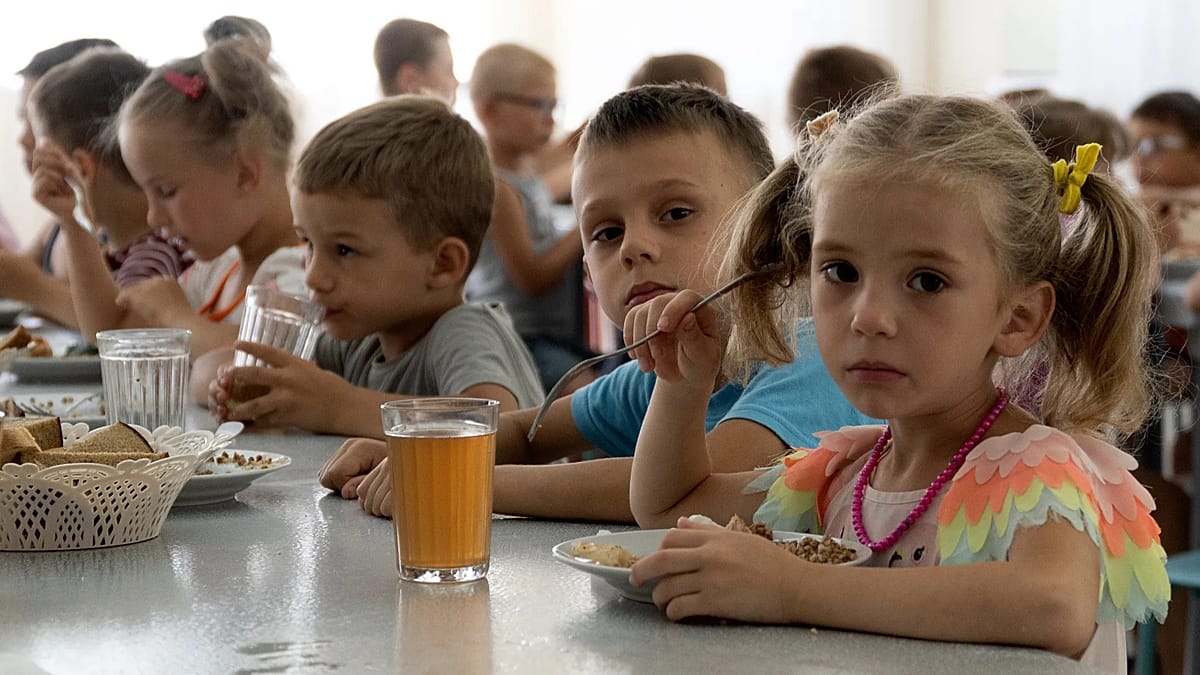
The head of the Bring Kids Back UA initiative has called for those responsible for Russia’s illegal deportation and forcible transfer of Ukrainian children to face prosecution, as the EU prepares new sanctions targeting another 27 Russian individuals and entities.
ADVERTISEMENT


ADVERTISEMENT
“Bring Kids Back UA has continuously called for all those responsible for Russia’s illegal deportation and forcible transfer of Ukrainian children to face prosecution, and we welcome this positive action from the European Union towards ensuring accountability for these crimes,” Maksym Maksymov told Euronews.
“Children who remain under Russian control continue to face the risk of indoctrination, militarisation and the erosion of their Ukrainian identity,” he said.
“There are still thousands of Ukrainian children who have yet to be returned home. The longer they remain under Russian control, the greater the risks they face.”
EU ambassadors reviewed the proposed listings on Wednesday at their first meeting since the summer recess.
“This is a humanitarian issue that concerns the entire international community. Every child who is returned demonstrates that coordinated international action can make a difference, while measures such as these send a clear message that these crimes will not go unanswered,” Maksymov said.
The new sanctions are being prepared ahead of a conference of the International Coalition for the Return of Ukrainian Children in Toronto, Canada, on 28-29 September.
“Through the International Coalition for the Return of Ukrainian Children, governments and international partners can support efforts to secure these children’s safe return while strengthening the international mechanisms that protect children during armed conflict,” Maksymov said.
Brussels has previously targeted those involved in Russia’s deportation and forced assimilation of Ukrainian minors, with individual listings included in earlier sanctions packages.
In May, EU countries blacklisted 16 individuals and seven entities over the unlawful deportation and forced transfer of Ukrainian children, including their indoctrination, militarised education and unlawful adoption.
Following Wednesday’s presentation, further technical work is required to finalise the new listings, including legal checks intended to ensure they can withstand challenges in court.
The European External Action Service has also shared with member states a list of 1,600 individuals and entities directly contributing to Russia’s war effort, part of a broader shift away from large, sector-focused sanctions packages.
How many Ukrainian children are in Russia?
Ukraine has verified the deportation or forced transfer of more than 20,500 children, although the true scale is believed to be considerably larger.
Yale’s Humanitarian Research Lab estimates the number may be closer to 35,000, while Moscow has openly suggested it could be as high as 700,000.
The US-based Institute for the Study of War has said that the true number is almost impossible to verify.
Euronews previously reported that Russia-installed occupation authorities in Ukrainian regions created an online “catalogue” of Ukrainian children, offering them for coerced “adoption” through the education department.
The minors were reportedly sorted and categorised so users could “filter” them by age, gender and physical characteristics such as eye and hair colour. The children were also described in terms of personality traits, with some labelled as “obedient” or “calm”.
Returning even one child can take years, from the moment Ukrainian authorities identify them until their eventual return home.
Almost every return so far has been mediated by a third state, notably Qatar, South Africa and the Vatican.
In March, the United Nations said that the deportation and forcible transfer of Ukrainian children to Russia constitutes a crime against humanity and a war crime.
“Bring Kids Back UA will continue working with our Ukrainian and international partners to ensure these children are returned safely to their families and their homeland,” Maksymov said.
Read the full article here