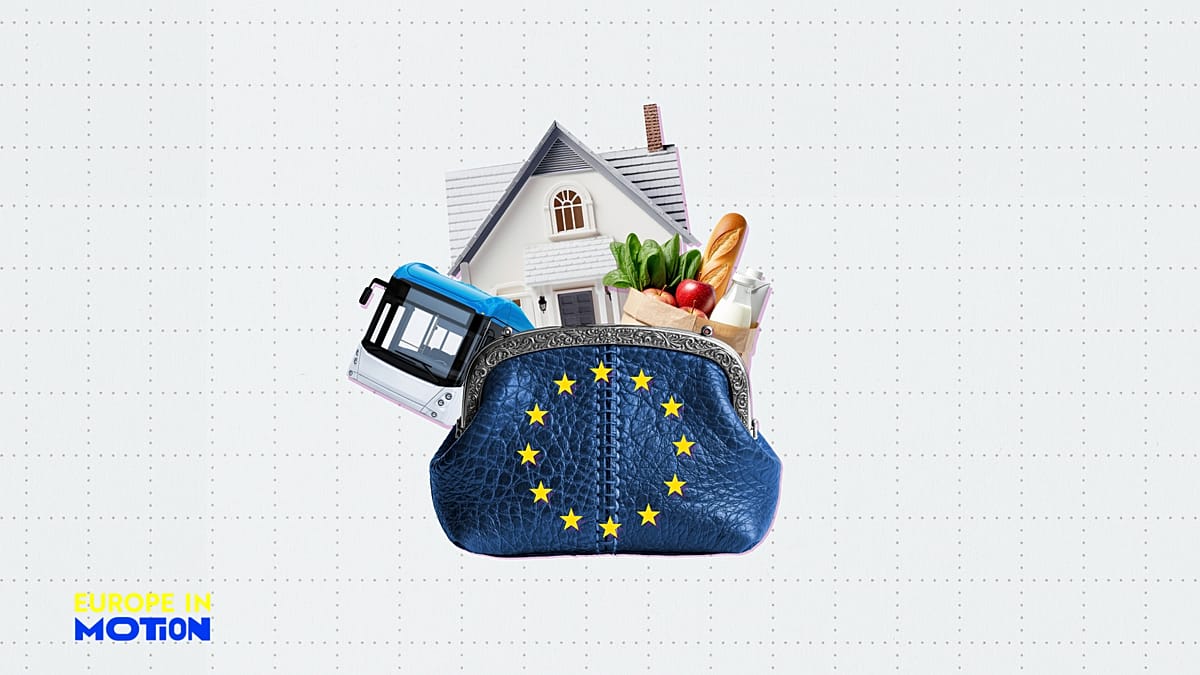










Senior EU officials are doubling down on the need for substantial new EU-level taxes to finance the bloc’s long-term budget, pushing back against scepticism from the so-called “frugal” member states.
ADVERTISEMENT


ADVERTISEMENT
The question of new own resources, part of the Multiannual Financial Framework, the bloc’s €2 trillion long-term budget for 2028–2034, dominated the informal meeting of European Affairs Ministers in Dublin on Thursday and Friday.
“The issue of own resources is an absolute prerequisite for us to adopt this budget,” Benjamin Haddad, the French Minister for European Affairs, told reporters on the margins of the meeting on Thursday.
“Our priority, once again, is to adopt a package of own resources which is in line with what the European Commission initially proposed. We are discussing own resources that essentially rely on actors outside the European Union to generate the funds needed to finance this Multiannual Financial Framework,” Haddad said.
Pressure for an ambitious budget backed by substantial new taxes has intensified since negotiations resumed after the summer recess, following a gathering of the “frugal” countries in Berlin last week.
Besides pushing for an overall reduction in the budget’s volume, the frugals – a group made up of the EU’s largest net contributors – remain sceptical that own resources would generate significant revenue.
That scepticism is rejected by member states including France and Spain, as well as by leading EU institutional figures who are pushing for an ambitious budget underpinned by own resources.
“The European Union must have genuine and new own resources that can help raise the level of ambition of the budget” said Spain’s Secretary of State for the EU, Fernando Sampedro, “but it must also consider the rollover of The Next Generation EU.”
“The challenges are bigger than in the past. We cannot do more with less. It is time to deliver, and that involves an ambitious budget. The way to do it would be with own resources, new joint debt and the rollover of the current debt.”
The bloc is expected to reach a deal on the MFF by the end of the year, avoiding a postponement of talks into 2027, an election year for France, Italy, Poland, Finland, Greece, Spain, Slovakia and Estonia.
“The message to all stakeholders is clear, and I think increasingly from all stakeholders, we need to reach an agreement on the next long-term EU budget by the end of the year,” Irish Minister for European Affairs Thomas Byrne said at a press conference on Friday.
“A balanced and ambitious package of so-called new own resources, the new revenue streams for the European Union, will be an essential part of an overall agreement,” European Council President António Costa said during a visit to Cyprus on Friday.
The European Parliament, meanwhile, is calling for a 10% increase to the budget’s main headings and wants repayment of the recovery fund, the loans used to fund the bloc’s recovery from the COVID-19 pandemic, kept off-budget.
“It’s very important to try to work on new own resources to have the conditions to support the new priorities that we have in the European Union, such as competitiveness, security, and defence, and the traditional policies, like cohesion, agriculture and fisheries,” MEP Carla Tavares (Portugal/S&D) said on the margins of the meeting in Dublin.
The European Commission proposed a set of own resources in its original budget proposal, which has since faced significant opposition from several member states.
“Today, we need a transformation of the whole of the European economy. If we as Europeans want our continent to determine its own destiny Also in the future, we must have strong economy and we need to invest into our competitiveness,” European Commissioner for the budget Piotr Serafin said in a press conference on Friday.
The Commissioner has repeatedly stressed that own resources are needed to power ambitious budget which could encourage investment in both strategic and traditional sectors.
The European Parliament has floated three alternative ideas, which the Commission estimates could yield up to €11 billion a year.
Costa is currently touring Europe to discuss the budget with member states. In the first two weeks, he met leaders from Slovakia, Estonia, Lithuania, Latvia, Czechia, Luxembourg, Croatia, Hungary, Romania, Bulgaria, Greece, Cyprus and Slovenia.
Next week, the European Council President will meet leaders in Poland, Germany, Malta, Spain, Portugal and Finland. He will not visit Sweden, which is heading to the polls on 13 September, possibly leading to an even more fiscally hawkish government.
The tour is intended to sound out countries’ “red lines”, helping Costa gauge how far the budget negotiations can go.
The Irish government, which currently chairs discussions among member states in Brussels, is expected to propose a new compromise text before mid-October, when EU leaders gather in Brussels for the European Council.
That compromise is expected to include a package deal on own resources, Euronews understands. To reach a final deal, all 27 member states must agree on the budget, with the consent of the Parliament.
Read the full article here