









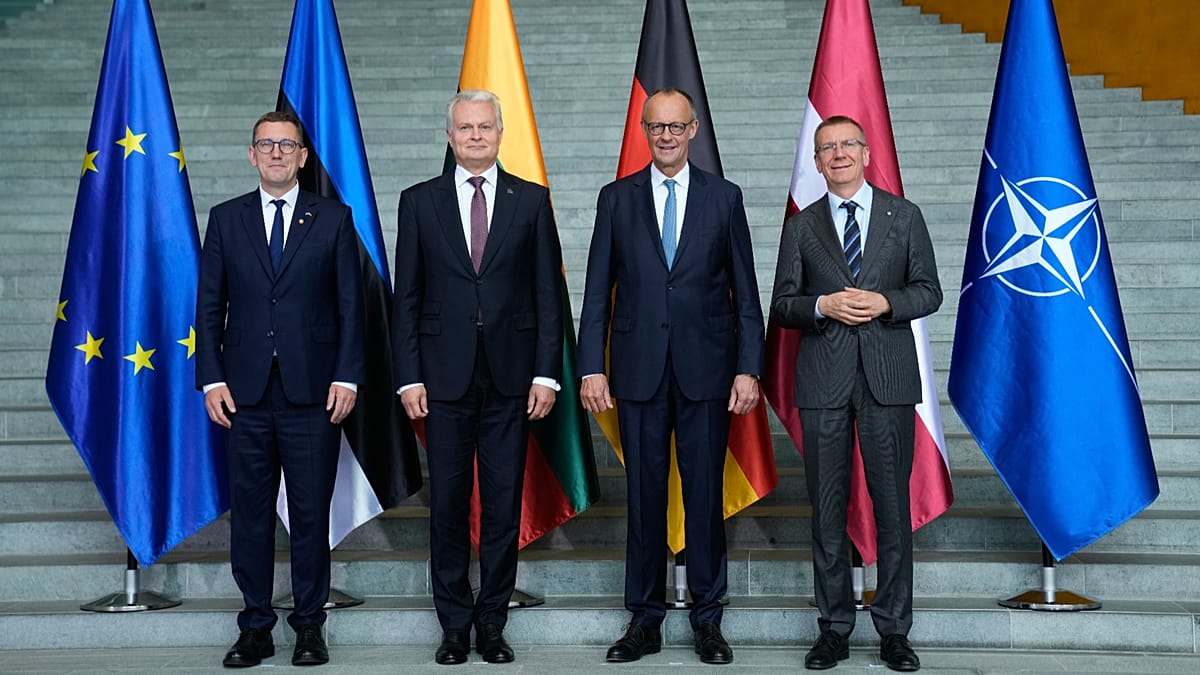
“The security of the Baltic states is also Germany’s security,” Chancellor Friedrich Merz (CDU) said as he welcomed the leaders of Estonia, Latvia and Lithuania to Berlin. He was referring to a plaque on Vilnius Town Hall which reads:
ADVERTISEMENT


ADVERTISEMENT
“The security of Lithuania is our security. The defence of Vilnius is the defence of Berlin.” The quote comes from a speech he delivered at the formation ceremony of the 45th Armoured Brigade in Lithuania in May last year.
Preparations for next week’s NATO summit in the Turkish capital, Ankara, were high on the agenda. At a joint press conference, Merz said coordination with Estonia, Latvia and Lithuania “is close to our hearts and will remain so well beyond the NATO summit.” He added that the summit “must be a success” by making NATO “more European so that it can remain transatlantic.”
Estonian Prime Minister Kristen Michal said the summit “must focus on delivery.”
Three priorities for the upcoming NATO summit
The Latvian president echoed that view, outlining three priorities for this year’s summit. “Number one: we have decided that 5% defence spending last year in The Hague, but what’s important is that now this figure is transformed into real capabilities. Sometimes we see that this is not the issue of money, but buying the right equipment, the right armourment and we see that we need to bolster the defence industry of each NATO memberstate,” President Edgars Rinkēvičs said.
“Second,” he added, “it’s important that despite of some discussions we have in the alliance – some public, some private – the alliance is united, and is united behind Article 5, behind all the committments.”
His third priority, he said, was ensuring continued support for Ukraine. “I do hope we come to a common term when it comes to tackling Russian and Belarussian hybrid threats, and all other provocations,” he added.
‘Security of the Baltic states is the security of NATO’
Merz said Germany was learning from its Baltic allies, recalling that they had recognised much earlier that we must be prepared to do something for our freedom, our security and our prosperity.
“The threat is not abstract; it is very real on NATO’s eastern flank,” he added. According to Merz, Russia is constantly violating NATO airspace, carrying out hybrid attacks in cyberspace and has also damaged undersea cables in the Baltic Sea.
“Moscow is testing how united and determined NATO is. We have been seeing where this Russian revisionism can lead for more than four years now in Ukraine,” the chancellor said, noting that the Baltic states had “long since met and exceeded” the 3.5% defence spending target agreed at last year’s NATO summit in The Hague.
Rinkēvičs warned that if the Alliance failed to meet its targets, the Baltic states could “have to pay more” in the event of a Russian attack. “To a certain extent, defence spending is also a form of deterrence and it is precisely this deterrence that we urgently need,” he said.
Estonian Prime Minister Kristen Michal likewise stressed the need to turn commitments into concrete capabilities. “We agreed to invest more in defence, now we must turn those commitments into capabilities. Estonia is already investing more than 5% of GDP in core defence, the other baltic states and Poland are doing the same. We also need closer cooperation in the defence industries and more joint procurement. This is how we close capability gaps faster.”
He underlined that the security of the Baltic states is “the security of NATO,” adding that the region “know[s] their neighbour” and “understand[s] the threat”. Calling Germany “one of our closest allies and one of the key contributors to the security of the Baltic region,” Michal highlighted the role of the German-Dutch Corps, which has taken over tactical command of the Allied land forces in Estonia and Latvia, as well as Germany’s contribution to NATO’s Baltic Air Policing mission.
He added that the EU could “strengthen these efforts” by providing greater support for military mobility, the defence industry, critical capabilities and the eastern border, which is “in the EU’s common interest.” Lithuanian President Gitanas Nausėda pointed to the permanent deployment of Germany’s 45th Armoured Brigade, which is due to be fully stationed in Lithuania by the end of 2027, describing it as a “strengthening of our defence.”
“If you ask some Lithuanians what they think about German soldiers on the streets of Vilnius or other Lithuanian cities, they will answer that they are more than welcome. this is the best proof and example of our solidarity and our friendship,” Nausėda said.
‘Europe must assume greater responsibility for its security’
Nausėda also argued that Europe must take greater responsibility for its own security. “A stronger Europe, within a stronger NATO, should remain our common strategic objective.” The upcoming summit, he said, therefore had to deliver tangible results. According to the Lithuanian president, Lithuania is on track to spend almost 7% of its GDP on defence and security this year – “significantly exceeding the commitment agreed in the Hague summit.”
Latvian President Edgars Rinkēvičs stressed that any attack on the Baltic states would amount to a “direct confrontation” with NATO. “That is something we sometimes miss in all of our discussions when we talk about the security of each and every single ally, we talk about the security of the whole alliance,” Rinkēvičs said. Merz said the four leaders had also discussed stepping up support for Ukraine and reaffirmed their commitment to Kyiv. He added that Germany would continue to back US efforts to achieve a lasting end to the war in Ukraine.
“We also take the Russian threat very seriously and we are preparing for it: we will reach the 3.5 mark agreed in The Hague as early as 2029, well before the agreed deadline,” the chancellor said. Alongside the NATO spending target, Merz highlighted Germany’s support for Ukraine, while acknowledging that the Baltic states were contributing more on a per capita basis.
“The Baltic states committed years ago to make 0.25% of their gross domestic product (GDP) available for assistance to Ukraine,” he said, describing the decision as “exemplary.” Merz argued that an end to the war – or even a negotiated ceasefire along the current front line – would only be possible if Russian President Vladimir Putin chose that path. “President Putin must end this war; it is entirely up to him to do that.” He added that the Baltic states would be “closely involved” in efforts to bring Putin to the negotiating table. The US nuclear umbrella also featured in the talks.
Nausėda referred to an agreement between the parties represented in Lithuania’s parliament, reached at his initiative, to begin lifting the constitutional ban on nuclear weapons and foreign military bases in the country. According to the president, the move would enable Lithuania to play a greater role in NATO’s nuclear deterrence against Russia.
Ukraine’s accession to the EU
Merz also addressed Ukraine’s path towards EU membership, highlighting his proposal for “associated membership.”
“This is, in my view, a very far-reaching offer, one that no candidate country has received before. In this way we could already bring Ukraine closer to the European Union today,” Merz said.
He stressed that such a status would not replace full EU membership, but would instead serve as a step towards it, acknowledging that accession “will, however, still take some time.”
Estonian Prime Minister Kristen Michal likewise underlined Ukraine’s European ambitions.
“A just and lasting peace also requires a clear path to the EU,” he said. “Ukraine has long been ready,” he added, arguing that the EU should open the remaining accession clusters for Kyiv.
Doing so, he said, would be “not a favour for Ukraine”, but in the EU’s own “strategic and economic interest”.
Read the full article here