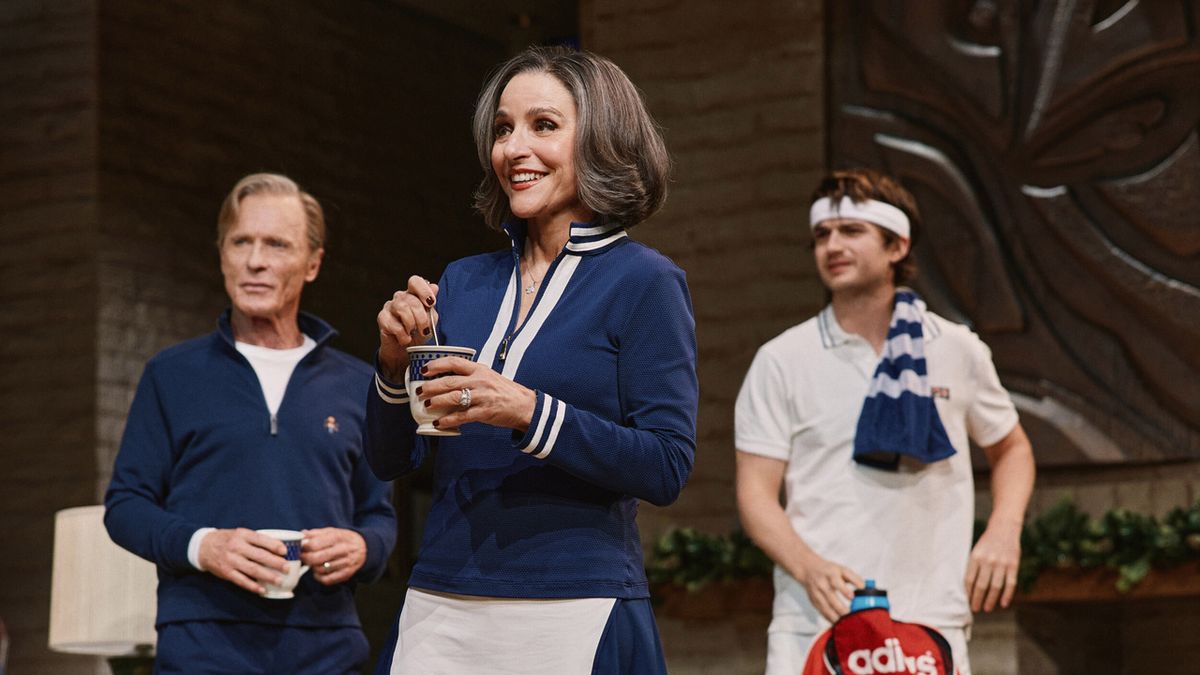
Now running at Broadway’s Hudson Theatre is Julia Louis-Dreyfus, Ed Harris, Allison Janney, Joe Keery, and Lily Rabe in the first Broadway revival of Jon Robin Baitz’s Tony Award-winning play Other Desert Cities, directed by Tony Award winner John Benjamin Hickey. Other Desert Cities will play a 16-week limited engagement through Sunday, January 17, 2027.
Every family has a secret. Not every family survives it. On Christmas Eve, the sunlit Palm Springs home of a politically connected family becomes a battleground of memory, loyalty, and legacy when a daughter returns with a memoir and the power to expose the explosive truth they’ve kept hidden. As the past comes into focus, the question isn’t just what happened, but who owns a family’s story, and what is the cost to tell it.
Let’s see what the critics are saying about the star-studded revival…
Jonathan Mandell, New York Theatre: Louis-Dreyfus does a credible job; her theatrical training, though long in the past, is self-evident. But most of the memorable moments in the production belong to other cast members: The single most memorable moment for me is Ed Harris as the patriarch Lyman Wyeth re-creating how he used to die in the movies. There are riveting monologues by both Rabe and Stranger Things’ Joe Keery, who is also making his Broadway debut, in the role of the son Trip.
Melissa Rose Bernardo, New York Stage Review: Rabe doesn’t hesitate to make Brooke snotty, entitled, and infuriating: Is she really so naive that she thought this book, which apparently blames her parents for Henry’s drug use and eventual demise, and accuses their high-placed republican friends of who knows what, wouldn’t destroy Polly and Lyman? When Harris looks at her, registering his disappointment—“I only had a little bit of my heart left intact after we lost Henry, and what’s left is breaking”—your heart will break too.
Frank Scheck, New York Stage Review: But Other Desert Cities also features sympathetic, complex characters who largely defy our expectations, with the result that it’s consistently engrossing nonetheless. There’s little point in comparing this cast to the off-Broadway and Broadway originals, who were superb, except that these players, under Hickey’s too relaxed direction, don’t quite bring the same edge. Dreyfus seems a bit miscast, easily scoring big laughs with her expert comic delivery but not successfully conveying her character’s rancorous nature. The same could be said of Janney, also very amusing but not fully convincing as someone supposedly ravaged by the effects of alcoholism. Harris, adorned with a distracting if appropriate blond wig, plays his role perfectly in mostly understated fashion with the exception of a mock death scene that brings down the house.
The real acting linchpins of the production are Keery, making an outstanding Broadway debut with his sharp turn as the acerbic Trip and scoring a triumph with his second act monologue, and Rabe, deeply affecting as the daughter who undergoes the play’s most seismic shift. The two younger performers may not be at the top of the billing, but they prove the evening’s MVPs.
Joey Sims, Theatrely: Of the production’s two genuine cast standouts, one is unsurprising: stage veteran Lily Rabe is both heartbreaking and appropriately annoying as Brooke, a high-intensity individual struggling with deep wells of pain. Rabe is not exactly restrained here, but her severity feels truthful. A greater surprise is Joe Keery, of Stranger Things fame, a natural stage presence who carefully reveals the confusion and torment lurking under Trip’s surface aloofness.
Adam Feldman, TimeOut New York: The men fare better. Harris is superb as Lyman, a craggily handsome Clint Eastwood type who tends toward the laconic—Polly is happy to do most of the talking—but who, when he does speak, does so with decency and feeling; Keely keeps a smooth balance on a precarious fence between Trip’s parents on one side and his sister and aunt on the other. And both men nail their big comic moments: Harris in an extended fake death, Keely in pouring out confessions while rolling a joint.
Aramide Timubu, Variety: “Other Desert Cities” is a resounding piece of theater, not simply because of the subject matter but because of the performances. The entire cast works as a seamless ensemble, switching from quippy wit, including Polly’s assertion that sarcasm is “only for teenagers and homosexuals,” to heartbreaking and volatile outbursts rife with the pain of a family standing on a foundation of lies and hypocrisy.
Christian Lewis, New York Theatre Guide: Alas, despite Baitz’s well-made play and an A-list cast, this revival is under-directed by John Benjamin Hickey, which leaves the actors feeling unmoored. Though Other Desert Cities has interesting points to make about family dysfunction, ethical obligations, and political complicity, particularly in the Republican party, the piece’s relevancy is overshadowed by the awkward production.
The entire Wyeth family are complex and morally gray, slippery and in some cases monstrous, and this cast doesn’t fully capture their shifting tides. As an ensemble, they struggle to work together and to elevate each other’s performances.
Richard Lawson, Hollywood Reporter: The best acting is done by Stranger Things star Keery, who credibly embodies a young man whose privilege and access have certainly made him cynical, but not yet entirely indecent. He is simply the spoiled, listless baby of a family whom he is too young to have known at their mightiest, before the postlapsarian retreat to the desert, buried child in tow. Keery nails the way that guys of a certain stripe tend to pivot between snark and sensitivity, punctuating real feelings with a joke or a nihilistic provocation. He understands the intended tone of Baitz’s rickety dynasty, the clan’s haughty but not entirely confident put-on that through even this, they — like a noble idea of old America itself — shall endure.
Shelby Stivale, Entertainment Weekly: Where Other Desert Cities really thrives is in its moments of levity. The show, at its core, is comment on how one’s mental health struggles impact those around them. But just when things are getting a bit too heavy for the audience, Allison Janney enters the chat. Playing Polly’s sister Silda, a recovering alcoholic, The West Wing star does what she does best: brings the laughs. And director John Benjamin Hickey, who won a 2011 Tony Award for his role as Felix Turner in The Normal Heart, has her lean into physical comedy. (One particularly standout moment has Janney smelling the alcohol residue left in a glass as she wishes to live in that scent.)
Thom Geier, Culture Sauce: After setting the stage with a punchline-heavy first act, the tone shifts after the intermission to a more serious drama where Rabe’s Brooke confronts her parents and presses them to open up after years of shutting down any difficult subject matter. When the gate is open, there’s no turning back. And Louis-Dreyfus steps up to the moment in a memorable series of speeches where she finally drops the carefully manicured, Missoni-inspired armor she’s been wearing for years (costumes by Tom Broecker) to reveal a rawer, appealingly vulnerable woman underneath.
Dave Quinn, People: At the center of it all is Louis-Dreyfus, whose Polly is as entertaining as she is difficult to love.
As she’s demonstrated in films like Enough Said, You Hurt My Feelings and Tuesday, Louis-Dreyfus has long been capable of much more than comedy. Here, she puts those dramatic instincts to good use, allowing glimpses of Polly’s vulnerability to emerge even as the character fights to keep her emotions in check.
She can squeeze a laugh from seemingly any line, but it’s in the play’s second act, when long-buried truths finally come to light, that her performance becomes truly extraordinary. As Polly’s carefully maintained composure begins to fracture, Louis-Dreyfus allows us to see the grief and fear she’s spent years suppressing beneath a polished mask of privilege and perfection.