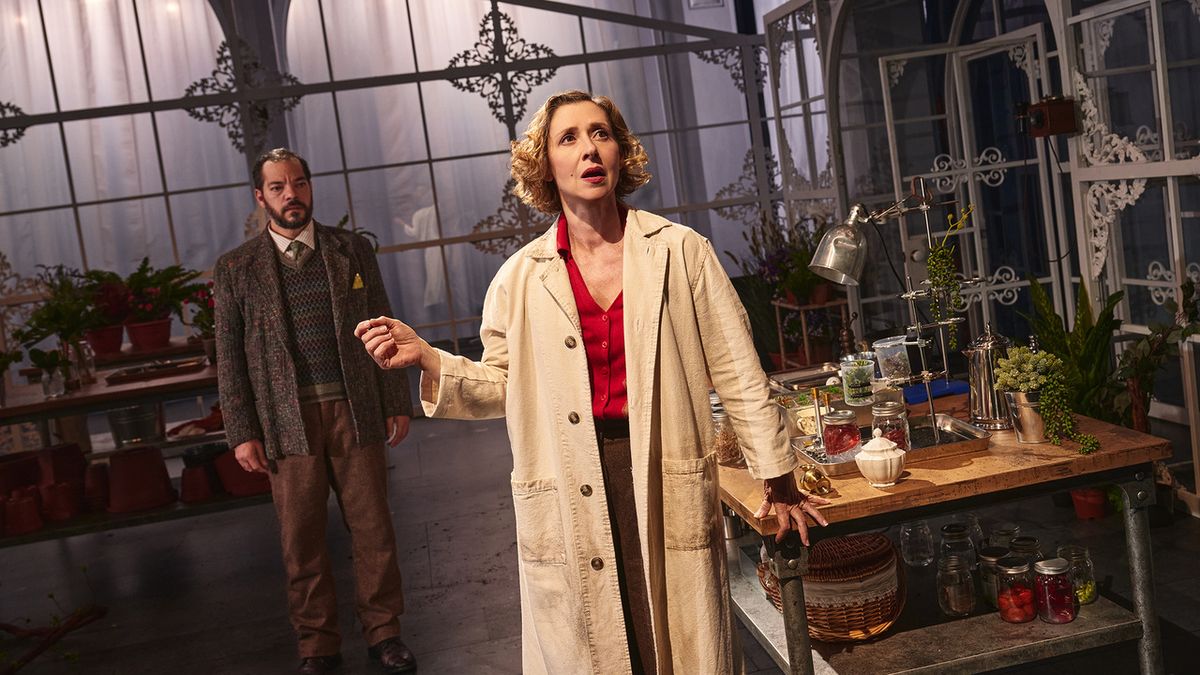
Fiasco Theater’s production of The Verge officially opens tonight, November 5, 2026, at The Public Theater. What do the critics think of Fiasco Theater’s production? Read the reviews below!
Directed by Jessie Austrian, the production stars Miriam Silverman and continues its limited engagement through Sunday, November 22.
Joining Silverman as Claire Archer are Noah Brody as Harry, Paul L. Coffey as Anthony/Dr. Emmons, Devin E. Haqq as Dick, Amara Leonard as Elizabeth, Paco Tolson as Tom, and Emily Young as Adalaide/Hattie.
Written by Susan Glaspell in 1921, The Verge follows Claire Archer, a botanist determined to cultivate a plant unlike anything that has existed before. When her husband, lover, and soulmate arrive at her greenhouse seeking refuge from a snowstorm, their competing demands threaten to derail her ambitions. As Claire challenges the expectations imposed upon her, she begins to question whether breaking free from society’s constraints requires destroying them altogether.
Blending farce, philosophical debate, and feminist commentary, the play explores the boundaries of identity, creativity, and personal freedom.
The creative team includes scenic designer Lawrence E. Moten III, costume designer Sarita P. Fellows, lighting designer Amith Chandrashaker, sound designer Bailey Trierweiler, music supervisor Daniel Kluger, and props director Caitlyn Murphy. Caroline Englander serves as production stage manager.
Helen Shaw, The New York Times: “The Verge,” directed by Jessie Austrian at the Public Theater, frequently refers to characters’ being “queer,” although in 1921, the word still mostly meant “strange.” Glaspell may not have been overtly (or consciously) referring to same-sex relationships, yet straight sexuality is certainly depicted as explicitly deranging.
Thom Geier, Culture Sauce: You can see why the play is so seldom performed. This is a problematic show with all-too-rare flashes of genius and ahead-of-its-time perspectives. Despite some intermittently funny moments of farcical humor, which director Jessie Austrian stages effectively on the Lawence E. Moten III’s simple period set, there’s a lot of antiquated speechifying that makes The Verge a very long and rather dull sit.
Kenji Fujishima, TheaterMania: And yet, it’s a tribute to the strength of Glaspell’s writing that this production’s oddities and shortcomings ultimately don’t matter all that much. If this revival garners enough interest among theatermakers to produce more of her work, perhaps that means there will be more productions of this particular play to dig even deeper into the intricacies and nuances of its rich text. Based on the dark poetry and feminist verve of The Verge, Glaspell’s oeuvre is one worth rediscovering.
Christian Lewis, New York Theatre Guide: Silverman gives a strong central performance — angry, passionate, and playful — but the slow-paced direction by Jessie Austrian doesn’t streamline the show, and some of the supporting players, especially Emily Young (as Claire’s sister) and Paco Tolson (as Claire’s best friend) fall flat. Lawrence E. Moten III’s sets and Sarita P. Fellows’s period costumes are delightful, though they can only do so much to alleviate the onerousness of the piece. The Verge explores a host of important themes — motherhood, mental health, eugenics, religion, art, and the aftermath of World War I — that offer a great deal to study and analyze, but this production does not make a case for it being performed.
Michael Sommers, New York Stage Review: A philosophical comedy with a tragic conclusion, The Verge studies an iconoclast whose anxiety provokes bouts of destructive behavior. Ultimately the verbose, symbol-coded play scarcely proves to be a lost masterpiece, but offers great interest to scholars of course, and it’s a little late in the day anyway to criticize Glaspell’s dramaturgy. Personally speaking, it was a pleasure to finally make this play’s edgy acquaintance.
Loren Noveck, ExeuntNYC: In the end, though, The Verge rises and falls on Claire, and Silverman’s Claire is a shot to the heart. On my way out of the theater, I walked behind two women discussing that they’d very much feared the play would end with Claire’s suicide (a la Hedda Gabler) or institutionalization. Instead, it leaves us with Claire triumphant, and the rest of the company–and ourselves–less sure than ever whether she’s inspirational or repulsive. But in her unwavering insistence on valuing originality for its own sake, for seeking to transcend what we know and are without equating transcendence and improvement, Claire spits in the face of our own age as much as her own. She reminded me that endless growth isn’t inherently a virtue. That AI can never produce the unexpected. That a woman has the right to determine her own fate and make her own terrible choices. That she can be monster, madwoman, genius, all at the same time.