











REVIEWS OF GIANT AND JEROME


Giant, The Music Box theater, through June 28
How do you square a contradiction between being one of the most endearing and successful children’s book authors in the world and being a nasty old man with antisemitic views? Don’t Jewish children count at all?
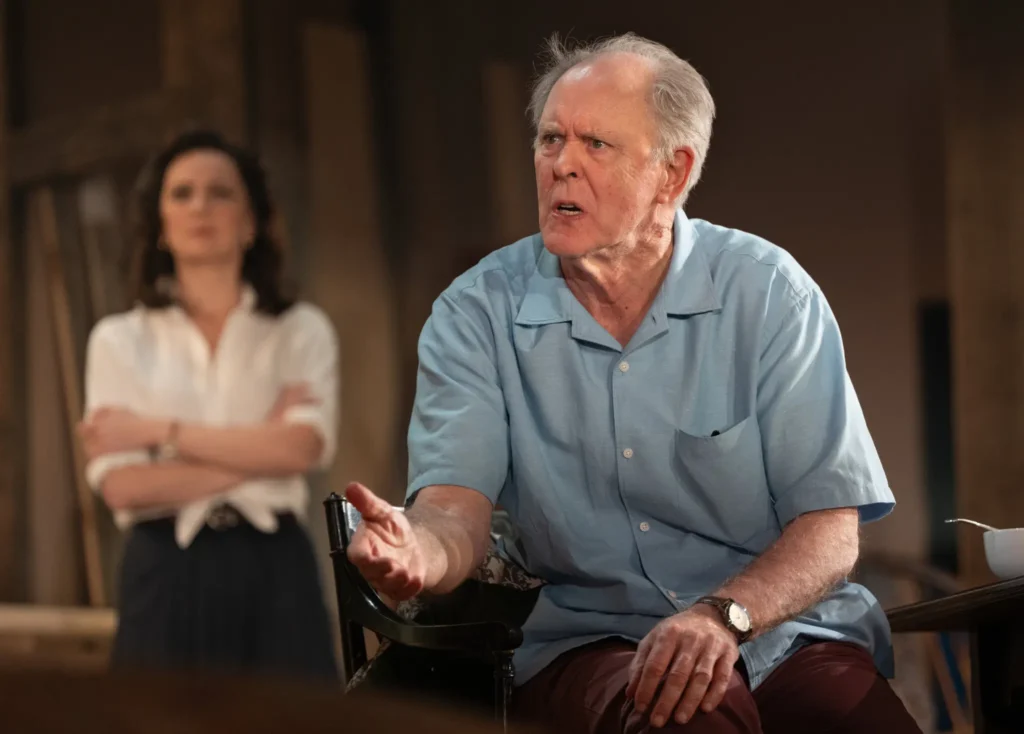
John Lithgow, in a fierce and unflinchingly honest portrayal, makes no attempt to soften Roald Dahl in Giant. His turn as Dahl is two hours and 20 minutes of luncheon with a contemptible human being, but something wondrous to watch unfold onstage. Icy and mocking, Lithgow’s Dahl picks people apart with a dagger for the sheer sport of it, including his longtime companion and his housekeeper. But he reserves his most venomous assaults for a Jewish woman representing his American publishing house (Aya Cash as Jessie) and his friend, British publisher (Elliot Levey as Tom), who is also Jewish. They want him to apologize for a book review in 1983 that first exposed his views.
How this plays out in Mark Rosenblatt’s script elevates what could be a period piece about events from decades ago into something relevant and contemporary. In this case, Dahl’s anger centers on Israel’s attack on Lebanon in 1982, which resulted in thousands of civilian deaths, including those of children. (The actual numbers and which country started it, like much else in the Mideast, are subject to dispute.)
For much of the play, Dahl offers the arguments that one could hear on any college campus today about Israel’s conduct in Gaza. So we are left to ponder during much of the show: Does criticism of Israel necessarily equate to antisemitism?
In Dahl’s case, the answer is yes. Rosenblatt’s script borrows, word for word, from a 1983 interview with the New Statesman in which Dahl said: “There is a trait in the Jewish character that does provoke animosity, maybe it’s a kind of lack of generosity towards non-Jews. I mean, there’s always a reason why anti-anything crops up anywhere.” He added: “Even a stinker like Hitler didn’t just pick on them for no reason.”
It took Dahl’s heirs to fix things some 30 years after his death. In 2020, they apologized for the “lasting and understandable hurt” he caused.
Jerome, Playwrights Horizons, Through June 21
John J. Caswell’s play Jerome isn’t that enlightening or funny, but it does show us gay men of a certain age growing old together with love.
It’s hard to believe that in 1992, two 60-ish gay men – in tiny Jerome, AZ of all places – established a throuple with another man. Not just a hook-up among consenting adults, mind you, but a full-on domestic relationship among three people that lasts a year or more.
But OK, let’s go along for the ride anyway. And why not, when it features two-time Tony winner Stephen Spinella in the role of Con? It’s almost as if we are imagining the young gay character Spinella played in back-to-back wins for two Angels in America productions, Prior Walter, as an old man. He has matured like a good balsamic vinegar – sometimes sweet but definitely acidic.
At any given moment in this play, Con trades those attributes back and forth with his longtime partner, Doane (Jeorge Bennett Watson), who shares them. This equilibrium gives them a comfortable but perhaps mundane life. They move through days with the TV always on and a nice place to put their feet up. Working with a script that doesn’t do much to establish them as individuals, Watson and Spinella wind up giving us an everyman couple – representative gay old fogies but not really specific people with interesting lives or differences.
The same is true for the foil that blunders into their cozy setup. Bruin (Ken Barnett) is a hunky stranger they spy at a Halloween party. He is more of a plot device than a specific character, but necessary to move the story somewhere.
About a decade or so younger than Con and Doane, Bruin is strutting into his gay daddy period well. He hits the gym and is apparently careful about carbs. He has a secret that will turn out to be not so surprising at all, given that he moved to Jerome from San Francisco in the early 1990s. When they invite him home for a bedroom romp – offstage – we can’t see the throupling but can tell that it’s more farcical than hot. Still, it goes well enough for them to make this trio a regular thing.
As any parent who has engineered a playdate can tell you, three is the number that invites problems. One child for a playdate is good. Two visitors invite the taking of sides, ganging up and bickering. Someone is always the odd one out.
Naturally, that’s where things go here, and the story winds up neither deeply enlightening nor out-and-out funny. That said, Jerome offers something that doesn’t get a showing too often in our culture: The sight of two 60-ish coupled gay men, growing old together and moving through life lovingly. Here’s to that.