












In Midnight at the Never Get, time is not a straightforward thing. It’s never clear what’s real and what’s fiction, how old the characters are, or what decade we’re in. We’re hearing Gershwin-esque jazz standards, but also references to “peaceniks” and Woody Allen.
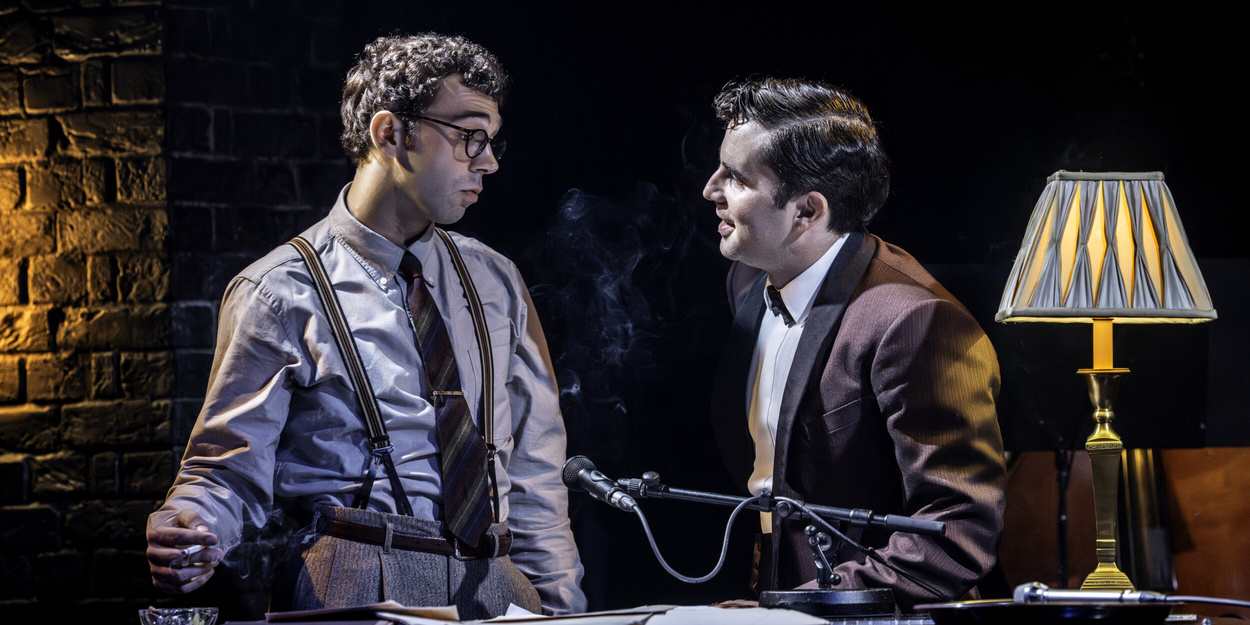
The titular Never Get is a fictitious historic gay bar in Greenwich Village, where a singer in the twilight of his career named Trevor (US musical theatre heavyweight Ben Platt) is giving a 54 Below-style cabaret show in honour of his late former lover, fictional Great American Songbook composer Arthur Brightman (Gregor Milne). David Cromer directs with clear affection for the conventions of the cabaret genre, and has Platt point out ‘friends’ in the audience and regale us with charming, self-deprecating anecdotes.
Trevor and Arthur once performed an underground queer cabaret act (“Judy at Carnegie Hall but gay, well, more gay”) at the Never Get, and so Midnight becomes partly a history of queer performance, activism and life in New York. Trevor recounts how his professional and personal relationship with Arthur began with debates over shifting pronouns in love songs, and how they cut their teeth at mafia-run gay bars under constant threat of police raid.
The burgeoning formation of the American gay identity spills into the relationship between the two men. Arthur’s assimilationist approach to his sexuality – “who I am is more than who I f*ck, I make art” – clashes with Trevor’s increasing sympathy with gay liberation and other civil rights movements. All the while, present-day Trevor argues with Arthur, the audience and himself – there’s a cameo later on from Barry James as an older version of Trevor – as he tries to reconcile the Arthur of his imagination with the real Arthur’s challenging, exclusionary political choices.
The metatheatrical style of Midnight feels perfect for someone like Platt, who may be exceptionally talented and the most memorable musical theatre voice of his generation, but possesses a distinctive, vibrato-laden voice that can divide opinion. This is a show where he can play something of a caricature of an esoteric well-known performer, all while indulging his voice’s rich emotional potential and natural comic timing in Mark Sonnenblick’s songs.
And what songs they are. Sonnenblick, who is best known for K-Pop Demon Hunters, has certainly shown his versatility in creating ‘Arthur’s’ back catalogue. The show runs the gamut of Arthur’s career, from sweeping, Irving Berlin-influenced romantic ballads through to his (unsuccessful) attempts to ingratiate himself with the encroaching guitar music of the Sixties. Among the comic songs, ‘Boy in Blue’ is a lyrical standout, for its satirical treatment of police officers honeytrapping gay men.
Sonnenblick, and his collaborators Sam Bolen and Max Friedman, have set themselves an ambitious task, to contain in the same show a love story, several decades of queer history, and a reflection on making art. As Trevor loses his grip on reality, his emotional revelations might land harder had we learned more about him and Arthur as individuals, beyond their creative practices and political standpoints.
Still, the fictional concert staging is a unique, attractive conceit, that implies a reckoning with how we remember the past, particularly when we’re doing so in front of an audience. A structural rebalancing might be needed to take these themes to their full conclusion, but as it stands this is far more than a mere showcase for Ben Platt.
Midnight at the Never Get plays at the Menier Chocolate Factory until 12 September

Buy Tickets to Midnight at the Never Get







Reader Reviews
To post a comment, you must register and login.