








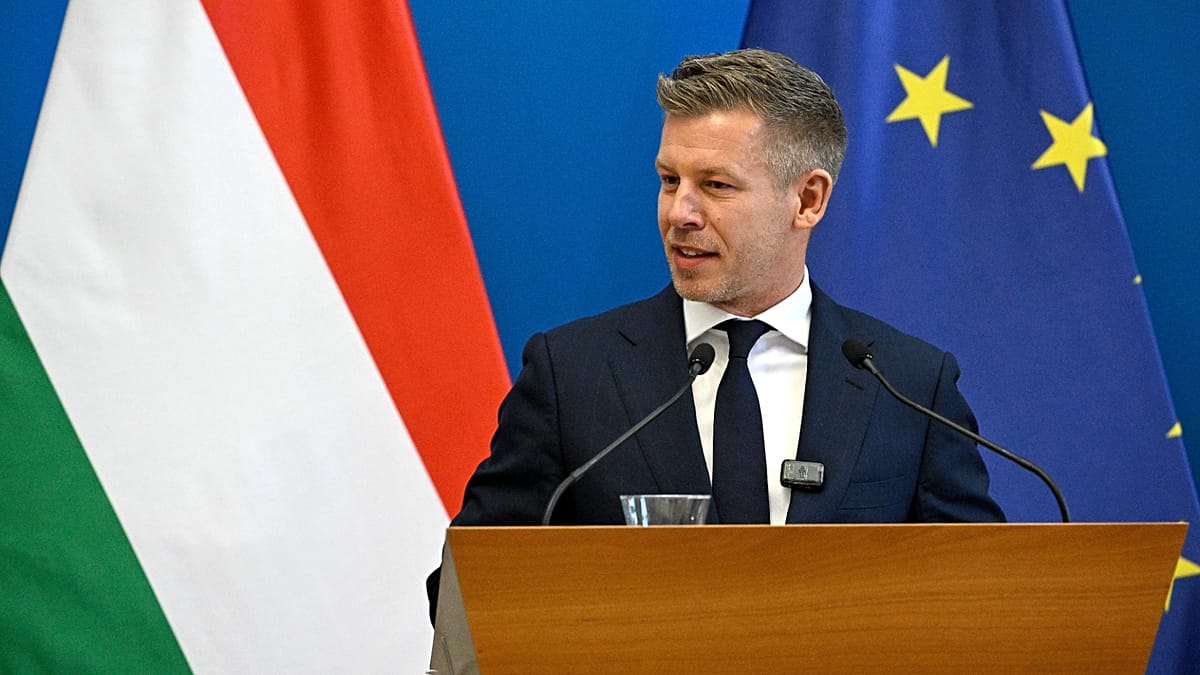
Hungarian Prime Minister Péter Magyar is facing the biggest test of his government yet, as an energy crisis triggered by the partial shutdown of the Paks Nuclear Power Plant threatens to disrupt supply during peak summer demand.
ADVERTISEMENT


ADVERTISEMENT
All but one reactor has been taken offline because of record-low water levels in the Danube, which the plant relies on for cooling. Should water levels fall further, the plant could be forced to shut down entirely for the first time since it opened 42 years ago – raising the prospect of blackouts and electricity restrictions during the high season.
For Magyar, who won April’s election and took office in May, managing the crisis marks his first major political test.
“The current situation can turn out to be either a threat to the reputation of the new Hungarian government or, in fact, an opportunity to strengthen the perception of an efficient crisis manager in Hungarian society,” said Dániel Hegedűs, deputy director of the Institut für Europäische Politik.
According to the latest opinion poll from the Republikon Institute, Magyar’s Tisza Party held a commanding lead in July, with 58% support. The opposition Fidesz Party, led by former prime minister Viktor Orbán, trailed on 20%.
Fidesz seizes on the crisis
Fidesz, which governed Hungary for 16 years before its electoral defeat and has seen its support fall sharply since, is already using the crisis to portray Magyar’s government as incompetent.
“The government is not in control of the situation. It is only thanks to the sacrifices of the Hungarian people, the self-restraint of companies, and the development achievements of the past 16 years that there is no bigger problem. The Tisza government cannot handle the energy crisis,” Fidesz parliamentary group leader János Bóka wrote on social media.
Government response
Paks typically supplies around 40% of Hungary’s electricity, but demand has risen sharply amid a heatwave. Magyar said Hungary would weather the crisis by boosting output from other power plants, increasing electricity imports, and asking industry and households to voluntarily cut consumption.
“The Hungarian government has already done what was possible under the given circumstances for successful crisis management — both in terms of strategic communication to Hungarian society and mobilising domestic power plant capacity, as well as ensuring that imports from European electricity markets can proceed smoothly to cover Hungarian consumption,” Hegedűs said.
The government also has a contingency plan in place to limit industrial consumption on a rotational basis, if required.
“The unprecedented situation calls for solutions that have never been used before,” Magyar said. “In these extraordinary circumstances, coordinated action and an exceptional level of cooperation will be essential.”
Magyar’s Party blames the previous government
Márton Hajdu, a Tisza Party lawmaker, told Euronews the current government could not be blamed for the lack of investment in infrastructure at Paks that would have allowed the plant to keep operating during periods of extreme drought.
“The government is getting on with the job,” Hajdu said. “At the same time, Hungarians are witnessing the true legacy of the previous government. Every day, it becomes clearer how much essential infrastructure was never built — projects the country desperately needed. While squandering and siphoning off vast sums of public money, they were also prepared to let billions in EU funding slip away. Our job is to minimise the price the Hungarian people have to pay for the previous government’s irresponsibility.”
Crisis could be an opportunity, if handled well
Another official close to Magyar’s government, speaking to Euronews on condition of anonymity due to the sensitivity of the matter, said the crisis could become an opportunity for the government — provided it avoids major missteps.
“This is an opportunity to prove ourselves, demonstrate that we are competent, and help reunite the nation. It is also a chance to explain how Fidesz betrayed the country, while allowing our ministers to prove themselves,” the official said.
“There is one condition: we have to get through this crisis without major mistakes or unnecessary distractions.”
“So far, we have not had to choose between impossible options, because the Hungarian people and businesses have shown remarkable maturity in managing the demand side, and Prime Minister Péter Magyar has been showing strong leadership. I don’t think this will be a major test for us; that will come later.”
Risks ahead
Magyar said the coming days would be crucial for the energy network. Expert Dániel Hegedűs warned that shortages could still benefit the opposition.
“If anything goes wrong and there will be blackouts in the coming days, then of course it will open up an opportunity for the opposition party Fidesz to attack the government with the argument that they failed to manage the situation,” Hegedűs said, adding that the political fallout for Magyar could be limited, as he could place the blame on Orbán’s government for its lack of investment.
“Péter Magyar can use the counterargument that the current situation is a consequence of the negligence of the Fidesz governments, and particularly the delayed investment and construction of new pipelines at the Paks nuclear power plant, which would have allowed operations to continue even at a lower water mark on the Danube.”
Read the full article here