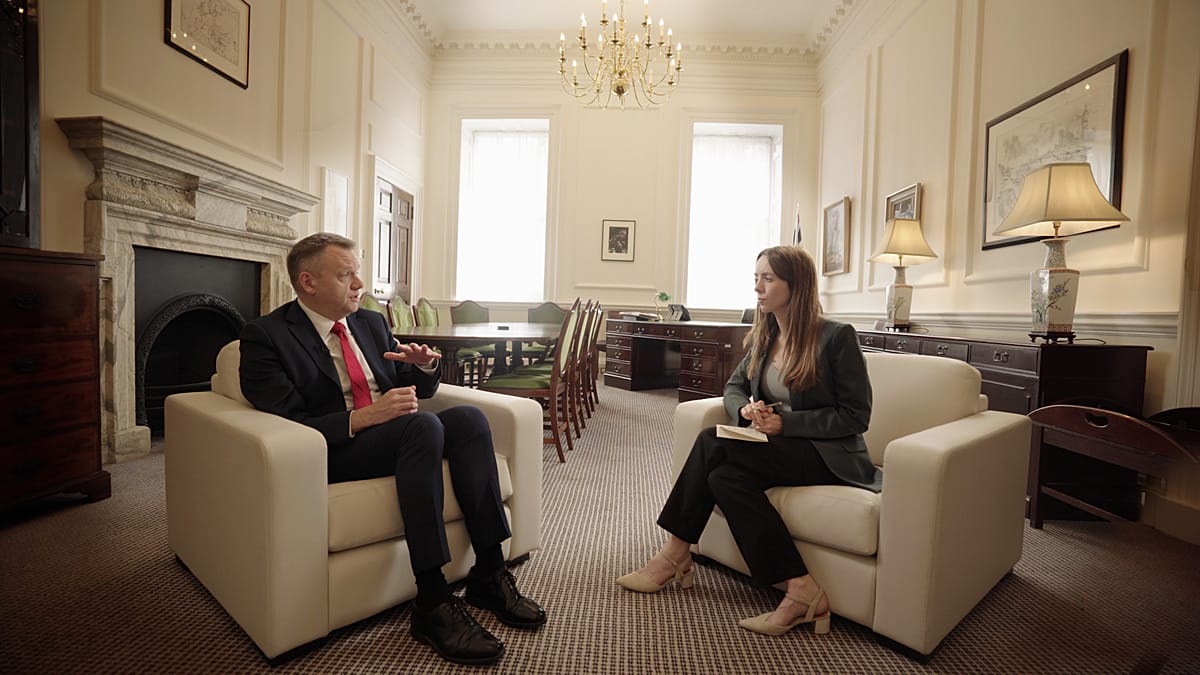









Euronews spoke to Lebanon’s Minister of Economy and Trade, Amer Bisat, as his country engaged in direct diplomatic talks with Israel for the first time in more than 30 years.
ADVERTISEMENT


ADVERTISEMENT
The talks, taking place in Washington and mediated by US Secretary of State Marco Rubio, are aimed at ending fighting between Israel and the Lebanese Shia militia, Hezbollah.
Bisat said that, for Lebanon, the main objectives of the negotiations are the end of hostilities and the cessation of the violence.
“Lebanon has paid an extremely high price and continues to pay an extremely high price both in terms of deaths, injuries, as well as massive displacement,” Bisat said on Euronews’ Europe Today programme.
“I genuinely believe that the Lebanese want peace, I genuinely believe the Lebanese want prosperity, they want stability, all of them. I think we’re all in the position right now where we are tired of wars, we are tired of instability, we are tired of violence,” he said.
More than 2,000 Lebanese have been killed, and around 1.2 million people have been forced from their homes since Israel launched an air offensive on March 2, soon followed by a ground invasion in mid-March.
The Jewish state said its wide-ranging operation was in response to Hezbollah firing rockets at Northern Israel to avenge the war on its primary backer, Iran.
Hezbollah slams Lebanon-Israel talks
A few days ahead of the 14 April talks, held at the ambassadorial level, Israel’s Prime Minister Benjamin Netanyahu said he had authorised them with a view to reaching a “historic, sustainable peace agreement” that would “last for generations”.
But he also conditioned the success of the talks on the disarmament of Hezbollah.
Hezbollah rejected the meeting between the Lebanese and Israeli ambassadors to the US, saying it would not be bound by their outcome and that it would not lay down its weapons.
Asked how Lebanon would circumvent Hezbollah’s demilitarisation refusal while seeking to convince Israel to end hostilities, Bisat hinted that the paramilitary group would eventually be pressured to disarm by popular demand.
“We’re counting on the national consensus at this point that nobody wants violence internally,” said Bisat.
He explained that if the government can ensure that Israel stops its operations in South Lebanon — Hezbollah’s stronghold — and manages to regain sovereignty, “we think the population, the society, including (…) what we refer to as the Shia community, which we believe that they are partners, we are all in the same boat at this stage. I think if we present it that way, there will be a consensus eventually on this.”
Bisat said the present round of talks in Washington was just the beginning. “This is more of laying the groundwork. Eventually, it’s probably going to have to be a larger group and a longer period. But this is the beginning. And again, our demand, our ask at this point is the end of hostility.”
The fragile ceasefire reached between Israel, the US and Iran last week was not extended to Lebanon.
The US State Department said at the conclusion of the 14 April meeting that Washington would continue to be the sole mediator and that “all sides agreed to launch direct negotiations at a mutually agreed time and venue.”
Read the full article here