









Published on •Updated
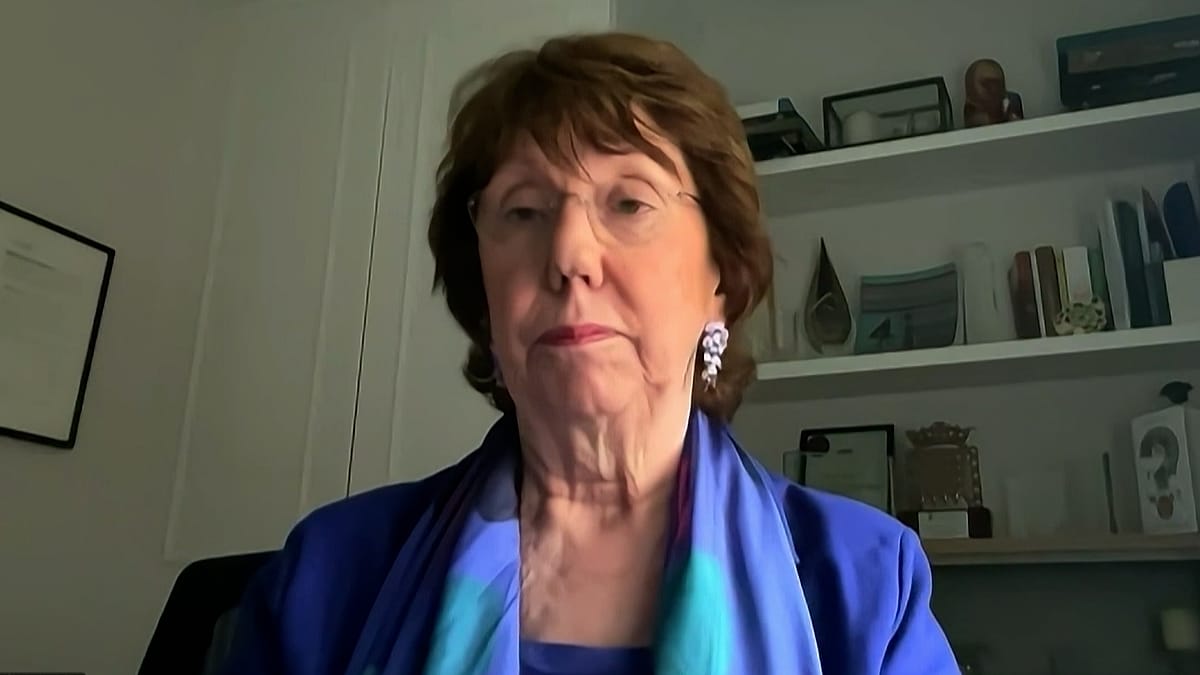
Former EU High Representative for Foreign Affairs and European Commissioner for Trade Catherine Ashton told Europe Today that European businesses and consumers need consistency during tumultuous periods, particularly as US President Donald Trump threatens European producers with a 25% tariff on cars and car parts, alleging non-compliance.
ADVERTISEMENT


ADVERTISEMENT
To do this, it is important to see that Trump recognises trade as a “weapon”, the British national said.
“Being a transactional president is the way that he (Trump) wants to go forward, and I think that’s how Europe – or any country – has to respond: by trying to work through that,” Ashton explained.
“We do have a president that sees… The willingness of others to kind of talk to him about trade as both: an important part of the conversation, but in a sense, almost to weaponise it, to make clear that if we don’t do things that he thinks are really important, then we can’t expect the benefits.”
The comments come as the EU scrambles to find the right response to Trump’s recently threatened tariff threats. Responding to the announcement, European Commission President Ursula von der Leyen said “a deal is a deal” and the EU was “in the final stages” of implementing a key pillar of the agreement designed to eliminate tariffs on a wide range of American products.
French President Emmanuel Macron said on Tuesday the EU has “tools to respond” to tariff threats, should they materialise, referring to the EU’s anti-coercion instrument.
Ashton, who was European Commissioner for Trade in 2008 and helped the EU and US solve a trade dispute over beef, said that the current trade chief Maroš Šefčovič is one of the most experienced commissioners in service – and he is up for the job finalising the deal from the EU’s side.
“I don’t want to give him advice because he will know this particular team far better than I do,” she said.
“He was there when I was there and he’s still there and there’s a good reason for that.”
‘Additional challenges require collective action’
Ashton went onto argue that bigger geopolitical issues, such as the developments in the Middle East regarding Iran’s blockade of the Strait of Hormuz and war involving the US and Israel, demand cooperation.
“With everything happening globally, especially in the Middle East right now, we are entering a period where additional challenges will require collective action. The more we can work together on trade, the better,” she said.
US and Israeli forces launched the war in Iran on 28 February, after which Iran effectively closed the Strait of Hormuz, a vital route for oil and gas exports, while American forces later launched a blockade of Iranian ports.
Trump has indefinitely extended what was initially a two-week ceasefire, but the conflict and its widespread economic fallout remain unresolved and sending energy prices skyrocketing.
During her tenure as the EU’s top diplomat from 2009 to 2014, Ashton helped broker the temporary suspension of Iran’s nuclear activities for sanction relief. She advocated as part of the P5+1 group, which comprised the US, United Kingdom, Germany, France, Russia, and China.
With Iran’s chief negotiator Mohammad Bagher Ghalibaf warning to the US on Tuesday “we have not even started yet”, Ashton said the danger now is the escalation of rhetoric, with no off-ramp in sight.
“I think there’s a different approach that’s being taken (now). It’s much more to raise the temperature rather than to lower it,” Ashton expanded, adding: “But the European Union’s always had a role, a potential role, to play in all of this. Now it is about trying to find and work out exactly what that could be.”
Read the full article here